
Table of Contents
- Why Facebook ads comments matter more than ever
- The real challenges of managing Facebook Ads comments at scale
- Why Facebook’s native tools are not enough
- Centralizing Facebook Ads comments in NapoleonCat
- Using Social CRM to manage conversations and customers
- Using AI Assistant in the Social Inbox
- Automating Facebook Ads comment moderation
- Team collaboration on Facebook Ads comments
- Monitoring performance with Inbox Activity Reports
- Best practices for managing Facebook Ads comments
- Scaling Facebook Ads comment management across multiple campaigns
- Wrap up
- Managing Facebook ad comments - FAQs
How do you monitor Facebook ads comments? This question keeps popping up as one of the bigger challenges for brands running multiple Facebook ad campaigns – and their moderation teams.
So here’s a look at how to make it easier and much more efficient, without risking your brand reputation – and your advertising budgets going to waste.
- Why Facebook ads comments matter more than ever
- The real challenges of managing Facebook Ads comments at scale
- Why Facebook’s native tools are not enough
- Centralizing Facebook Ads comments in NapoleonCat
- Using Social CRM to manage conversations and customers
- Using AI Assistant in the Social Inbox
- Automating Facebook Ads comment moderation
- Team collaboration on Facebook Ads comments
- Monitoring performance with Inbox Activity Reports
- Best practices for managing Facebook Ads comments
- Scaling Facebook Ads comment management across multiple campaigns
- Wrap up
- Managing Facebook ad comments – FAQs
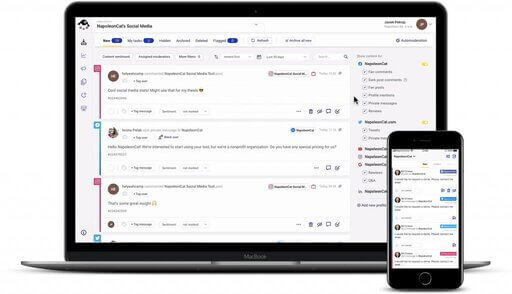
Manage comments on Facebook Ads from one place
Monitor Facebook, Instagram, and TikTok Ad comments from one simple view – with an all-in-one social media tool.
Why Facebook ads comments matter more than ever
Facebook ads comments matter more than ever because:
- They directly affect conversion rates and trust
- They influence how your brand is perceived in real time
- They can derail an otherwise great campaign if left unmanaged
- They often replace traditional customer support touchpoints
While you might still think you’re paying for reach using Facebook ads, you’re also paying for conversations in the comments. Every ad comment is public. People see every reply (or lack of reply). Every unanswered question or unresolved complaint sits right under your ad copy, quietly influencing whether someone clicks, buys, or scrolls away.
For many users, the comment section is where the real product validation happens. People ask about pricing, availability, delivery, refunds, compatibility, and real-life use cases. Others complain, spam, tag friends, or post completely unrelated content. Including links that feed off your advertising budget.
If you don’t actively monitor Facebook ads comments, you’re letting the narrative around your paid campaigns run on autopilot. And that’s risky, to say the least.
The real challenges of managing Facebook Ads comments at scale
Managing comments under one or two ads is manageable. But if you want to monitor Facebook ads comments across dozens of campaigns, multiple ad accounts, regions, languages, and teams – that’s where things start to break.
What usually happens as brands scale Facebook ads:
- Comments come in faster than teams can respond
- Messages get missed because they’re spread across ad posts (and it’s not easy to monitor Facebook ad comments at scale using native tools)
- The same question gets answered 20 times by different people under different ad variants
- Spam and scams slip through and stay visible for hours (sometimes even days)
- With different teams managing ads and comment moderation, there’s no clear ownership of conversations
On top of that, Facebook ad comments are not neatly separated from organic comments in the native interface. They live inside individual posts tied to ad campaigns, making it hard to:
- See everything in one place
- Prioritize urgent or negative comments
- Track response time and performance
- Collaborate as a team
All this to say: at scale, manual monitoring of Facebook ad comments just doesn’t work.

Automatically Block Spam with AI Precision
Automatically hide or delete spam and hate comments on your posts and ads across all your social media profiles, powered by advanced AI.
Why Facebook’s native tools are not enough
Facebook does provide basic tools for managing ad comments, but they’re mostly designed for single-page, single-person workflows.
Some of the biggest limitations include:
- No unified inbox for Facebook ad comments across campaigns
- Limited filtering and prioritization options
- No collaboration features like assignments and internal notes
- No conversation history across channels
- Very basic Facebook automation options
You can hide or delete individual comments, reply manually, and apply simple moderation rules. But once volume increases, the tools can quickly become a bottleneck.
Centralizing Facebook Ads comments in NapoleonCat
NapoleonCat’s Social Inbox was built specifically to solve the chaos of managing conversations at scale, including Facebook ad comment moderation.
Instead of jumping between ad posts, Ads Manager views, and notifications, you get one centralized place where all comments land, one by one.
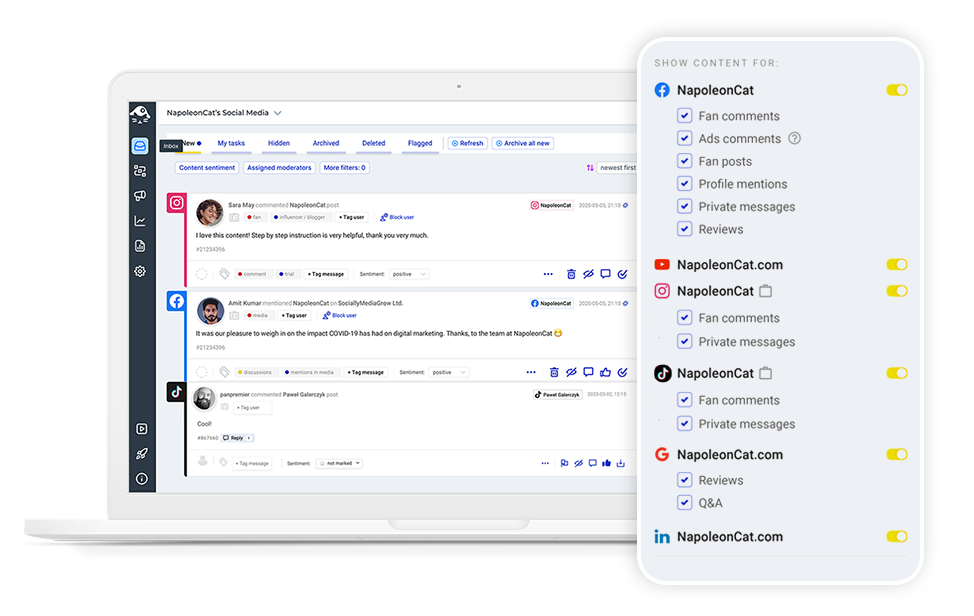
Social Inbox for Facebook Ads comments
With the Social Inbox, Facebook ad comments are automatically pulled into a single stream alongside:
- Organic Facebook comments
- Facebook messages
- Instagram comments and DMs
- Other supported social channels, like Instagram and TikTok
Everything appears in real time, ready to be handled, and you don’t have to hunt for each separate ad to see the comments.

Managing organic and paid comments in one view
One of the biggest benefits is that you don’t have to treat paid and organic comments as two separate worlds.
Facebook ad comments and organic comments appear together in one list, and you can filter them and apply the same workflows and Auto-moderation rules. And your team works from one consistent interface, regardless of where the comment originated.
Using Social CRM to manage conversations and customers
Think of Facebook ad comments as data points (apart from being customer interactions, obviously). NapoleonCat’s Social CRM will help you turn ad engagement into long-term customer context.
Building customer profiles from ad interactions
Every time someone comments on your Facebook ad, NapoleonCat starts building a profile that includes:
- Previous comments and messages
- Interaction history across channels
- Tags and labels added by your team
- Notes and conversation outcomes
This is especially useful when:
- Someone comments multiple times across campaigns
- A public comment turns into a private conversation
- A support issue reappears weeks later
It’s all there in the Social CRM profile.
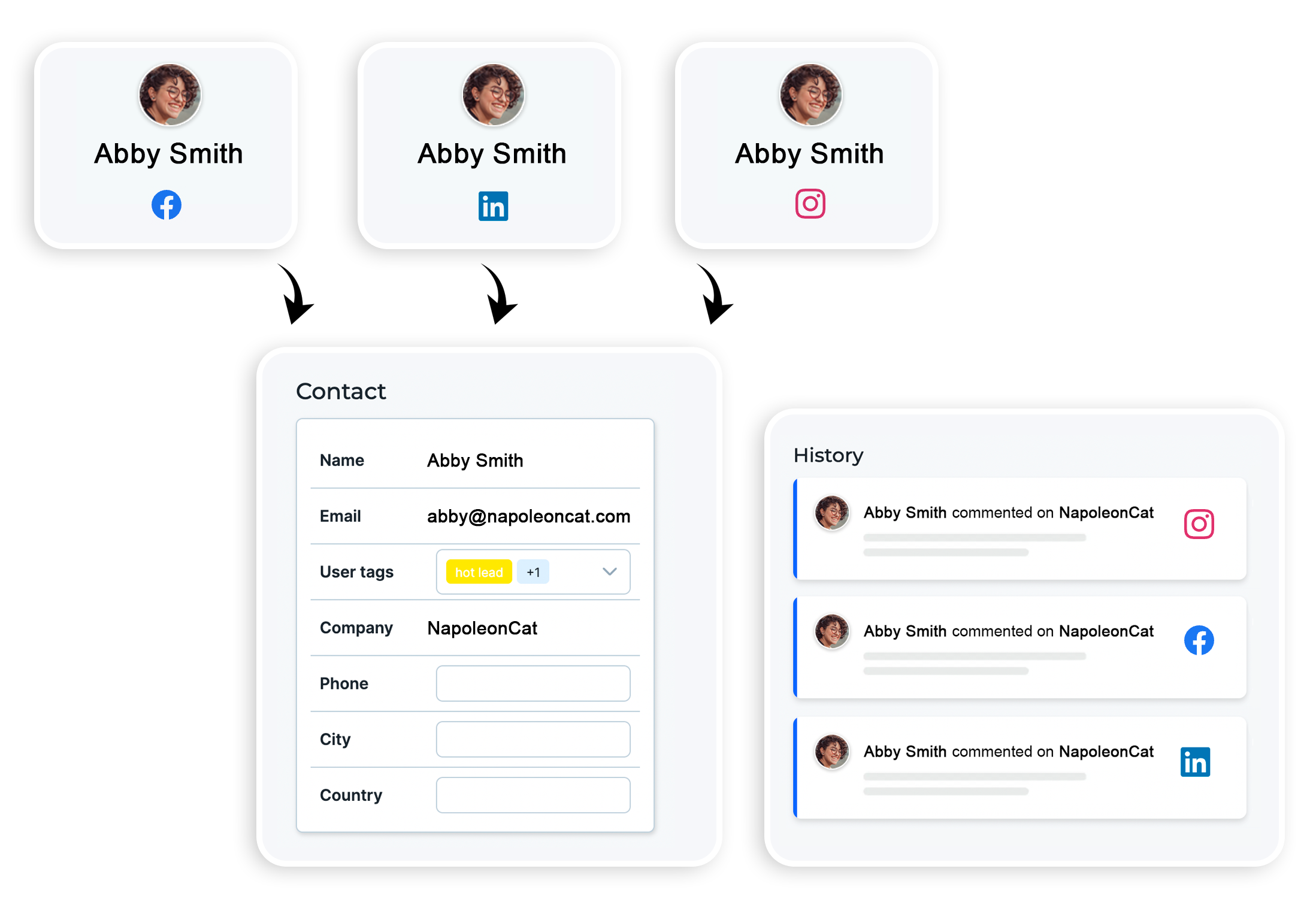
Tracking conversation history across channels
One of the most frustrating things about native tools is losing the context. That’s why Social CRM profiles are so valuable. Anyone on your team can have easy access to:
- Past Facebook comments
- Previous DMs or Messenger conversations
- Instagram interactions
- And more.
All in one place, under one name. Which means no more asking customers to repeat themselves or guessing what happened last time. Or telling the customer something they’ve already heard from someone else on your team (maybe even more than once).
Using AI Assistant in the Social Inbox
The Social Inbox has one more super helpful feature – the AI Assistant. And when you use the scale at which AI can analyze comments, comment volume suddenly stops being an issue.
AI-powered response suggestions for ad comments
The AI Assistant can suggest replies based on:
- The content of the comment
- Previous responses
- Your brand tone and past interactions
Using the AI reply suggestions, it’s even easier for your team to respond faster, stay consistent in tone, no matter who’s on the case, and avoid rewriting the same answers repeatedly. You might find it especially useful for common questions like pricing, shipping, availability, or features.
AI support for understanding context and sentiment
The AI Assistant also continuously analyzes things like sentiment (positive, neutral, negative), emotional intensity, and spam and hate patterns, tagging the comments accordingly.
At a glance, your team can now see – and prioritize – negative comments, complaints or compliments, purchase-related questions, escalations, offensive content, etc. And this makes it so much easier to monitor Facebook ad comments at scale.
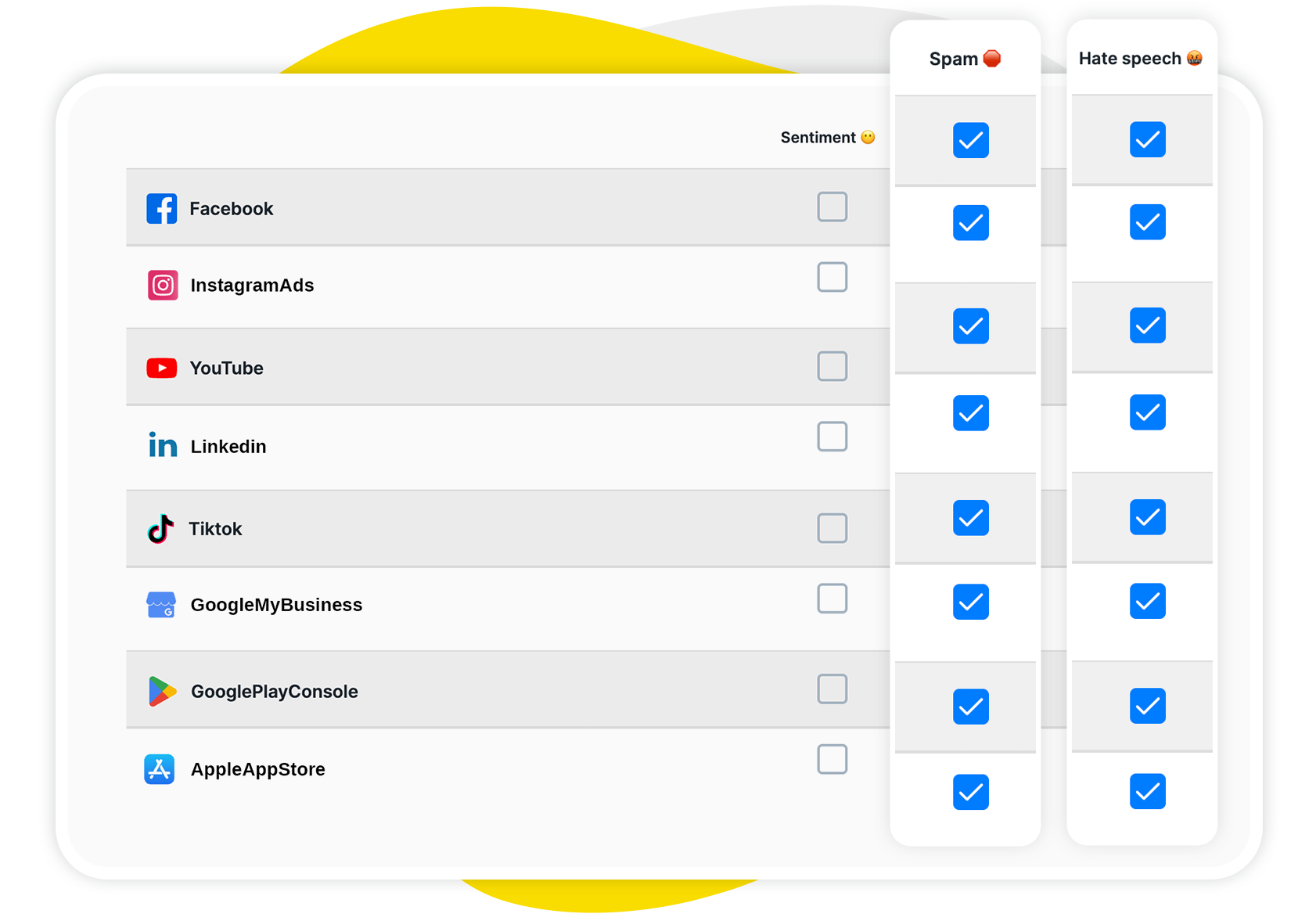
Triggering auto-moderation rules with AI
AI tags can also trigger Auto-moderation rules. For example, if the AI Assistant detects spam or offensive content, you can set up a rule that instantly hides the comment from view.
Nobody will ever see it, and you won’t have to worry about spam removal at all, as it happens quietly and consistently in the background.
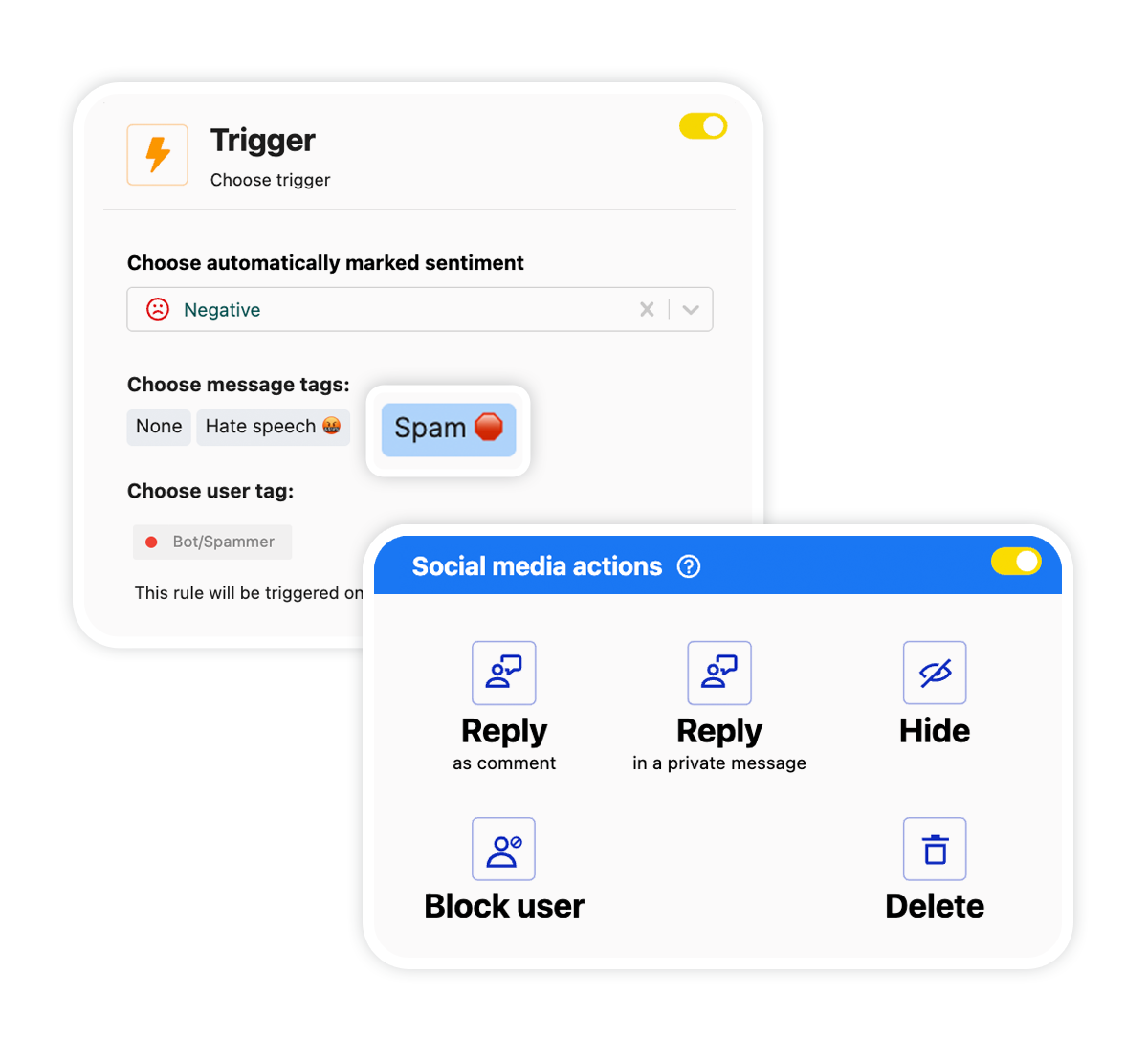
Automatically Block Spam with AI Precision
Automatically hide or delete spam and hate comments on your posts and ads across all your social media profiles, powered by advanced AI.
Automating Facebook Ads comment moderation
With NapoleonCat, you can create advanced auto-moderation rules for Facebook ad comments. Worry not, advanced doesn’t mean complicated – they’re actually pretty easy to set up. The hardest part is probably coming up with relevant scenarios you want to automate.
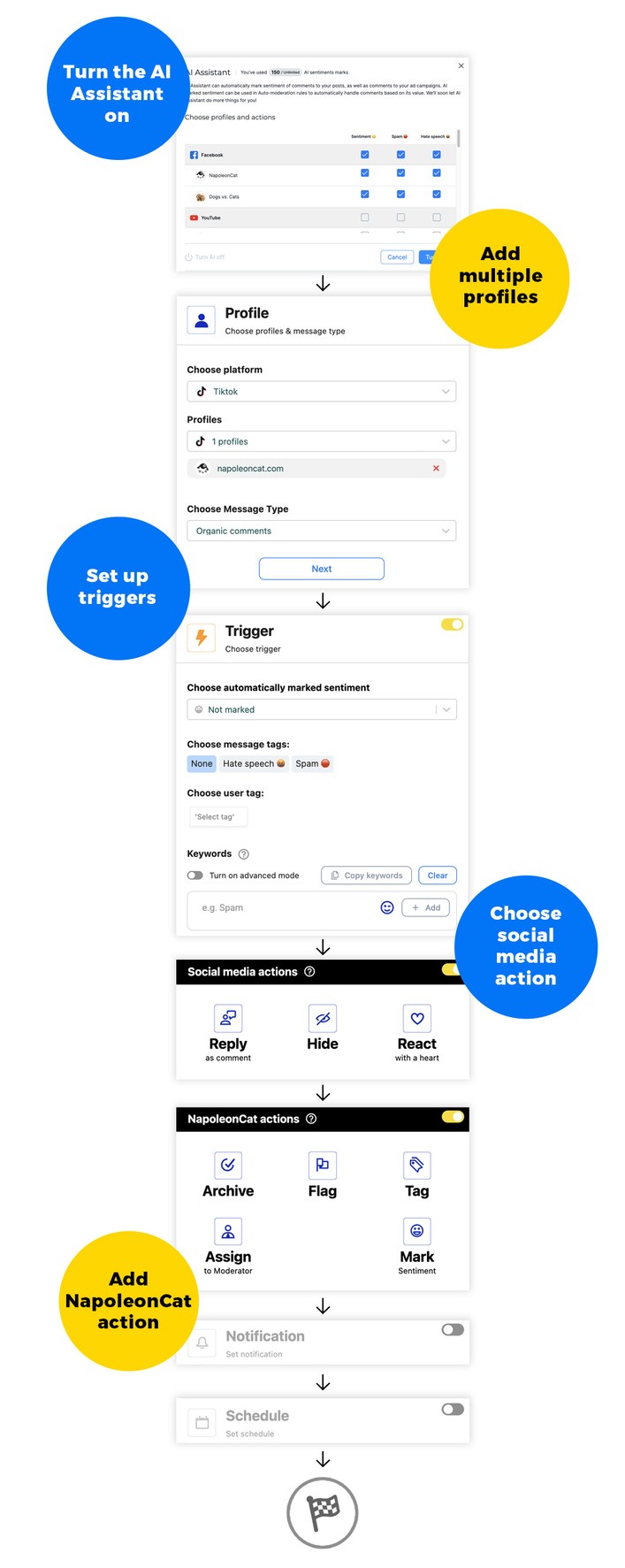
Here are a few ideas.
Auto-hiding spam and offensive comments
Using Auto-moderation, you can automatically hide or delete comments that:
- Contain offensive language
- Include spam links
- Use scam-related keywords
You can set up your rules based on keywords, AI spam and hate tags, or the presence of links (or all combined).
Automatic replies to repetitive questions
For frequently asked questions, you can set up multiple auto replies based on selected keywords and phrases to cover responding to questions about price, opening hours, shipping, etc.
What’s even better, you can write up multiple (unlimited, actually) reply versions for each of your rules. The system will rotate them randomly, and your audience won’t keep seeing the same obviously automated reply in one comment section.
Combining auto-moderation with manual review
You can also set up your Auto-moderation rules to automatically assign comments to individual moderators (based on the same trigger types) and flag or tag them in NapoleonCat.
This way, your team can review auto-hidden comments and be alerted to the ones that need a human follow-up in addition to a first automated response.
Team collaboration on Facebook Ads comments
Speaking of human teams, NapoleonCat is built with teams in mind, even when it comes to automation. Here are some things you can do in the Social Inbox:
Assigning conversations and internal notes
The Social Inbox can literally be your social media customer service command center, letting you:
- Manually assign comments to specific team members
- Add internal notes (not visible to customers)
- Tag conversations for follow-up and users for the Social CRM profiles
- Consult a comment with an external team or expert when needed, without moving to your email inbox or a different messaging tool
This is especially useful when sales, support, and marketing share the inbox, issues need escalation, and just for everyday comment moderation management.
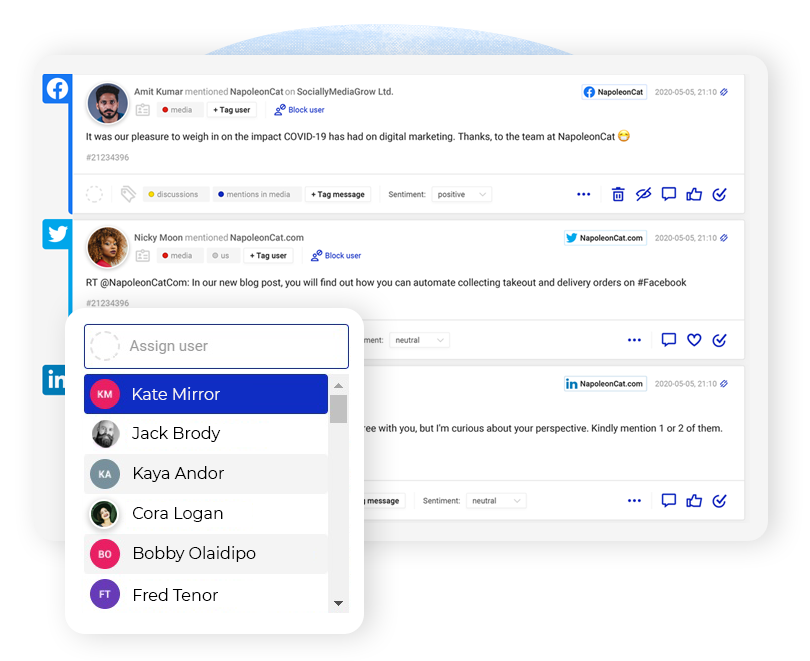
Preventing duplicate replies
NapoleonCat prevents replying twice to the same comment by showing who is currently handling a conversation and updating the status in real time.
One look at the inbox and you’ll know which comments are assigned, which are being handled, and which still need attention. There’s literally no way for two people to be working on the same comment at the same time.
Monitoring performance with Inbox Activity Reports
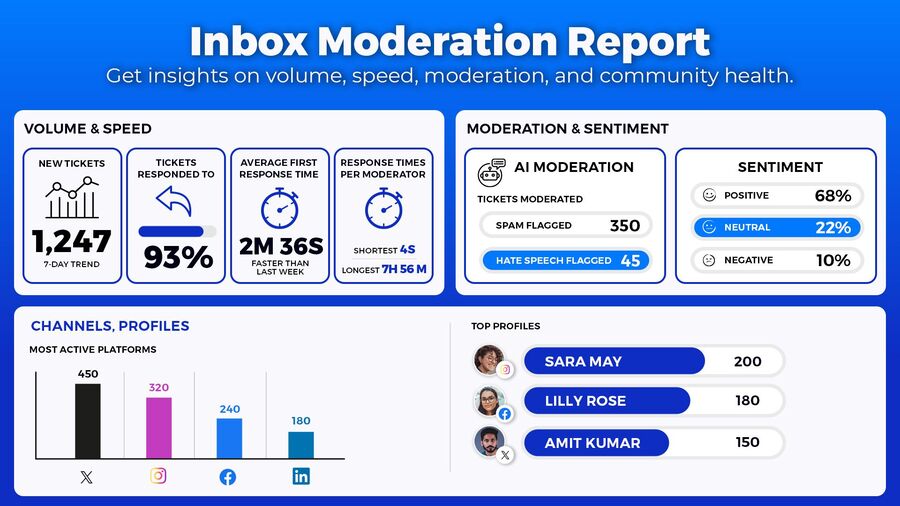
To measure the impact of your moderation tools on your team’s performance, use NapoleonCat’s Inbox Activity Reports – they’ll give you clear visibility into how your team is doing.
Tracking response time and team efficiency
You can track things like:
- Average response time
- Time to first reply
- Number of handled comments per agent
This will help you identify potential bottlenecks, under-resourced campaigns, training opportunities, etc.
Measuring volume and sentiment of ads comments
Reports also show comment volume and sentiment breakdown, letting you plan resources better and optimize future ads for performance.
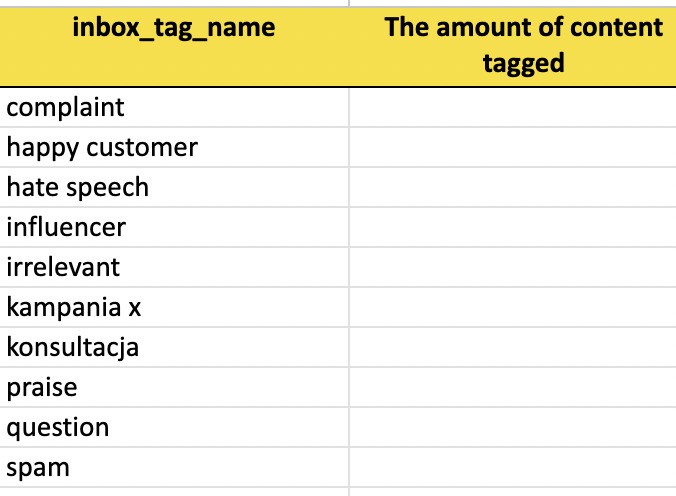
You can also monitor inbox tags and how they change over time to analyze what types of conversations dominate your inbox and adjust your moderation strategy accordingly.
Best practices for managing Facebook Ads comments
Managing Facebook Ads comments is really like managing any other comment types on social media. Here are a few important tips to remember.
- Respond quickly, especially to questions and complaints.
- Hide spam, and don’t engage with it. (Best, leave it to automation entirely. No need to engage your team – they have more important things to do.)
- Be consistent in tone and messaging across all your comments.
- Use automation, but review your rules regularly – and adjust if necessary.
- Pay attention to comments with links – they’re usually spam piggybacking off your ad budget. Best to automate hiding those instantly (with a human review just in case).
- Treat comments as part of the customer journey, which they definitely are.
Scaling Facebook Ads comment management across multiple campaigns
One of the biggest headaches with managing Facebook ads comments is that there are usually multiple campaigns and ads running at the same time. The more you have running, the bigger the headache.
You can think of NapoleonCat as the painkiller. 🙂 Letting you handle comments from multiple Facebook pages and ad accounts in one tool, assign teams and client accounts to workspaces to organize the work even better, apply shared moderation rules across campaigns. And, eventually, build and maintain consistent workflows across teams and client accounts.
Manage comments on Facebook Ads from one place
Monitor Facebook, Instagram, and TikTok Ad comments from one simple view – with an all-in-one social media tool.
Wrap up
You can’t ignore Facebook ad comments. They’re a core part of performance, trust, and customer experience.
Also, you don’t have to. NapoleonCat’s Social Inbox brings structure, automation, collaboration, and intelligence to Facebook ads comment management – all in one tool. Plus, a whole suite of Facebook management tools for business.
If you’re serious about scaling paid social without losing control of conversations, try NapoleonCat completely for free and see how easy it can be.
Managing Facebook ad comments – FAQs
Let’s answer some more questions regarding managing comments on Facebook ads.
How to monitor comments on Facebook ads?
You can monitor Facebook ads comments directly on each ad in Meta Business Suite, but this quickly becomes inefficient at scale. With NapoleonCat, all comments from your Facebook ads are pulled automatically into one Social Inbox, so you can monitor them in real time without jumping between ads, campaigns, or accounts.
Where do Facebook ads comments appear?
Facebook ads comments appear:
- Under the ad post itself (in feeds, Stories, Reels, etc.)
- In Meta Business Suite (limited visibility, spread across ads)
In NapoleonCat, they appear in one unified inbox together with organic Facebook comments, messages, and comments from other platforms, fully searchable and filterable.
How to manage comments on Facebook ads in one place?
To manage Facebook ads comments in one place, you need a social media inbox tool. NapoleonCat’s Social Inbox centralizes all ad comments across campaigns and ad accounts, letting you:
- Reply, hide, or delete comments
- Assign comments to team members
- Track response times
- Apply automation rules
How to filter Facebook ad comments?
It’s best to use a Social Inbox tool like NapoleonCat, where you can filter Facebook ad comments by:
- Profile
- Sentiment
- Status (new, assigned, resolved)
- Time, and more.
How to prioritize Facebook ads comments by sentiment or urgency?
NapoleonCat uses sentiment detection and customizable rules to help you prioritize:
- Negative or urgent comments
- Questions about pricing, delivery, or product issues
- High-risk comments that could escalate publicly
You can automatically flag or assign these comments to the right team members.
How to access Facebook comment history?
Facebook itself offers limited comment history visibility. NapoleonCat stores comment history in your Social Inbox, so you can:
- See past conversations with users
- Track how issues were handled
- Review moderation and response activity over time
You can also review conversation history for individual users in their Social CRM profiles in NapoleonCat.
How to see hidden comments on Facebook ads?
Hidden comments are not visible publicly, but they remain accessible to page admins. In NapoleonCat, hidden Facebook ads comments are still visible in the inbox, so your team has full context and control.
Can you reply to Facebook ads comments from a social media inbox?
Yes. With NapoleonCat, you can reply to Facebook ads comments directly from the Social Inbox, without opening Ads Manager or Meta Business Suite. Replies are published in real time under the ad.
How to assign Facebook ads comments to team members?
NapoleonCat lets you assign Facebook ads comments to specific team members or teams manually or via Auto-moderation rules based on keywords, sentiment, or comment type.
How to automate Facebook ads comment moderation?
You can automate Facebook ads comment moderation using NapoleonCat’s Auto-moderation rules and:
- Hide spam and offensive comments automatically
- Tag or assign comments
- Trigger auto-replies for common questions
Automation can run 24/7 or according to your predefined schedule, even outside business hours.
Can AI help manage Facebook ads comments?
Yes. NapoleonCat uses AI to support Facebook ads comment management by:
- Detecting sentiment
- Identifying spam and harmful content
- Helping prioritize comments that need human attention
- And even suggesting replies in line with your brand’s tone
How to auto-hide spam and offensive comments on Facebook ads?
With NapoleonCat, you can auto-hide spam and offensive comments using keyword-based and AI-supported moderation rules. Comments containing profanity, hate speech, links, or promotional spam can be hidden instantly, before they damage your ad’s performance or brand image.
How to respond faster to Facebook ads comments?
You can respond faster by:
- Centralizing all ad comments in one inbox
- Using saved replies for FAQs
- Automating replies to repetitive questions based on relevant keywords
- Assigning comments instantly to the right team
You can do all that and more using a tool like NapoleonCat.
How to track response time for Facebook ads comments?
NapoleonCat tracks response time for Facebook ads comments and shows details in its moderation reports, including average and first response time, performance per team or profile, and more.
How to measure team performance when managing Facebook ads comments?
Use NapoleonCat’s Inbox Activity reports with analytics for:
- Number of handled comments per team member
- Response time and resolution time
- Workload distribution
- Moderation activity
This will help you optimize staffing and workflows.
Can you manage comments from multiple Facebook ad accounts at once?
Yes. NapoleonCat supports managing comments from multiple Facebook ad accounts in one dashboard. This is especially useful for agencies, multi-brand teams, and international organizations.
How to manage Facebook ads comments alongside organic comments?
NapoleonCat lets you manage Facebook ads comments and organic comments together in the same Social Inbox. You can filter comments, apply different moderation rules, and maintain a consistent tone and response quality across paid and organic content.
Manage comments on Facebook Ads from one place
Monitor Facebook, Instagram, and TikTok Ad comments from one simple view – with an all-in-one social media tool.