

Save hours on social, every day.
Automate moderation and replies, schedule posts, and pull reports - all in one tool.
Table of Contents
- Facebook automated responses: What they are and why brands use them
- How Facebook automated responses work natively
- Types of Facebook automated responses you can set up
- How to set up automated responses for Facebook comments
- How to set up automated responses for Facebook Messenger (DMs)
- Meta Business Suite inbox Automations: what you can (and can’t) automate
- Limitations of native Facebook automated responses
- When native Facebook auto-Replies stop being enough
- Introducing NapoleonCat as an advanced solution for Facebook automated responses
- How NapoleonCat Auto-moderation improves Facebook automated responses
- Using AI to generate smart Facebook auto-replies
- Combining Auto-moderation, AI, and Social CRM for scalable automation
- Facebook automated responses for customer support, sales, and community management
- Why NapoleonCat is the ultimate tool for Facebook automated responses
- Facebook automated responses - FAQs
- How do you set up an automated response on Facebook?
- How do I change the auto reply on my Facebook Page?
- How do I stop automated replies on Facebook?
- What is a good automatic reply message on Facebook?
- Can Facebook automated responses work differently for comments and private messages?
- Are Facebook automated responses available on all types of Pages?
- Can Facebook automated responses be personalized for different users?
- Do Facebook automated responses support multiple languages?
- How can I scale Facebook automated responses beyond native Facebook features?
Facebook automated responses help businesses keep up with the always-on expectations of social media users. With messages and comments coming in around the clock, responding manually isn’t always realistic – or healthy.
That’s where Facebook automated responses come in, and this guide covers their types, tools, and use cases for 2026. Most of the native setup now lives in Meta Business Suite, so that’s where we’ll start – before showing you what it can’t do.
- Facebook automated responses: What they are and why brands use them
- How Facebook automated responses work natively
- Types of Facebook automated responses you can set up
- How to set up automated responses for Facebook comments
- How to set up automated responses for Facebook Messenger (DMs)
- Meta Business Suite inbox Automations: what you can (and can’t) automate
- Limitations of native Facebook automated responses
- When native Facebook auto-Replies stop being enough
- Introducing NapoleonCat as an advanced solution for Facebook automated responses
- How NapoleonCat Auto-moderation improves Facebook automated responses
- Using AI to generate smart Facebook auto-replies
- Combining Auto-moderation, AI, and Social CRM for scalable automation
- Facebook automated responses for customer support, sales, and community management
- Why NapoleonCat is the ultimate tool for Facebook automated responses
- Facebook automated responses – FAQs
- How do you set up an automated response on Facebook?
- How do I change the auto reply on my Facebook Page?
- How do I stop automated replies on Facebook?
- What is a good automatic reply message on Facebook?
- Can Facebook automated responses work differently for comments and private messages?
- Are Facebook automated responses available on all types of Pages?
- Can Facebook automated responses be personalized for different users?
- Do Facebook automated responses support multiple languages?
- How can I scale Facebook automated responses beyond native Facebook features?
Key Takeaways
- Native auto-replies live in Meta Business Suite. Inbox → Automations holds instant replies, away messages, FAQs, and follow-ups – that’s also where you edit or stop them.
- Comments and DMs need different automations. Messenger gets instant replies and away messages; comment replies have far fewer native options – that’s the biggest gap.
- Keyword triggers are the ceiling. Business Suite automations can’t read sentiment, barely touch ad comments, and must be rebuilt per Page.
- Scaling means going beyond Business Suite. NapoleonCat’s Auto-moderation, AI replies, and Social CRM run smarter rules across every Page and platform from one place.

Smart Facebook Automated Responses
Set up smart auto-replies for your organic posts and ads on Facebook and Messenger. Automatically hide or delete spam and hate comments – with an all-in-one social media tool.
Facebook automated responses: What they are and why brands use them
At their core, Facebook automated responses are pre-set triggers that send out messages or perform actions when someone interacts with your Facebook Page. They act as your digital front desk, greeting customers, answering FAQs, and keeping the conversation going even when your social media manager is asleep (rightfully so – it’s the middle of the night).
And they’re helpful, because we’ve all been there. (We = current and former social media managers 👋). Finally sat down on a couch at 9:00 PM on a Tuesday, ready to watch that show everyone’s talking about. And then *ping* – a customer asks a question on your Facebook Page. Then another. Then a comment pops up on an ad campaign you launched three days ago.
In a world where 24/7 connectivity is the norm, customers don’t just want answers. They also want them right now, not in “three business days”. That’s why brands use Facebook automated responses to:
- Improve response times
- Maintain brand consistency
- Filter customer intent
- And save the sanity of their human moderation teams
But while “automation” might sound sophisticated, the native versions are actually quite simple. Let’s look at how they work.
How Facebook automated responses work natively
Meta has integrated automation directly into the Meta Business Suite. Natively, the automated responses on Facebook work on a trigger-and-action logic. When a specific event happens, Facebook sends a specific message.
For example, someone sends their first message to your Page, and Facebook sends an “Instant Reply” saying, “Hi! Thanks for reaching out. We’ll be with you shortly.”
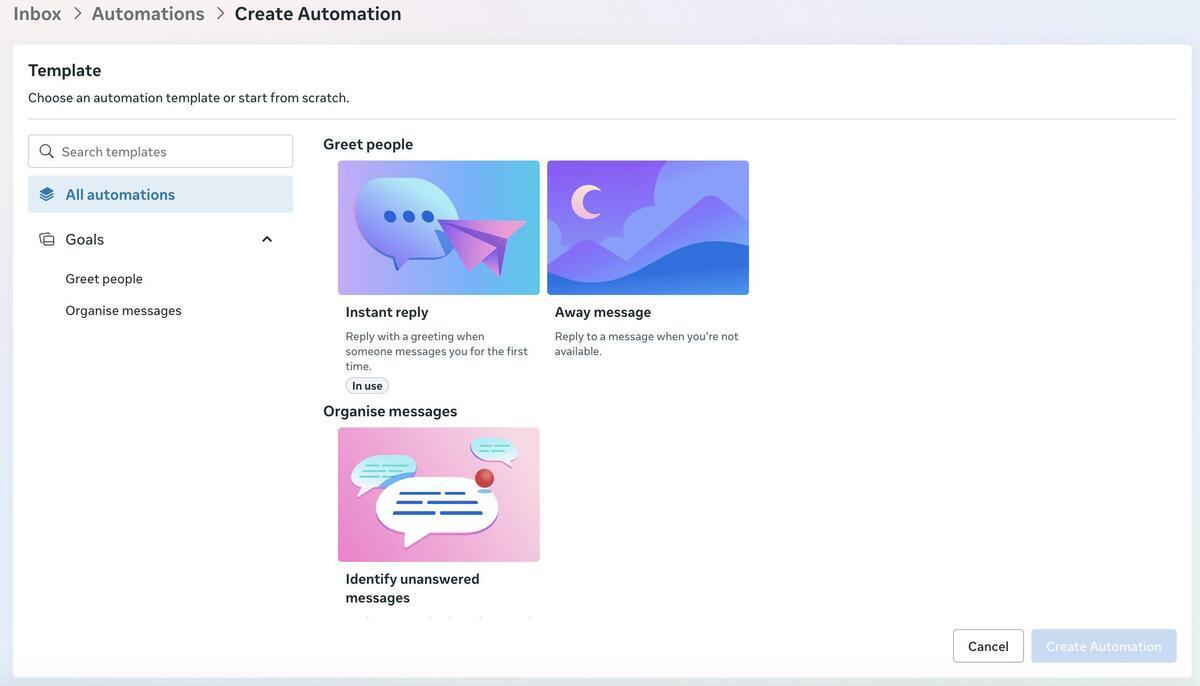
It’s basic, functional, and for a very small business just starting out, it’s a lifesaver. You don’t need to know how to code – you just need to navigate the maze of Meta’s settings menu. Your best bet is to go to the Inbox – you’ll find the Automations button there, right at the top.
Types of Facebook automated responses you can set up
Inside Meta Business Suite, you’ll find a few specific categories of automation – there might be different ones available depending on your region and Facebook page (plus, whether you want to automate Facebook comments or Messenger DMs):
- Instant replies: Sent immediately after someone starts a new conversation.
- Away messages: Scheduled for when your Page is “Offline” (outside of business hours).
- Frequently asked questions (FAQs): You suggest questions (e.g., “What are your hours?”), and when a user clicks one, they get a pre-written answer.
- Comment to message: (Available via some business configurations) sending a DM to someone who comments with a specific keyword.
- Location: Reply to a message asking for your location.
- Contact information: Reply to a message asking for your contact information.
- Hours: Reply to a message asking for your hours.
- Custom keywords: Reply to a message that contains specific keywords. (Only available on Meta Business Suite desktop.
You can also identify unanswered comments in the Inbox to follow up.
How to set up automated responses for Facebook comments
Managing comments is a bit trickier than DMs because they are public. Natively, Facebook’s automation for comments is a bit limited. You generally have to rely on keyword-based triggers. (If comments are your main battlefield, Facebook comment auto-reply goes far beyond what the native tools offer.)
To set this up:
- Go to Meta Business Suite and click on Inbox.
- Click Automations at the top.
- Look for “Custom Keywords“.
- You can add specific words (like “price” or “shipping”). When someone uses these in a comment, you can choose to have Facebook send an automated reply.
The catch is that it’s very “all or nothing.” If a user says “I hate your price,” and your keyword is “price,” they might get a happy (or at least irrelevant) message, which might sometimes make you look a bit tone-deaf.
How to set up automated responses for Facebook Messenger (DMs)
Facebook Messenger is where native tools are most commonly used. Here’s the quick workflow: (For DMs and comments together, a full Facebook autoresponder covers both from one set of rules.)
- Go to Meta Business Suite → Inbox → Automations.
- Instant Reply: Toggle this on to greet people. You can personalize it using their first name (which is always a nice touch).
- Away Message: Set your schedule on your Facebook page. If you’re closed on weekends, make sure this is active so people don’t think you’re ignoring them.
- FAQs: This is the most powerful native tool. Create 3-5 questions that you get asked daily. Add the answers. You can even add buttons that link to your website or “Order Tracking” page.
Meta Business Suite inbox Automations: what you can (and can’t) automate
All of Facebook’s native auto-reply features live in one place: Meta Business Suite → Inbox → Automations. That’s where you’ll find instant replies, away messages, suggested FAQs with saved answers, and follow-up messages – and where you edit or turn off any automated response your Page is currently sending.
Meta Business Suite automations are genuinely useful for the basics: greeting new messages, covering off-hours, answering the same five questions. Their ceiling shows fast, though – triggers are keyword-based only, there’s no sentiment detection, comments on ads are barely covered, and everything is per-Page, so managing several Pages means rebuilding every automation several times.
Limitations of native Facebook automated responses
While the price (free) is right, native Meta automation eventually hits a wall. If you’re managing a brand that’s actually growing, you’ll start to notice it sooner than later:
- There’s no sentiment analysis, so Facebook treats all triggers the same.
- You have to set up Facebook automations in one place, Instagram in another, and they don’t talk to your other channels.
- The logic is a basic “If X, then Y.” You can’t create complex workflows or “hide” comments that contain spam or hate speech automatically based on nuanced rules.
- Beyond “First Name,” there’s not much personalization to make the bot feel human.
- If you have a team of five people, it’s hard to see who’s handling what or if an automation has already intervened in a way that requires a human to step in.
So, while simple automated responses on Facebook are absolutely fine with the native tools, when you want to go for more nuanced scenarios, they’ll quickly stop being enough.
When native Facebook auto-Replies stop being enough
You’ll know you’ve outgrown Meta Business Suite when:
- Your notification bell is mostly a source of anxiety for you and your team. You’re getting hundreds of comments and DMs every day, perhaps across multiple Facebook Pages (which also means switching between them in the Meta Business Suite).
- Trolls are faster than you. You can’t delete or hide spammy or hateful comments fast enough – they’re still there the second you look (which often is the second you wake up in the morning).
- You’re repeating yourself. You spend 3 hours a day copy-pasting the same five answers, wondering how you got to this point in your life (you had such big dreams).
- You’re running Facebook Ads. High-spend ads bring high-volume comments. If you don’t moderate those comments, your ad ROI will eventually plummet.
I do have an alternative, though. 👀
Introducing NapoleonCat as an advanced solution for Facebook automated responses
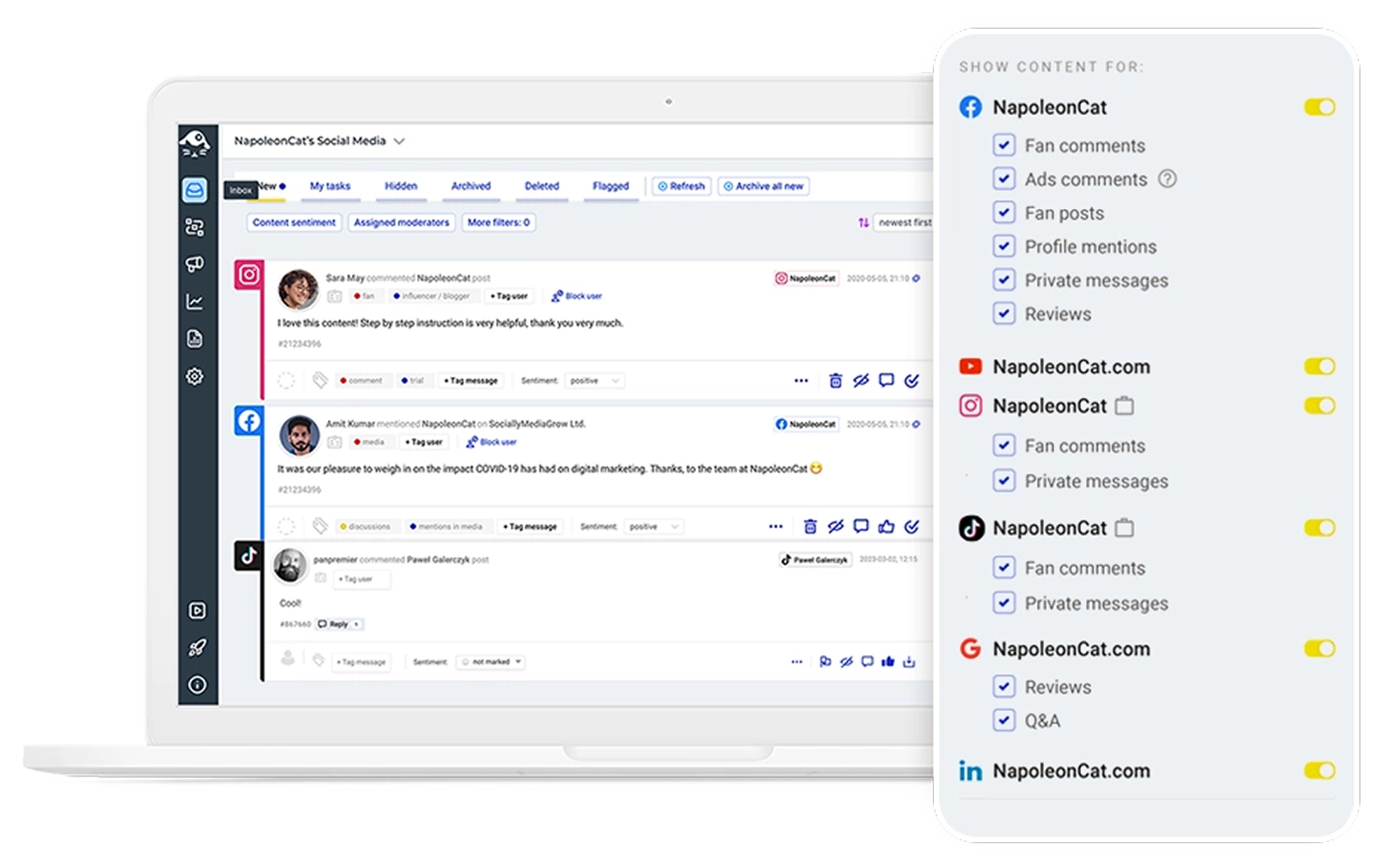
NapoleonCat is a comprehensive suite of Facebook management tools for business – and a smart Facebook autoresponder – with AI-powered moderation that actually understands context, letting you send more relevant (and human) automated responses in a more flexible way.
It works for organic posts, ad posts, and Messenger DMs. And you can create specific scenarios and multiple reply variants for automation that feel much more personal (even though it’s still simple to set up).
Let me show you.
How NapoleonCat Auto-moderation improves Facebook automated responses
The Auto-moderation feature in NapoleonCat goes way beyond a simple “Out of Office” reply. Paired with a Facebook comment moderation tool, replies and clean-up run from the same rules.
You can:
- Instantly hide comments containing links (spam), profanity, links, or specific competitor names.
- Specify actions based on comment sentiment, keywords, AI tags, and more.
- Manage organic comments and ad comments, and set different rules depending on the content.
- Automatically assign comments to team members based on specific triggers.
And more. The key difference is that Auto-moderation in NapoleonCat lets you create flexible automation scenarios that are as specific as you need them to be. And you can have multiple rules running at any time, supporting your human team in busy sales seasons and while they focus on building customer relationships.
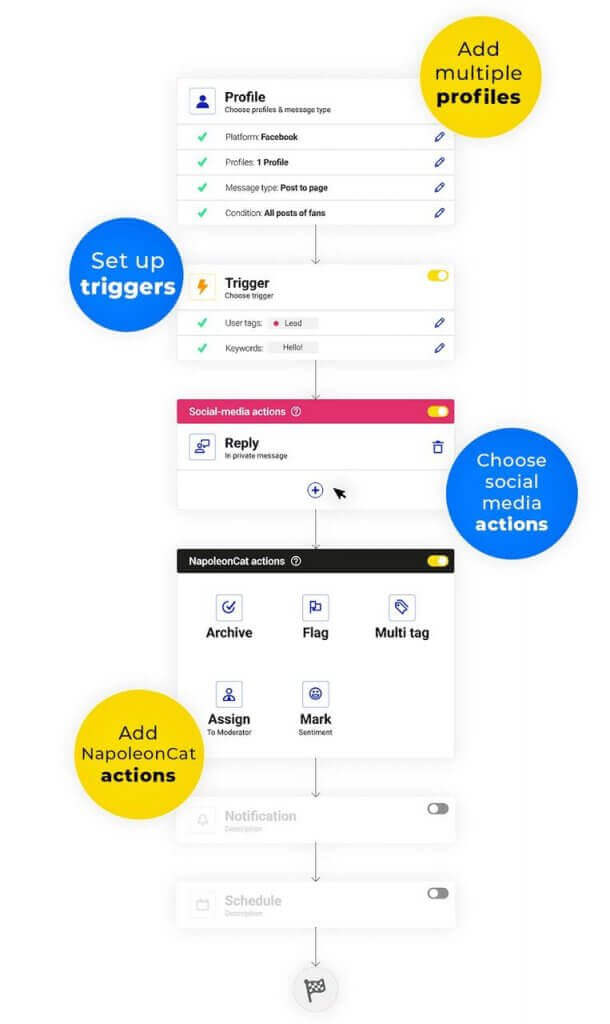
The premise is simple:
- You specify the Facebook page (and possibly post/ad) for your automation rule
- You select triggers (keywords, spam, sentiment, etc.)
- You define actions (reply, DM, assign, hide, and more)
- You add a schedule – or leave the rule running 24/7
And you add as many rules as necessary to cover relevant scenarios.
Using AI to generate smart Facebook auto-replies
Some of the features that make the most noticeable difference in the time you and your team save every day are the AI Assistant and AI Replies (the latter now in beta). That’s the job of auto-commenting AI for Facebook.
The AI Reply generates suggested responses by analyzing your moderation history and additional sources such as FAQ and help centers.
This way, instead of a static “We’ll get back to you shortly,” NapoleonCat’s AI can help you draft replies that are contextually aware, on brand, on theme, and multilingual. It can also rewrite responses for a particular audience or tone, suggesting replies that actually make sense in a given situation.
And you can still tailor it to your needs afterwards.
In the beta stage, AI replies are available for comments only and need to be activated on request. But stay tuned until the feature is rolled out to everyone soon.
Smart Facebook Automated Responses
Set up smart auto-replies for your organic posts and ads on Facebook and Messenger. Automatically hide or delete spam and hate comments – with an all-in-one social media tool.
Combining Auto-moderation, AI, and Social CRM for scalable automation
NapoleonCat really lets you take social media management to the pro level.
Every person who interacts with you is logged in the Social CRM, along with your conversation history.
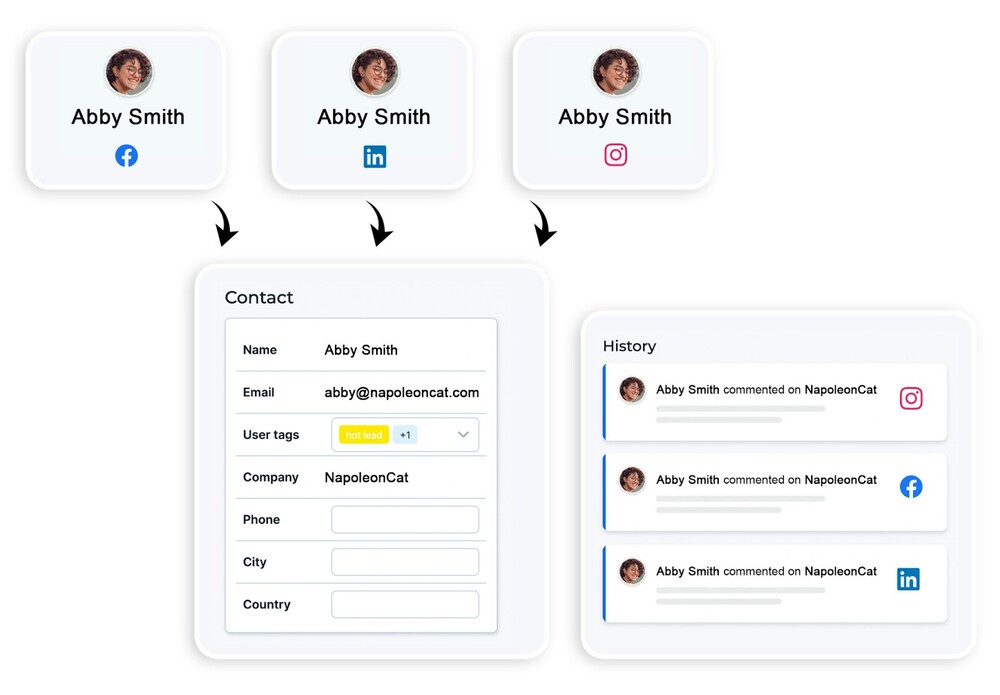
So if someone complains for the third time in a row, your team can see that history instantly. You can also assign a tag to them (e.g., upset customer), and use it to trigger Auto-moderation actions – like assigning the message to a specific team member, while also sending an instant message that “you’re on it”. Add a keyword like “refund,” for example, to make that automated interaction even more relevant and specific.
Meanwhile, the AI Assistant will also automatically watch out for the sentiment and hate or spam content – continuously in the background. A negative comment with certain keywords might be redirected to a customer service agent, while another one that’s clearly offensive (and possibly coming from a known “troll” 🧌, who’s already been tagged in the Social CRM) will be hidden and tagged for review.
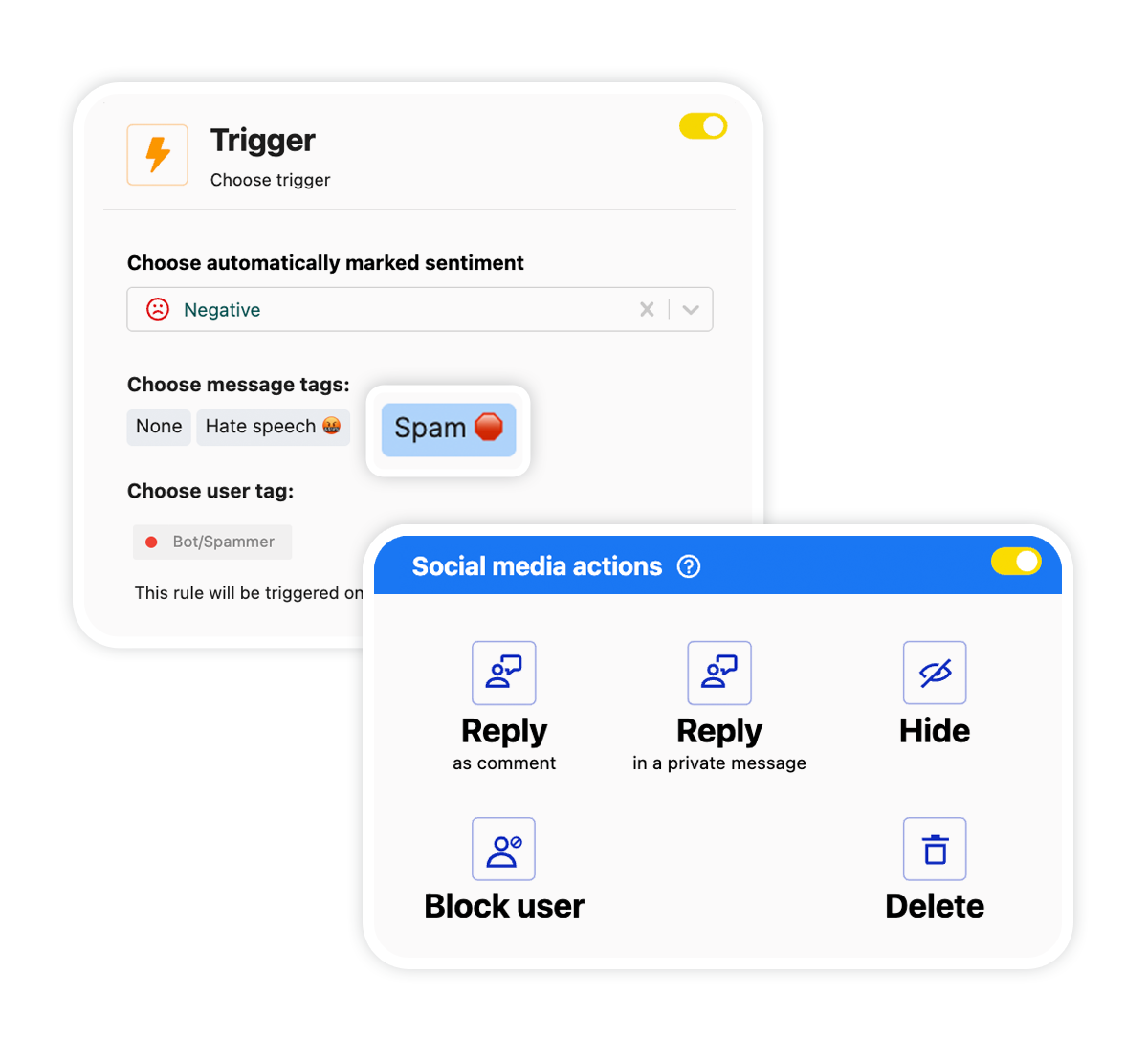

Automatically Block Spam with AI Precision
Automatically hide or delete spam and hate comments on your posts and ads across all your social media profiles, powered by advanced AI.
Facebook automated responses for customer support, sales, and community management
With multiple Auto-moderation rules running at the same time, you can use NapoleonCat for many purposes at once.
- Handle the “Where is my order?” crowd. Set an auto-moderation rule that detects “order status” + “tracking” and sends a DM in response asking for their order number.
- When someone comments “How much?” on a product photo in a Facebook ad, automatically send them a private message with a discount code and a link to the shop.
- Automatically hide “Check my bio for crypto” spam, so your real fans can actually have a conversation in the comments.
- Ask people to comment a word or phrase for extra content you’ll send them in a DM – or to take part in a giveaway.
- [Enter your own scenario here].
You can reply publicly in the comments, send a DM asking for more details, assign to a customer service agent, tag a message and add an internal note to the conversation, and it might all be happening at the same time, for multiple Facebook pages and different types of content across organic posts and ads.
Try calculating the time your moderation team will save – you might be surprised.
Why NapoleonCat is the ultimate tool for Facebook automated responses
Looking at the limited native options available on Facebook via the Meta Business Suite automations, NapoleonCat’s range is really impressive – but, more importantly, covers most of marketing/sales/CS-related needs.
Plus, it works for multiple accounts and other social media platforms like Instagram or TikTok. And gives you other tools like the Social Inbox, content scheduling, and even analytics. Like a true all-in-one tool should.
And you can try it completely for free for 14 days, which I highly recommend.
Facebook automated responses – FAQs
Let’s answer some of the most common questions regarding automated responses on Facebook.
How do you set up an automated response on Facebook?
Natively, go to Meta Business Suite, navigate to the “Inbox” tab, and click on “Automations” at the top. From there, you can choose from templates like Instant Replies or FAQs.
How do I change the auto reply on my Facebook Page?
Return to the “Automations” section in Meta Business Suite. Click “Edit” on the specific automation (like Away Message) you want to update, change the text, and hit “Save Changes.”
How do I stop automated replies on Facebook?
In the Meta Business Suite “Automations” tab, there is a toggle switch next to each active automation. Simply switch it to “Off.”
What is a good automatic reply message on Facebook?
A good reply is transparent, human, and helpful.
Here’s an example: “Hi [Name]! Thanks for reaching out. We’ve received your message, and our team usually responds within 2 hours. In the meantime, you can check our FAQs here: [Link].”
Can Facebook automated responses work differently for comments and private messages?
Yes. Native tools are much better for DMs (Messenger). For comments, native tools are limited to basic keyword triggers, but a tool like NapoleonCat allows for advanced public-facing auto-replies and moderation (including DMs, too).
Are Facebook automated responses available on all types of Pages?
Yes, any Facebook Business Page has access to the Meta Business Suite and its basic automation features. Also, you can connect any Facebook Page to a tool like NapoleonCat – including connecting multiple Pages at once.
Can Facebook automated responses be personalized for different users?
Natively, you can only use basic placeholders like the user’s first name, last name, or a link to your Page. For more personalization and customization, you’d need an AI-integrated tool like NapoleonCat.
Do Facebook automated responses support multiple languages?
Natively, no – you would have to manually write different responses or use keywords to trigger specific languages. NapoleonCat’s AI features can help translate and respond in various languages more fluidly.
How can I scale Facebook automated responses beyond native Facebook features?
The best way to scale is by using a third-party social media management platform like NapoleonCat. You can then create complex rules, handle high volumes of comments across multiple pages, and integrate AI to maintain a human touch at scale.