

Save hours on social, every day.
Automate moderation and replies, schedule posts, and pull reports - all in one tool.
Table of Contents
- The 18 best social media management tools at a glance
- The best social media management tools, reviewed
- What a client or a read-only seat actually costs you
- What five people and three reviewers actually cost
- Does the inbox actually cover ads and reviews, or just organic posts?
- Which of these really do social listening?
- What happens to your data when you cancel
- Security and compliance, since somebody will ask
- Which one, by team shape
- Social media management tools: your questions, answered
Picking a social media management tool used to be about features. In 2026 it’s mostly about the bill, because the same eight people can cost you $33 a month or $2,392 a month depending on which vendor you sign with. Same work, same posts – seventy-two times the invoice.
That gap almost never comes from what the software does. It comes from what the vendor decides to count – your people, your channels, your clients, or nothing at all.
So this guide does two things. It reviews 18 social media management tools with prices read off each vendor’s own pricing page – every one of them, not a starting price with an asterisk. And it answers the question every comparison table skips: if you add a client or a colleague who only needs to look, does that cost you a full seat? Two vendors state the answer outright, in writing, and they state opposite answers. Everybody else makes you guess – and guessing here is expensive.
- The 18 best social media management tools at a glance
- The best social media management tools, reviewed
- What a client or a read-only seat actually costs you
- What five people and three reviewers actually cost
- Does the inbox actually cover ads and reviews, or just organic posts?
- Which of these really do social listening?
- What happens to your data when you cancel
- Security and compliance, since somebody will ask
- Which one, by team shape
- Social media management tools: your questions, answered
Key Takeaways
- Ad comments and Google reviews are what “unified inbox” quietly leaves out. A dark post never appears on your Page at all, so its comments are invisible to you unless the tool syncs them – and a boosted post can pull ten times the comment volume of an organic one. Agorapulse is the only vendor here that publishes the sync limits: Instagram capped at 2,000 posts and 200 comments per post, Facebook on a rolling 32-day window, and only ads with Active status syncing at all.
- The free reviewer is usually a link, not an account. Later, Metricool Studio, Statusbrew and Agorapulse’s Shared Calendar all work by sending a link rather than creating a cheap seat. Later’s links “expire 7 days after they’re created and aren’t password-protected” – fine for most teams, disqualifying if your client is in finance or healthcare.
- Social listening is now something vendors buy rather than build. Platform API access for listening can run to thousands of dollars a month, and after X moved to per-call pricing that cost gets passed to you as an add-on. Buffer doesn’t mention listening on its pricing page at all, SocialPilot has no listening row, and Hootsuite’s real listening is a separate product.
- Nobody publishes what happens to your data when you cancel. We went looking for a statement from every vendor here and found almost nothing – which is its own answer. Export a report and an inbox archive during the trial, and check the format is actually usable before you put three years of conversation history in there.
- Sprinklr no longer sells self-serve. End of service was 30 April 2026, so any 2026 comparison still quoting a Sprinklr self-serve price is quoting a product you cannot buy.
- The same eight people cost $33 a month or $2,392 a month, depending only on what the vendor charges you for. For five staff plus three outside approvers, the bill runs from Planable at the bottom to Sprout Social Professional at the top, with almost no difference in what the software actually does.
The 18 best social media management tools at a glance
The whole list first, so you can skip to the three you’re actually choosing between – the detail is underneath.
| # | Tool | Best for | Starts at | What you pay for | Free client or view-only seat? |
|---|---|---|---|---|---|
| 1 | NapoleonCat | Teams whose inbox is as much work as the calendar | from $89/mo (2 users, 5 profiles) | Users and profiles together, in published steps | No, a Client uses a paid user slot |
| 2 | Hootsuite | Big social teams that need control | $99 per user/mo, billed annually | Seats, from seat one | Not documented |
| 3 | Sprout Social | Making social make sense to the wider business | $79 per seat/mo annually, $99 monthly | Seats, from seat one | No |
| 4 | Agorapulse | Inbox-led teams that want ROI attribution | $79 per user/mo annually, $99 monthly | Users | Guest costs a seat, Shared Calendar is free on Advanced |
| 5 | Zoho Social | Anyone already inside the Zoho suite | $10/mo billed annually, $15 monthly | Brands and members | Yes, client logins documented as free |
| 6 | Buffer | One or two people, a few channels | $6 per channel/mo | Channels | Yes, all users are free on Team |
| 7 | Metricool | Cheap analytics across many brands | from $20/mo billed annually | Brands | Yes, via a no-account share link |
| 8 | Later | Visual-first planning for Instagram and TikTok | $18.75/mo billed yearly | Plan, capped by users and social sets | Yes, for link-based reviewers |
| 9 | Vista Social | An honest all-in-one with published prices | $79/mo, or $758/year | Plan (profiles + users) | Not documented |
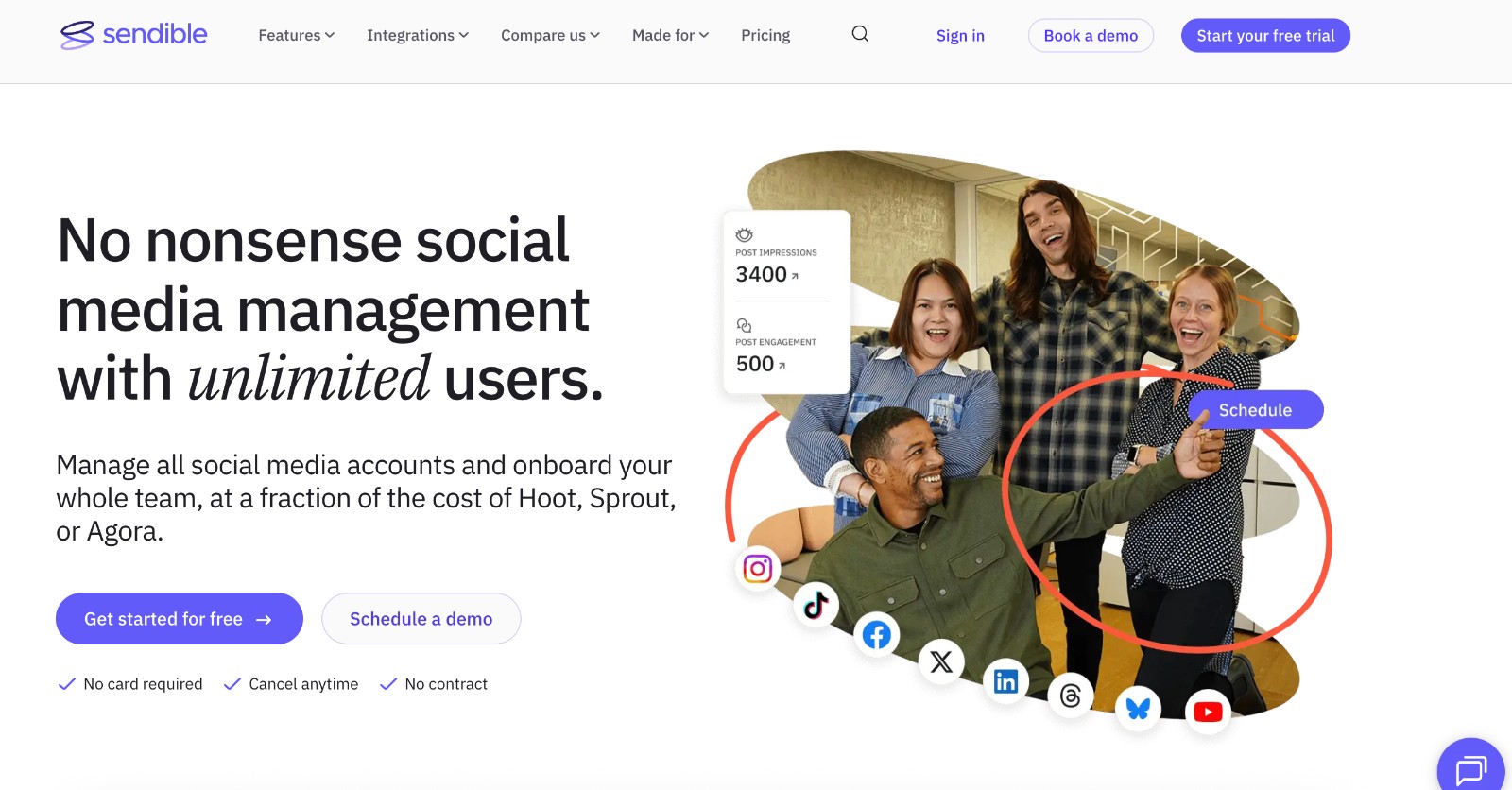
| 10 | Sendible | Agencies done with per-seat billing | $29.75/mo billed yearly, $35 monthly | Workspaces | Yes, Client user type is free |
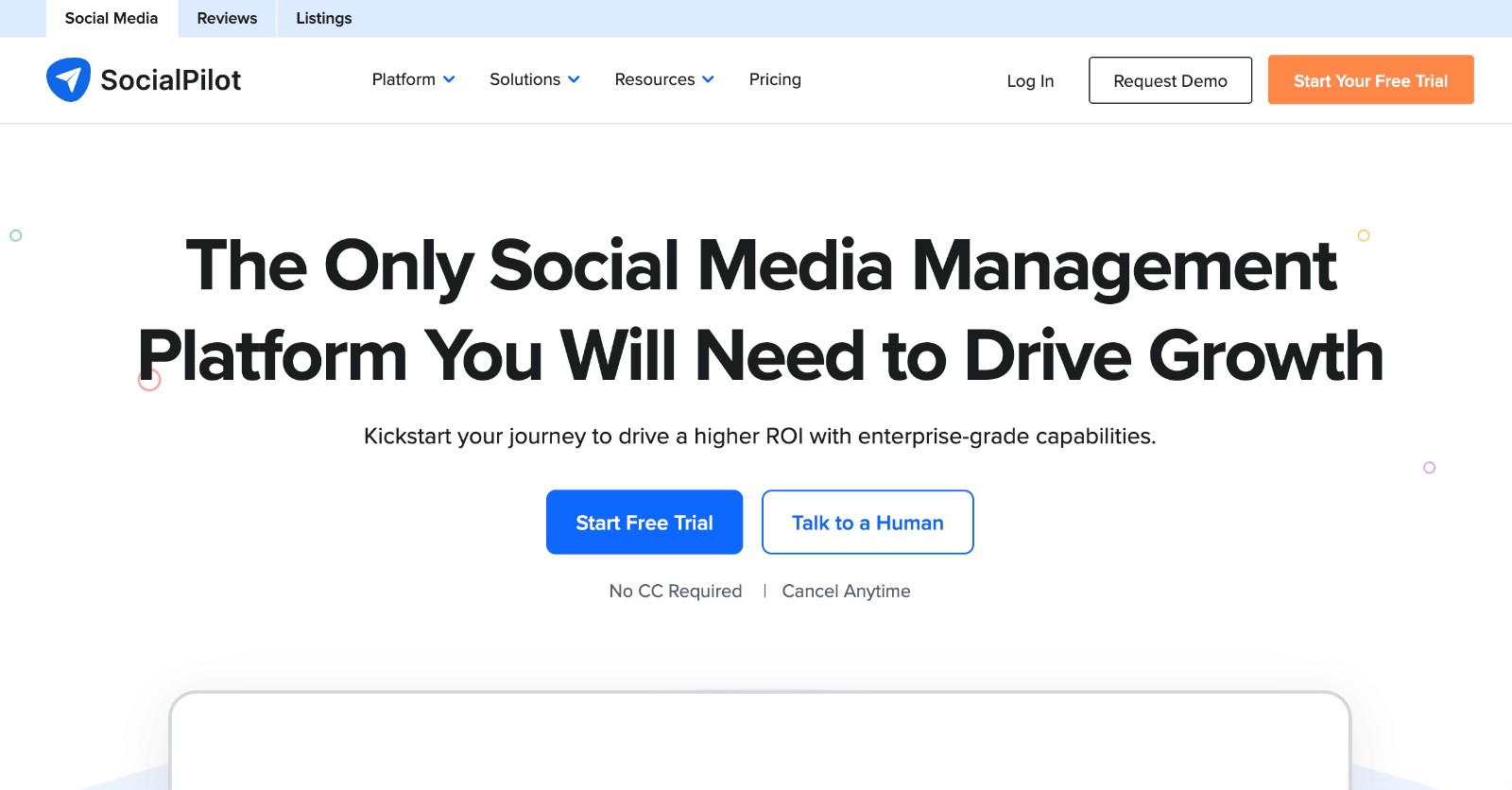
| 11 | SocialPilot | Many client accounts on a small budget | $20/mo monthly, $17 annually | Plan, plus per-account overage | Yes, unlimited from Premium, zero below it |
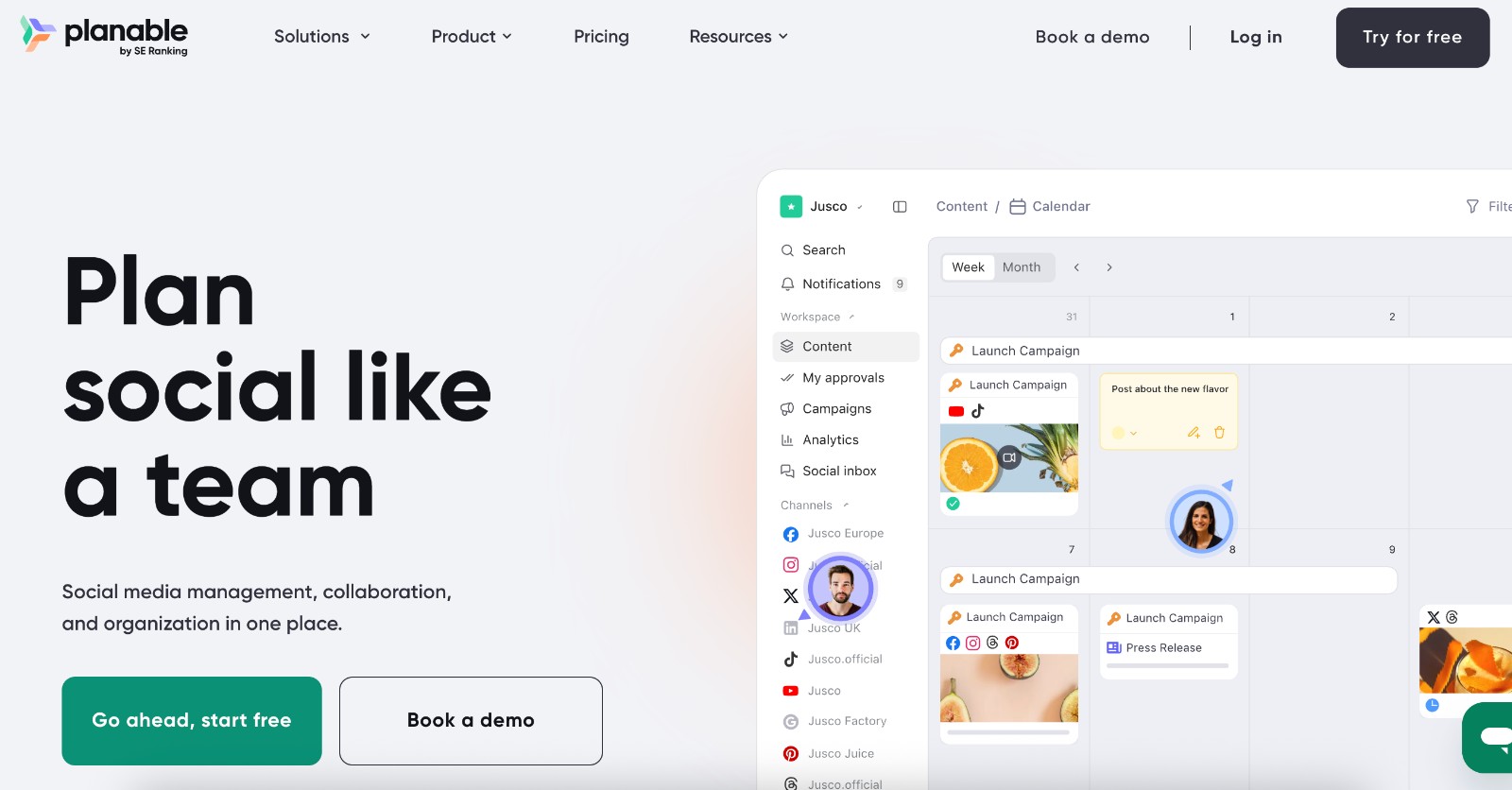
| 12 | Planable | Getting nervous clients to approve things | $33 per workspace/mo billed yearly | Workspaces | Yes, Guest and Approver roles are free |
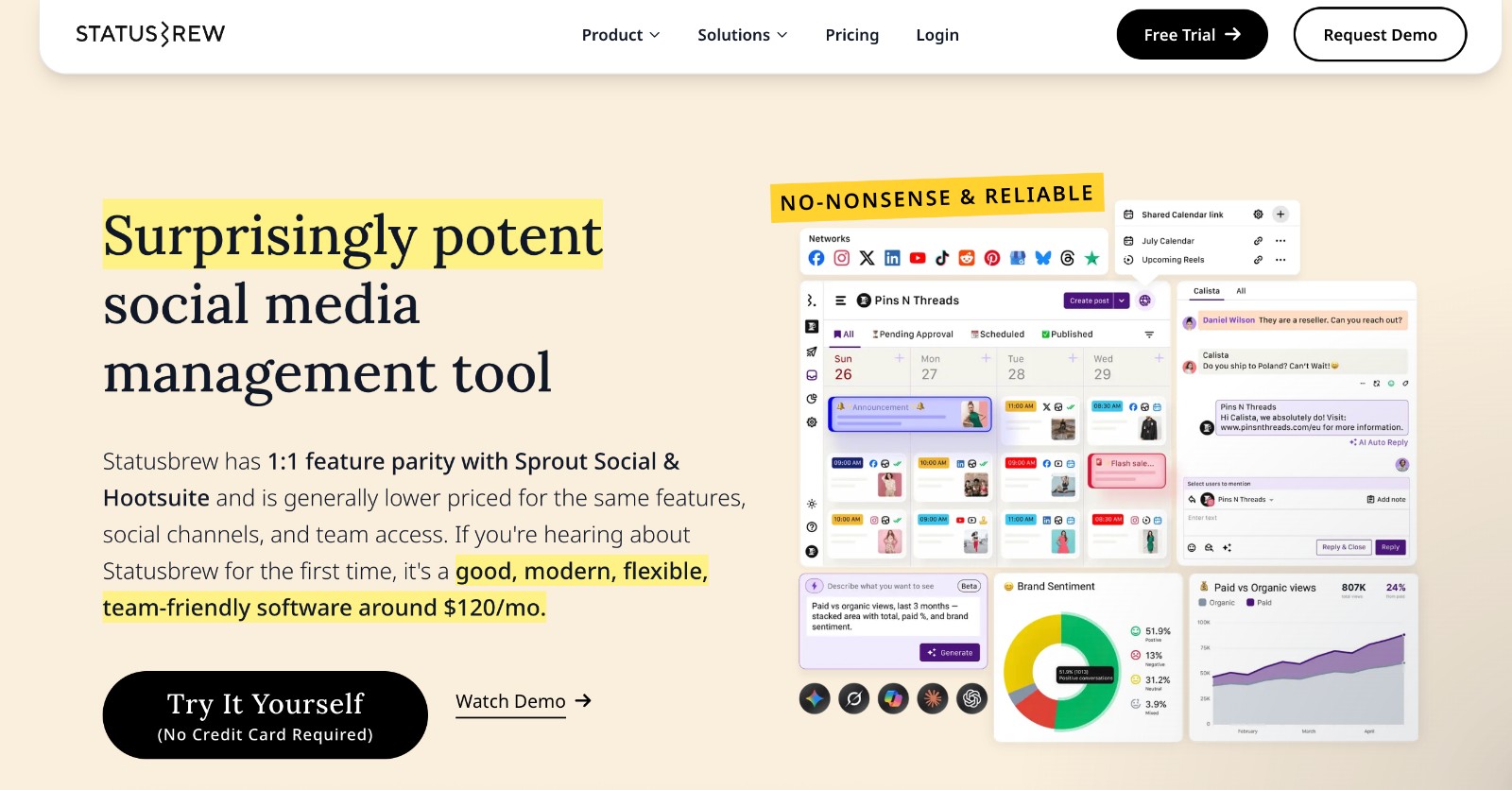
| 13 | Statusbrew | Moderation at volume with an audit trail | $69/mo billed annually, $89 monthly | Plan, then per user and profile | Yes, stated explicitly |
| 14 | SocialBee | Recycling evergreen content | $24.20/mo billed annually, $29 monthly | Plan, 1 user hard cap | No view-only role at all |
| 15 | Loomly | Small in-house teams wanting post guidance | $49/mo billed yearly, $65 monthly | Seats | No, stated explicitly |
| 16 | Sprinklr | Enterprise governance and real listening | No published price, quote only | Not published | Not published |
| 17 | Oktopost | B2B social tied back to pipeline | from $499/mo, billed annually | Users, profiles are unlimited | Not published |
| 18 | SOCi | Multi-location brands and franchises | No published price, quote only | Locations | Not applicable, not seat-priced |
Two things to hold on to while you read that table. Prices are list prices in the vendor’s own currency, and several vendors run promotions that make the headline look softer than the standing rate. And the last column is the one that will surprise you, which is why it gets its own section further down – it decides more than the price does.
The best social media management tools, reviewed
1. NapoleonCat
Best for: teams where the comment section is a bigger job than the calendar.
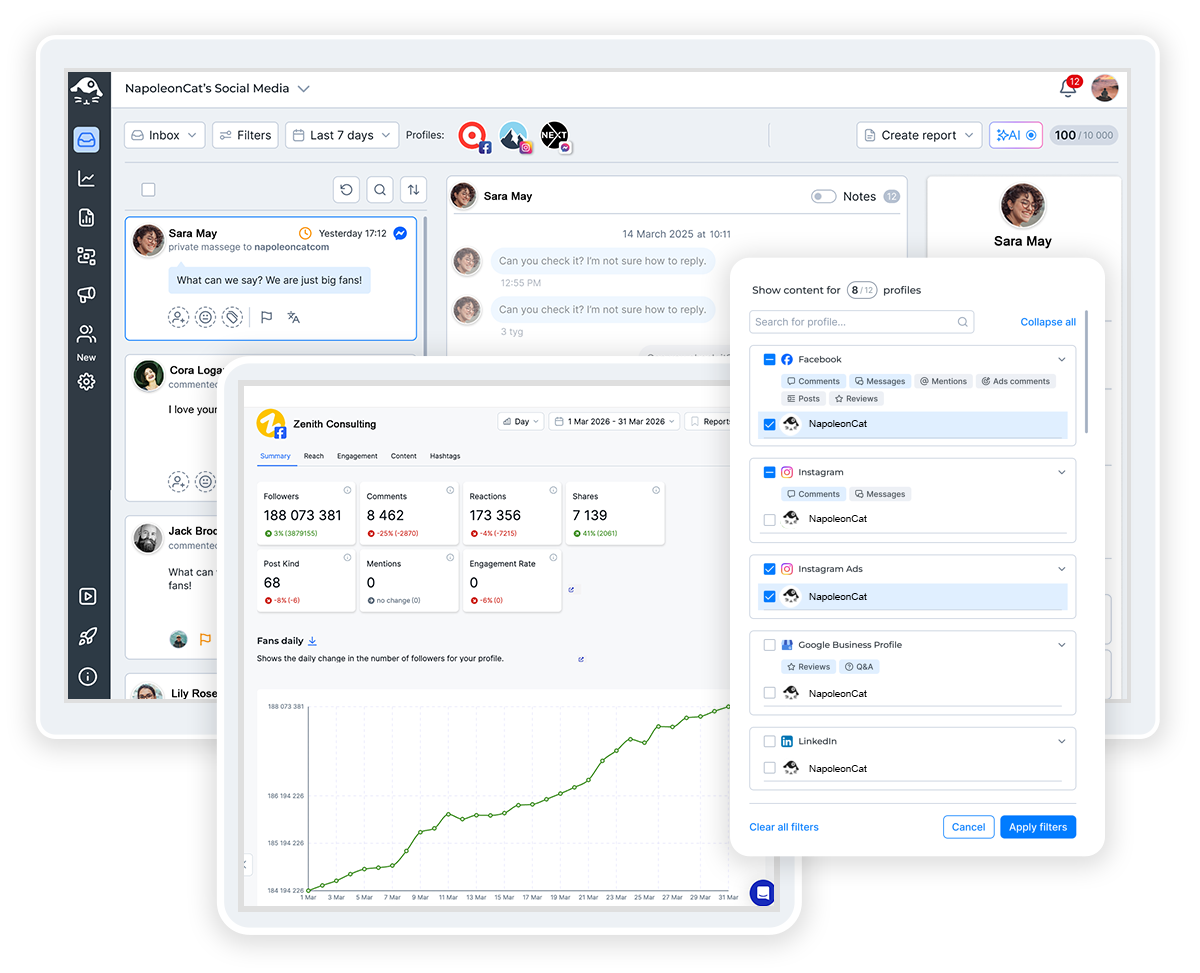
Most suites are a publisher with an inbox bolted on. NapoleonCat is the other way round, which is why it tends to get bought by people whose actual problem is 400 comments – and three of them are a crisis.
You publish to Facebook, Instagram, TikTok, LinkedIn Company Pages, YouTube and Google My Business from one calendar, and to X as well. If you are running several Pages or handles, that is one place to manage multiple Facebook accounts and a single app to manage multiple Instagram accounts instead of a browser full of tabs.
Then the Social Inbox pulls comments, DMs, mentions and Google reviews from the networks it supports into one queue, and Auto-moderation handles the repetitive half on its own: hiding spam, answering the question you have answered nine hundred times, moving a conversation into DMs. It also covers Google Play Store and App Store reviews, which almost nothing else on this list does.
Ad comment moderation covers Facebook, Instagram, TikTok and YouTube ads. That is rarer than it sounds, and worth checking against anything else here.
On the team side, which is what this whole guide is really about: NapoleonCat splits people into Administrators, Users and Clients. Clients can approve, reject and comment on drafts in the Publisher and see only the workspaces you put them in. Users get per-module permissions across Inbox, Publisher and Reports, set to VIEW, EDIT or NONE, per workspace. So a read-only person really is read-only – and a client never sees another client.
The numbers: from $89/mo for 2 users and 5 profiles. Pro $109/mo and Expert $139/mo cover the same 2 users and 5 profiles, with more automation and reporting depth. Post scheduling is unlimited on every plan. Enterprise from $465/mo. 14 days free, no credit card. EU-based and EU-hosted.
Users and profiles scale together rather than being sold one seat at a time, so the price for a bigger team is published up front instead of multiplying:
| Users / profiles | Standard | Pro | Expert |
|---|---|---|---|
| 2 / 5 | $89/mo | $109/mo | $139/mo |
| 5 / 10 | $149/mo | $189/mo | $249/mo |
| 10 / 20 | $249/mo | $299/mo | $369/mo |
| 15 / 40 | $349/mo | $419/mo | $519/mo |
| 20 / 60 | $499/mo | $619/mo | $799/mo |
Work that back to a cost per person and it’s $24.90 a month per user at ten users on Standard, against $99 for the same headcount on Hootsuite and $199 on Sprout Social Standard. The gap widens as the team grows, which is the opposite of how per-seat pricing behaves.
Worth knowing before you count seats: a Client counts as a paid user. Giving a client view-and-approve access uses one of the user slots in your plan, exactly like a colleague does. Plenty of tools here work the same way, but a few genuinely do not, and the seat section below sorts them.

Social media management for teams
Moderation, automation, analytics, reporting, scheduling, and more. Save tons of your time spent on marketing tasks – with an all-in-one social media tool designed specifically for teams.
2. Hootsuite
Best for: a large organisation where governance matters more than unit cost.
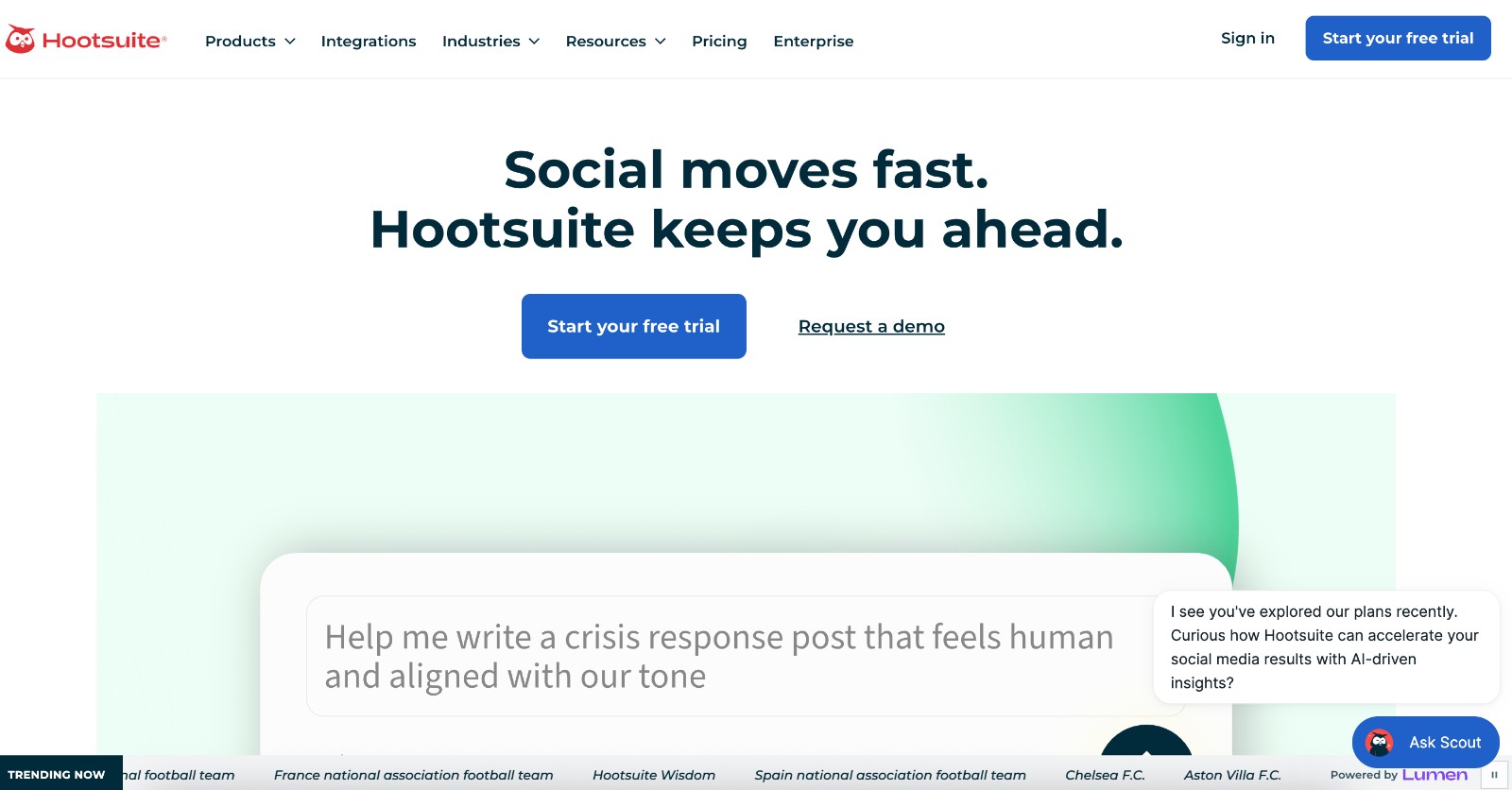
Hootsuite is the tool everyone’s boss has heard of, and at scale it earns that. You get departmental organisation, granular permissions, and since June 2026 a renamed product line where publishing is Perch and the inbox is Nest.
Then the seat model bites – hard. Hootsuite’s own pricing page says plans “are sold per user (or ‘seat’)” and no plan includes any. Eight people on Standard is $792 a month – and that is the cheap tier. Approval workflows don’t appear until Advanced, where eight people is $3,192 a month. Worth adding: Hootsuite’s help centre returns errors to anyone not logged in, so you cannot read what its cheaper roles can actually do until after you’ve bought.
The numbers: $99, $199 and $399 per user/mo, all billed annually. No free plan, 14-day trial, no card. Full detail in our guide to Hootsuite pricing, and if the per-seat bill is the problem, NapoleonCat works as a Hootsuite alternative without charging for every extra seat.
3. Sprout Social
Best for: the quarterly deck you have to defend in front of people who don’t work in social.
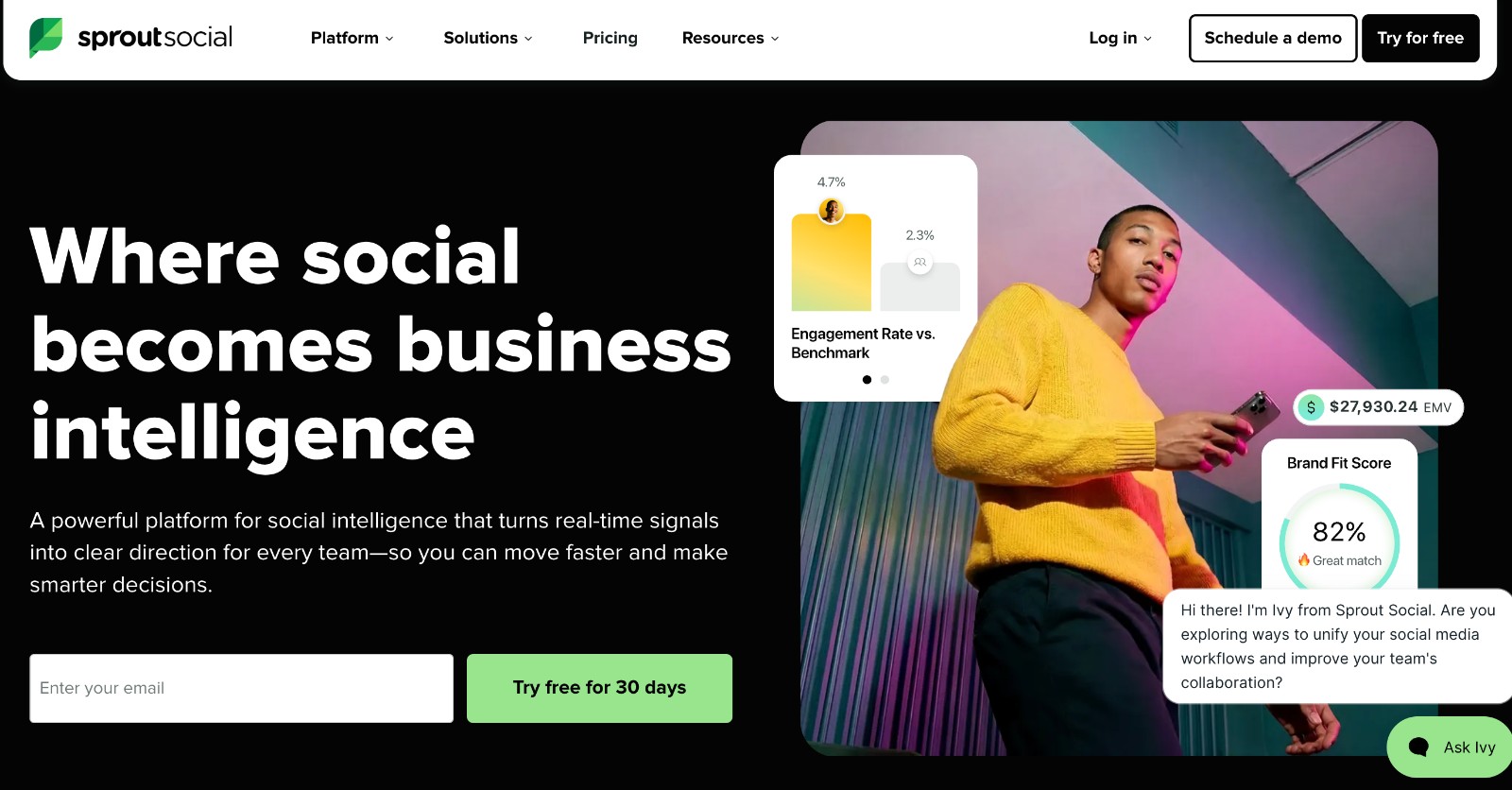
Sprout’s reporting, listening and review management are the best-regarded on this list, and its Smart Inbox pulls in reviews from Facebook, Google, the app stores, Glassdoor, Yelp, Trustpilot and TripAdvisor. (You can reply from all of them except TripAdvisor, which doesn’t allow partner replies.)
It is also the purest per-seat product in this guide. There is no free role of any kind – “Read Only” is a permission you attach to a paid seat, and per-profile permissions aren’t available until Professional. Five staff and three reviewers on Professional is $2,392 a month. One small mercy Sprout does document: remove someone mid-cycle and the seat stays open until the next billing cycle, so you can swap people without paying twice.
The numbers: Essentials $79, Standard $199, Professional $299 and Advanced $399, all per seat/mo on annual billing. No free plan, 30-day trial, no card. See our Sprout Social pricing breakdown.
4. Agorapulse
Best for: an inbox-first team that wants ROI attribution without an enterprise contract.
Agorapulse is the closest competitor to NapoleonCat’s shape, and it’s genuinely good: moderation rules, ad comment sync across Facebook, Instagram, LinkedIn and TikTok, and a Social ROI report wired to Google Analytics.
Its seat model is the most useful trap in this whole guide, so read it twice. Agorapulse has a role literally called Guest, described as “view-only access, with no publishing or moderation capabilities”. And its own documentation says: “Social profile roles, including Guest, can only be assigned to a user with a Paid seat.” Your view-only client costs $79 a month – to look. The genuinely free route is the Shared Calendar, where external people approve without an account, and that is gated to “an Advanced or Custom subscription plan” at $149 per user a month.
So you pay more per seat in order to stop paying for reviewers – which is a strange sentence to have to write.
Two more facts you’ll find wrong elsewhere: the free plan was retired on 6 July 2026 (Agorapulse’s own FAQ still promises one), and ad comment sync starts at Professional, not Standard.
The numbers: Standard $79 per user/mo annually, $99 monthly. Professional $119. Advanced $149. 30-day trial, no card. More in our Agorapulse pricing guide.

5. Zoho Social
Best for: teams already paying Zoho for something else, and agencies with lots of clients.
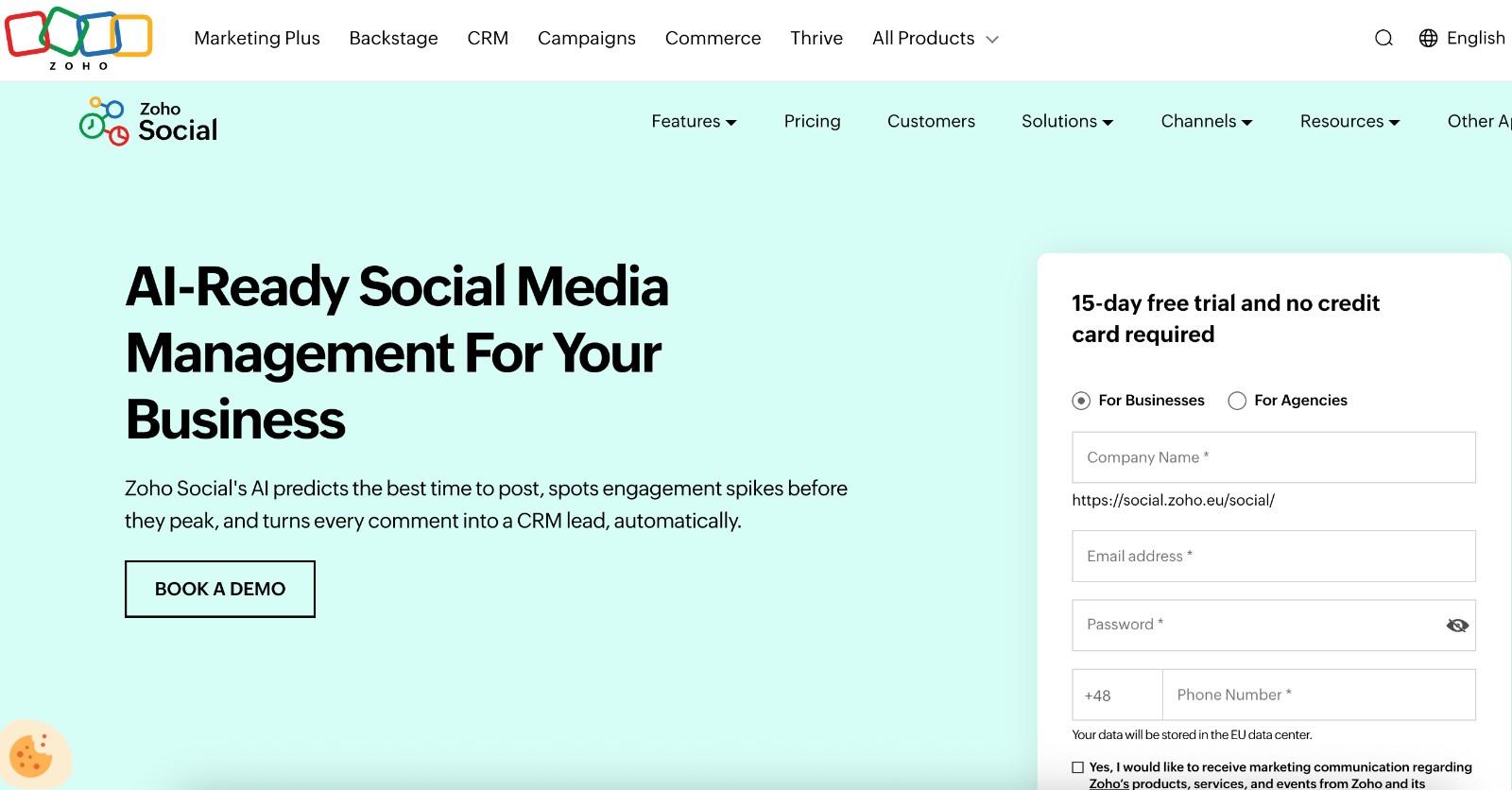
At $10 a month on annual billing this is the cheapest paid plan here by a distance, and the free tier is permanent rather than a trial wearing a disguise. Social leads flow into Zoho CRM, so they land where your sales team already works.
Zoho’s seat rules are the exact inverse of Agorapulse’s, and rather charming for it – internal team members cost $10 to $12 a month each, while client logins are free, documented on the pricing page as “Free login for clients” on Premium and Agency plans. So the cheapest Zoho setup is a small internal team and as many clients as you like. What Zoho doesn’t document is whether a client counts against the member allowance, so confirm that if it matters.
The numbers: Free forever with 1 brand, 6 channels, 1 member. Standard $10/mo annually ($15 monthly). Professional $30 ($40). Premium and Agency add members and brands. Extra members $10 to $12 each. 15-day trial, no card.
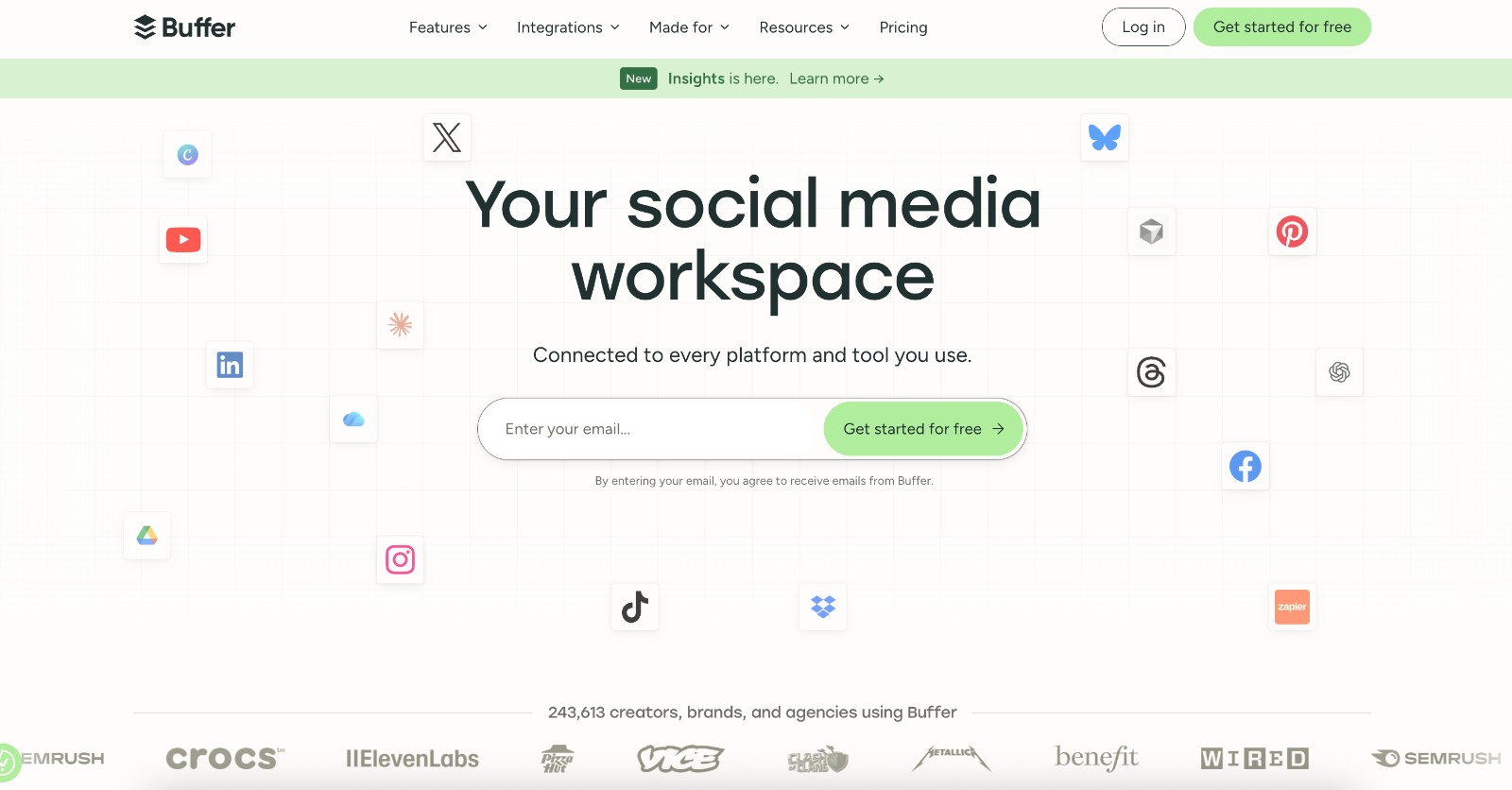
6. Buffer
Best for: one or two people who want the bill to stay boring.
Buffer prices per channel, so people are free. The Team plan says “unlimited team members” and means it. Ten channels is $120 a month whether that’s you alone or your whole department – which is the friendliest maths on this list for a growing team.
It is a publisher first, though – not a suite. The permissions are per-channel rather than walled workspaces, and Buffer’s “View Only” role exists only inside Community, its comment tool, not for the calendar. So a client who just wants to look at the plan has to be given a “Needs Approval” role instead. Free – but not actually read-only.
The numbers: Free forever with 3 channels, 10 queued posts per channel, 1 user. Essentials from $6 per channel/mo. Team from $12 per channel, unlimited users. Volume pricing drops to $1 per channel above 51 channels.
7. Metricool
Best for: measuring a lot of brands without paying per head.
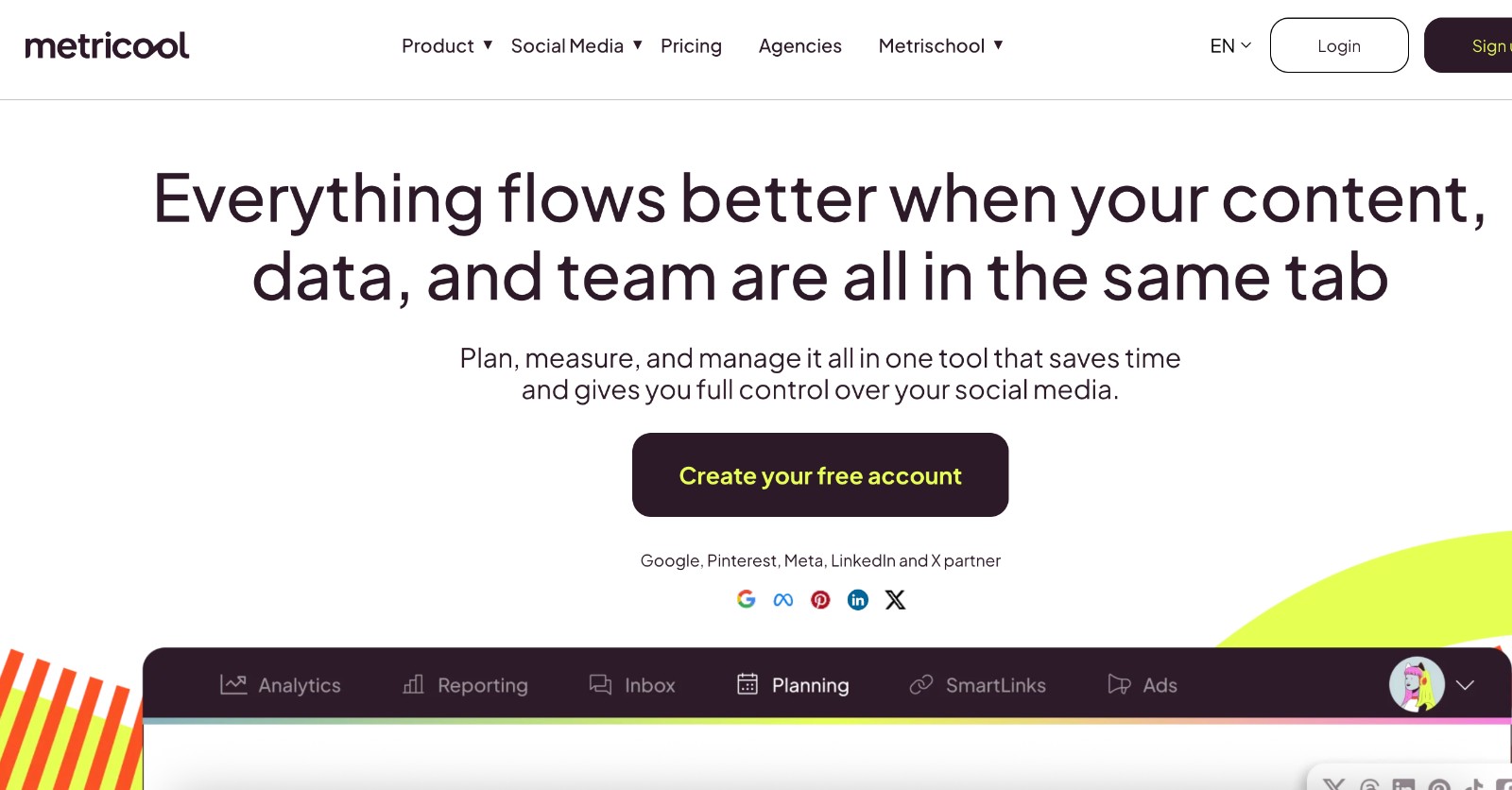
Metricool bills per brand, and a brand is one profile on each supported network. Five brands is $20 a month on annual billing. Advanced gives you unlimited team members, which means the internal seat question simply stops existing at $53 a month.
For clients there’s Metricool Studio: a read-only calendar view where, in Metricool’s words, “anyone with the link can open and explore the view without needing a Metricool account”. Free and frictionless – genuinely. The catch is worth knowing before you build a workflow on it: Metricool runs two separate user systems, and the client you added the account-free way is the one you cannot route an approval to. Also budget for X, which is never included and doubled to $10 per connected account in July 2026.
The numbers: Free forever with 1 brand, 20 posts a month, no LinkedIn or X. Starter from $20/mo annually for 5 brands. Advanced from $53/mo for 15 brands, unlimited team members, roles and approvals.
8. Later
Best for: a small brand team planning a grid rather than running a service desk.
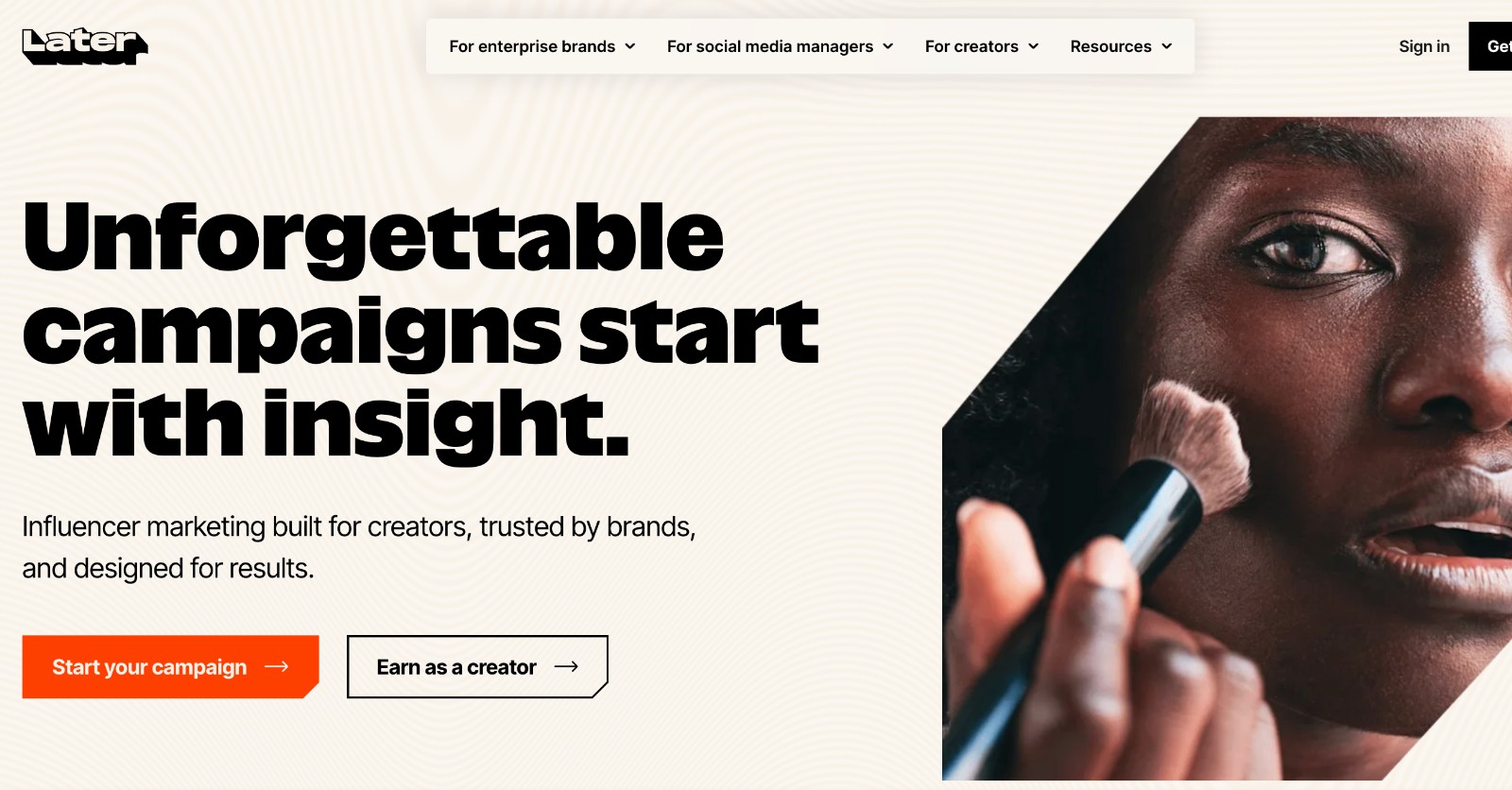
Later is where visual-first brands land, and the mobile experience is the nicest here. For clients it does something clever: you share a link and, in Later’s words, external reviewers “don’t have a Later account” at all. Free, no seat.
Read the small print on both sides of that – there is some. Those review links “expire 7 days after they’re created and aren’t password-protected”, which some clients’ legal teams will refuse outright. Internally, Starter is one user, Growth is two, Scale is four, extras are $3.75 a month each at the annual rate, and collaboration and approvals don’t exist below Growth. Later also doesn’t support X, and the company’s navigation now leads with influencer and affiliate products rather than social management.
The numbers: Starter $18.75/mo billed yearly, Growth $37.50, Scale $82.50. No free plan, 14-day trial.
9. Vista Social
Best for: an all-in-one where you can actually see the price before a sales call.
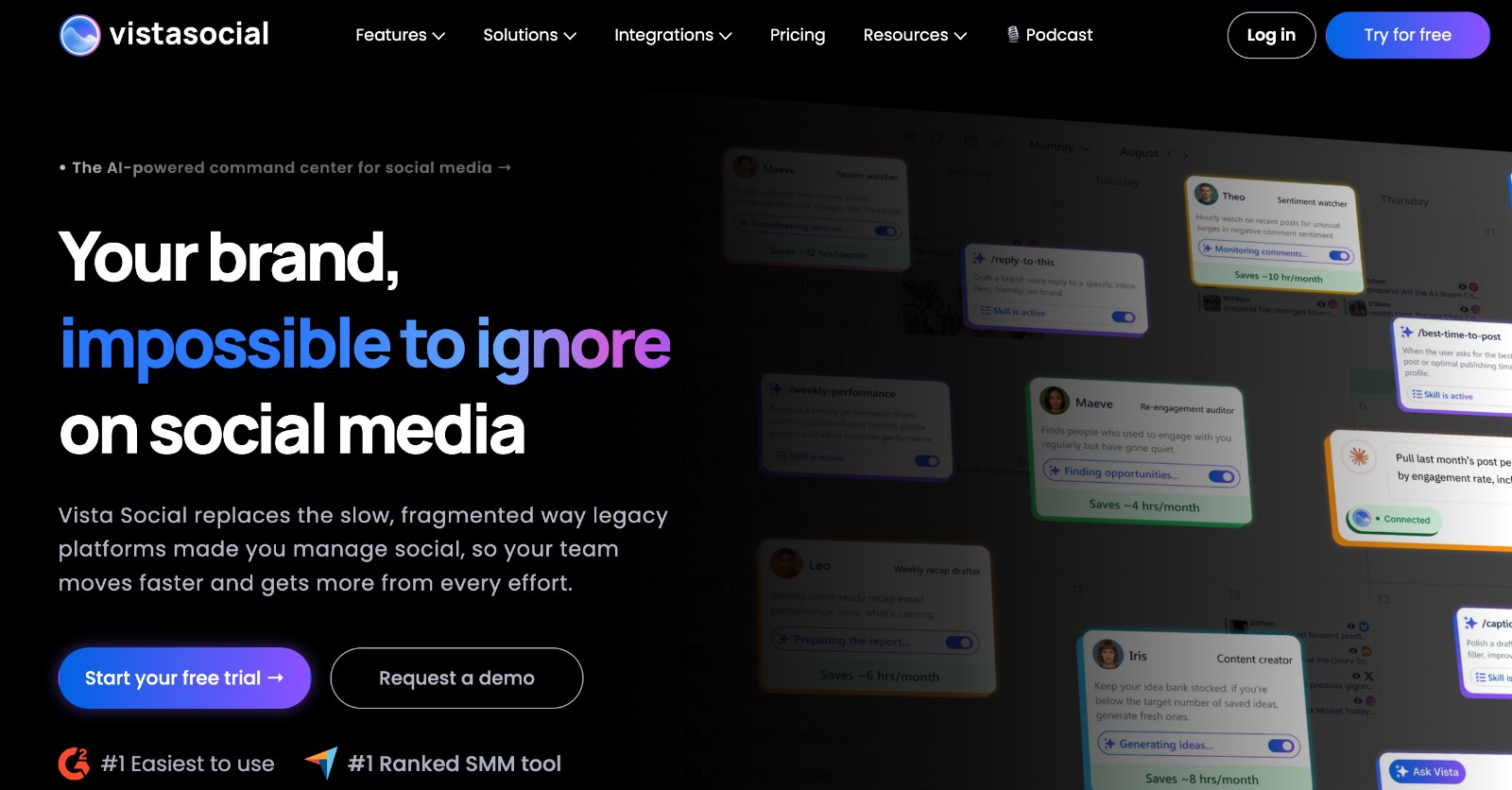
Vista Social keeps turning up on management lists for a reason: it does the whole job at a published price – which in this category is almost a differentiator on its own. Inbox, six review sites (Facebook, Google Business, Yelp, TripAdvisor, OpenTable and Trustpilot), and it is one of only four tools here that publicly documents ad comment moderation, for Meta.
Its listening is priced honestly too, which almost nobody does: free for your own profiles, $75 a month to listen across social, web and news. Two things to budget for. X is a $29 a month add-on on every tier. And Vista Social’s own page claims 20% off yearly billing, which is true on Professional and Advanced but works out at 13% on Scale, so check the numbers – not the banner.
The numbers: Professional $79/mo or $758/year, 15 profiles, 2 users. Advanced $149/mo or $1,430/year, 30 profiles, 4 users. Scale $349/mo or $3,638/year. 14-day trial, no card. No free plan.
10. Sendible
Best for: an agency that has done the seat maths once and never wants to do it again.
Sendible’s pricing page leads with “Unlimited users on all plans” and the whole product is built around that. Client users get their own logins, see only their own dashboards, and Client Connect lets them authorise their own accounts instead of emailing you passwords.
You buy capacity in workspaces of six profiles, so a brand with eight profiles pays for twelve. And because every client is a real login inside your hierarchy rather than a link, the settings that keep clients apart matter more here than anywhere else – the “Also has access to” and “Managed by” fields are one careless click from showing Client A your work for Client B. Note also that Sendible rebuilt its entire plan lineup on 18 August 2026, so anything published before then describes plans that no longer exist.
The numbers: Core $29.75/mo billed yearly ($35 monthly), 1 workspace, 6 profiles, unlimited users. Plus $84.15 ($99), 3 workspaces, 18 profiles. 14-day trial, no card.
11. SocialPilot
Best for: running a lot of client accounts on the smallest realistic budget.
SocialPilot is the only tool here that puts client seats in the pricing table as their own numbered row, which is refreshing – and rare. From Premium up they are unlimited and free.
Below Premium that same row reads zero – which is the part to notice. A one-person agency on Essentials or Standard cannot give a client a login at all. And there’s a second gate people miss: the Social Inbox, comment replies, message replies and approval workflows are all switched off on Essentials, so the real entry price for anything resembling management is Standard at $34 a month, not the $17 on the badge. Reviews are a separate product with separate pricing.
The numbers: Essentials $20/mo monthly, $17 annually, 5 accounts, 1 user, no inbox. Standard $40/$34, 10 accounts, 3 users, inbox. Premium $100/$85, 20 accounts, 6 users, unlimited client seats. Extra accounts $4/mo, extra users $5/mo. 14-day trial, no card.
12. Planable
Best for: approvals, and the cheapest way to get eight people into one tool.
Planable’s whole personality is getting content signed off. Posts render exactly as they’ll look live, feedback happens inline, and there are dedicated Guest and Approver roles, both free, because Planable states flatly: “Planable’s pricing is per workspace, with unlimited users. It’s not priced per seat.”
That makes it the cheapest option in this guide for a team with reviewers, at $33 a month. The meter just moves somewhere else – clients are the unit. Three client workspaces on Basic is $99 a month whether two people use it or forty. Analytics and the social inbox are also paid add-ons on every tier, Enterprise included, so “management” here means planning and approvals more than engagement.
The numbers: Free for your first 50 posts, no time limit, no card. Basic $33 per workspace/mo billed yearly ($39 monthly), 4 social pages. Pro $49 ($59). Analytics +$12, Social Inbox +$7.50 per workspace.
13. Statusbrew
Best for: moderating at volume, with the clearest seat policy in the category.
Statusbrew’s Rule Engine is the nearest thing on this list to automated moderation done properly, and its audit logging is genuinely built for teams that get asked who approved what.
It also writes the sentence every other vendor avoids: “Guest Users do not consume a paid user seat. You can add as many external approvers as needed without affecting your plan’s user count.” Guests review, approve, reject and comment through a shared calendar link or a one-time email link, never entering the main app. No inbox, no analytics, no other clients. That is exactly what an external approver should be – no more, no less.
The permissions are granular in a way that matters: “View Conversations” is a read-only inbox, “View Planner” is a read-only calendar, and a regular user cannot see any report unless you grant it per profile. One oddity: its own meta description advertises “pricing starts at $129/month”, which is the Standard annual rate, not the entry plan.
The numbers: Lite $69/mo billed annually ($89 monthly), 1 user, 5 profiles. Standard $129 ($179), 3 users, 10 profiles. Premium $199 ($299), 6 users, 15 profiles. Agency from $49/mo per client. 14-day trial, no card.
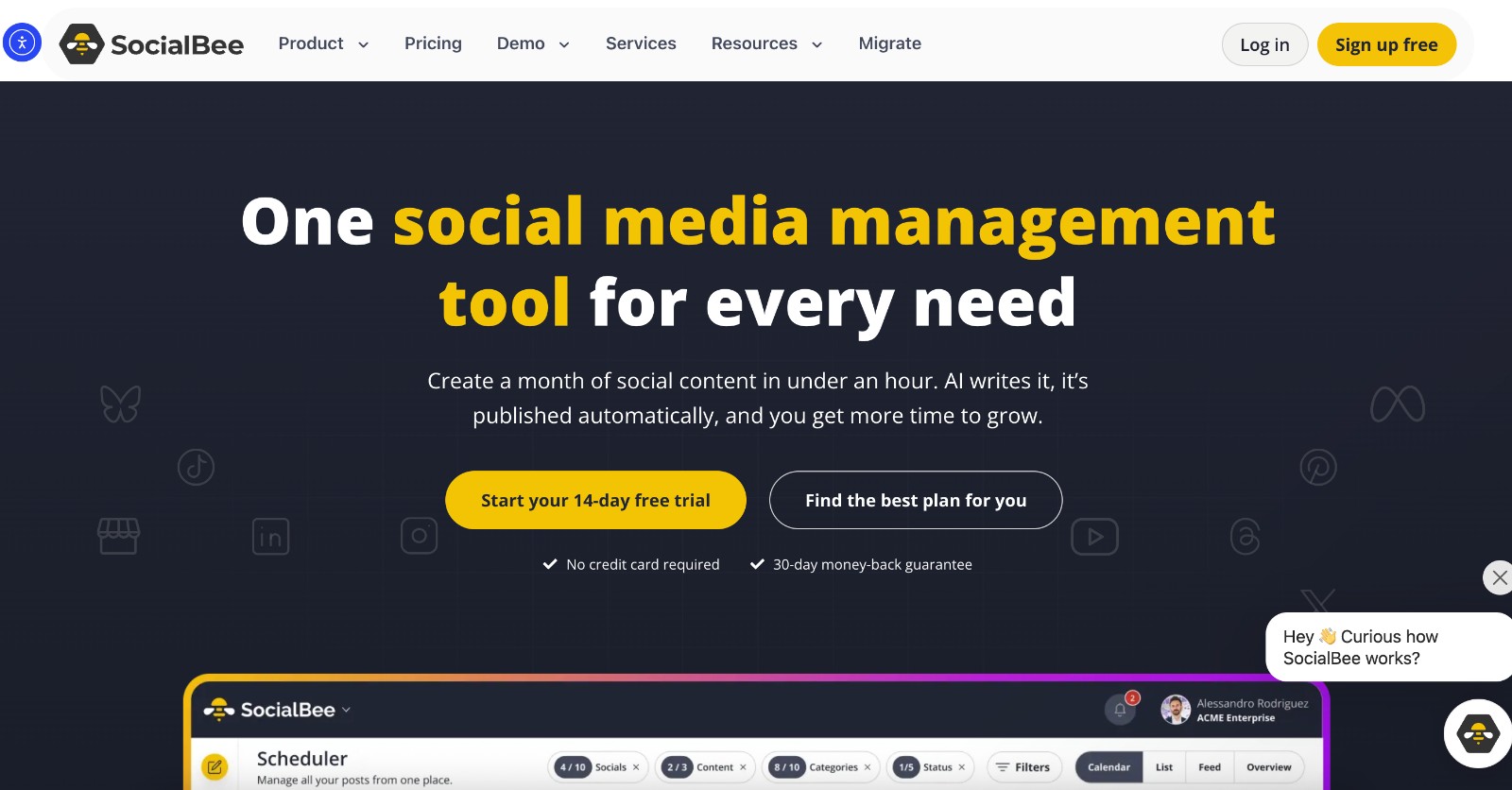
14. SocialBee
Best for: an evergreen library that keeps going out without you touching it.
SocialBee’s category-and-queue recycling is the thing it does better than anything else here. Fill the buckets, set a schedule per bucket, and your back catalogue keeps working.
As a management tool it is thin – and honestly so. There is no view-only role at all – the narrowest role, Contributor, still creates content – so a client who only wants to look has to be given content-creation rights. Bootstrap and Accelerate are capped at one user per workspace. The user allowance is per workspace rather than per account, which sounds generous until you notice the missing viewer role.
The numbers: Bootstrap $24.20/mo billed annually ($29 monthly), 5 profiles, 1 user. Accelerate $40.80 ($49). Pro $82.50 ($99), 25 profiles, 3 users per workspace, 5 workspaces. Extra users $10/mo. 14-day trial of Pro, no card.
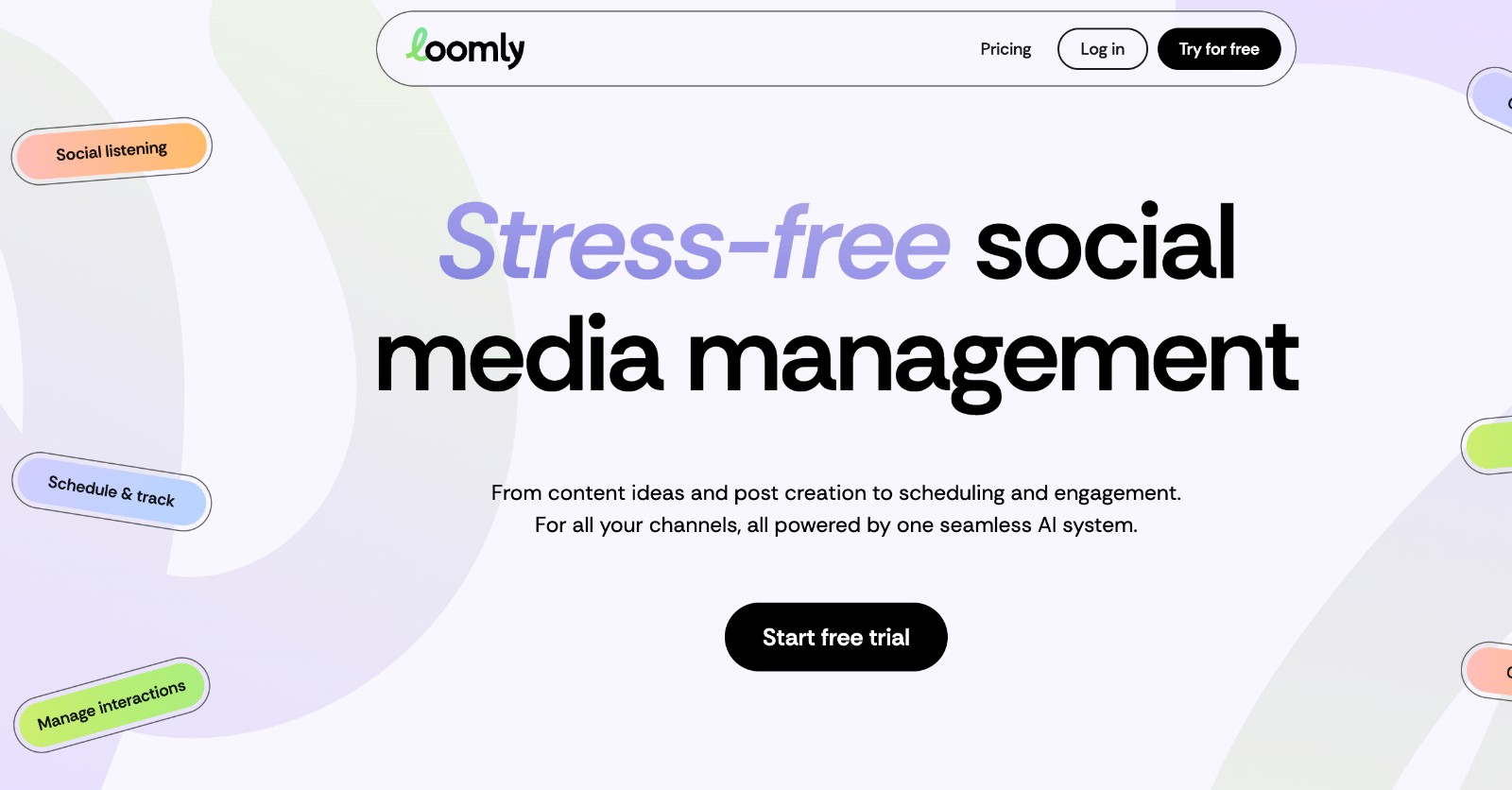
15. Loomly
Best for: a fixed three-person team that will stay a fixed three-person team.
Loomly is pleasant to use and builds post guidance into the composer, which genuinely helps when the person running social is also running three other things. It has five well-defined roles including a real Viewer and a real Client.
And then it charges you for them – all of them. Loomly’s own pricing FAQ: “Each person that would be participating in a calendar (including clients who simply need to approve posts) is considered a user.” Starter includes three users. There is no fourth seat to buy. The next published plan is Beyond at $249 a month. So a three-person team that signs one client with two approvers goes from $49 to $249, a five-fold jump caused entirely by two people who will never write a post.
Loomly has been a Bending Spoons property since January 2025 and its marketing blog has been silent since that month, though the help centre is maintained.
The numbers: Starter $49/mo billed yearly ($65 monthly), 12 accounts, 3 users. Beyond $249/mo yearly ($332), 60 accounts, unlimited users. Trial with no card, length not stated on the page.
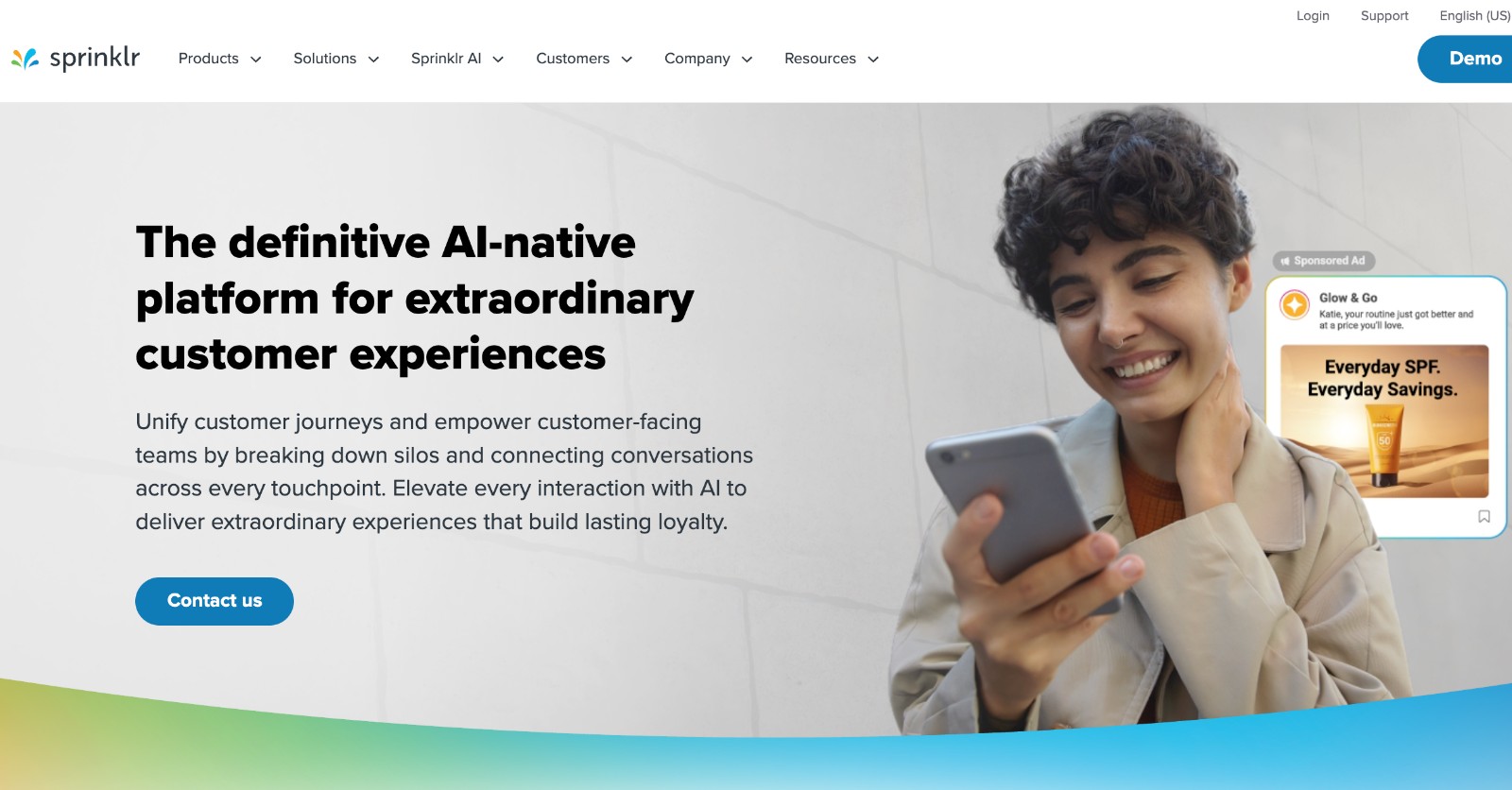
16. Sprinklr
Best for: enterprises with a procurement department and a governance problem.
Sprinklr has the deepest ad comment moderation here, across Reddit, Facebook, Instagram, TikTok, YouTube, X, LinkedIn, Pinterest and TikTok, and “across organic, boosted, and dark sponsored post types”. Its listening suite is the most serious in this guide.
The important 2026 fact is commercial – not technical. Sprinklr has discontinued self-serve. Its own page says so: “Self-Serve products have been discontinued,” with existing customers running “until the end of service on April 30, 2026”. There is no trial, no published price, and both `/pricing` URLs return 404. Note too that ad comment moderation is a separately licensed module and listening lives in a different suite again, so “all-in-one” here means several products on one contract.
The numbers: none published. Quote only, via a demo.
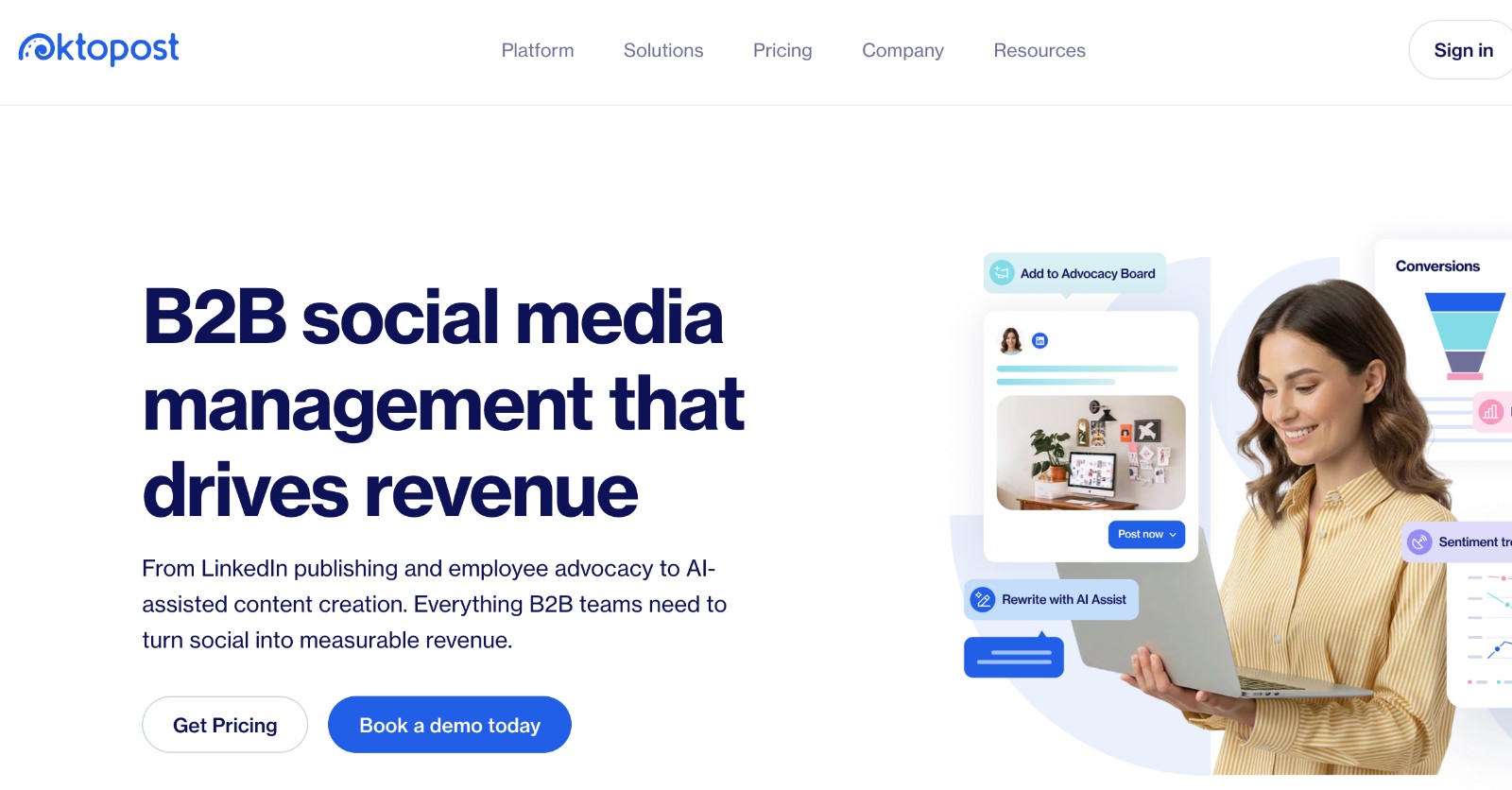
17. Oktopost
Best for: B2B teams who have to show social’s effect on pipeline.
Oktopost is built for a job the rest of this list barely acknowledges: connecting social activity to a CRM. Salesforce, HubSpot and Marketo sync, lead conversion tracking, employee advocacy, and enterprise identity handling with SAML SSO and SCIM provisioning on both published plans.
It is also the only tool here that explicitly refuses to charge per profile: “Connect as many company pages and accounts as you need – no per-profile fees.” Users are the meter instead. Reviews are absent from the published feature set entirely, and what the plans call listening is really keyword streams, with true listening sold separately.
The numbers: Professional from $499/mo, Advanced from $799/mo, both billed annually. Both prices carry a “from”, and Oktopost says “final quote depends on team size and add-ons”. No trial or free tier published.
18. SOCi
Best for: franchises and chains running social across hundreds of locations.
SOCi is a different category of product that keeps landing on these lists because multi-location brands genuinely need it. Reviews, local listings and local social, run largely by AI agents that escalate exceptions to a human, with a compliance layer that blocks publishing until issues are cleared.
It is priced per location, not per seat, and it publishes no prices at all – the pricing URL redirects to a demo form. SOCi describes its buyer as brands with “dozens to thousands of locations”, so if you have one location this isn’t for you. The product line was renamed to Genius Agents in 2026.
The numbers: none published. Quote only.
Also worth knowing about
Tools that show up on other lists and didn’t make this one, with the honest reason. Birdeye and Reputation are reputation platforms where social is one module, priced per location through a lead form. Brandwatch, Socialinsider and Keyhole are listening and analytics products that don’t publish prices at all. HeyOrca, Kontentino and MavSocial are approval-led planners that overlap heavily with Planable at similar money. Simplified and Nuelink are content-creation tools with scheduling attached rather than management suites.
Social media management for teams
Moderation, automation, analytics, reporting, scheduling, and more. Save tons of your time spent on marketing tasks – with an all-in-one social media tool designed specifically for teams.
What a client or a read-only seat actually costs you
This is the section every other comparison skips, and it’s the one that decides your invoice.
You know how many people are on your team. What you probably haven’t priced is everyone else: the client who approves the monthly plan, the brand manager who reads the report, the compliance person who has to see the post before it goes out. None of them will ever write a caption – not one. On some tools they’re free. On others they are not. On others they cost exactly the same as your head of social.
The word “Guest” is not a signal. Agorapulse has a Guest role and it’s a full-price paid seat. Planable has a Guest role and it’s free. Statusbrew has a Guest role and it’s free. Same word, opposite invoice.
| Tool | Free view-only or client access? | The vendor’s own words |
|---|---|---|
| Statusbrew | Yes, explicitly, unlimited | “Guest Users do not consume a paid user seat. You can add as many external approvers as needed without affecting your plan’s user count.” |
| Planable | Yes, everyone is free | “Planable’s pricing is per workspace, with unlimited users. It’s not priced per seat.” |
| Sendible | Yes, everyone is free | “Unlimited users on all plans.” |
| Zoho Social | Yes, clients are free | “Provide a free log in and Custom view for clients.” (Premium and Agency) |
| SocialPilot | Yes, from Premium. Zero below it | Client Seats row: 0 / 0 / Unlimited / Unlimited |
| Buffer | Yes, users are free, but “View Only” only exists in Community | “The Team plan allows you to invite unlimited users to your organization.” |
| Metricool | Yes, via a link with no account | “Anyone with the link can open and explore the view without needing a Metricool account.” |
| Later | Yes, for link-based reviewers | “You can also share posts with external reviewers who don’t have a Later account.” |
| Agorapulse | Guest costs a seat. Free route is the Shared Calendar, Advanced tier and up | “Social profile roles, including Guest, can only be assigned to a user with a Paid seat.” |
| NapoleonCat | No, a Client uses a paid user slot | “Clients: they play a more limited role, being able to approve, reject, and comment on content drafts in the Publisher.” |
| Sprout Social | No | “Read Only” is a permission on a paid seat. No exempt role documented |
| Loomly | No, explicitly | “Each person that would be participating in a calendar (including clients who simply need to approve posts) is considered a user.” |
| SocialBee | No view-only role exists at all | Narrowest role, Contributor, still creates content |
| Hootsuite | Not documented | “Hootsuite plans are sold per user (or ‘seat’)” |
One more thing worth knowing before you build a process on the free options. The free reviewer is usually a link, not a role. Later, Metricool Studio, Statusbrew and Agorapulse’s Shared Calendar all work by sending an unauthenticated or single-use link rather than creating a cheap account. That’s fine for most teams and unacceptable for some – Later states plainly that its review links “expire 7 days after they’re created and aren’t password-protected”. If your client works in finance or healthcare, ask before you promise – the answer is in the small print, not the sales deck.
What five people and three reviewers actually cost
Same job, same eight humans: five staff who work in the tool, three outsiders who look and approve. List prices, annual billing where the vendor offers it, and where a free-reviewer route is gated behind a tier, we’ve priced the tier that makes it possible.
| Tool | How it adds up | Per month |
|---|---|---|
| Planable Basic | $33 per workspace, all 8 people free | $33 |
| Sendible Core | $35 at the monthly rate, 8 users at $0 | $35 |
| Later Growth | $37.50 + 3 extra users at $3.75, reviewers free by link | $48.75 |
| Metricool Advanced | $53, unlimited team members, reviewers free by link | $53 |
| Buffer Team | $12 per channel, people free. At 5 channels | $60 |
| SocialPilot Premium | $85, 6 user seats, unlimited free client seats | $85 |
| NapoleonCat | a Client uses a seat, so all eight people need slots: 10 users and 20 profiles | $249 |
| Loomly | Starter stops at 3 users. Next published plan is Beyond | $249 |
| Agorapulse Advanced | 5 users at $149, reviewers free via Shared Calendar | $745 |
| Hootsuite Standard | 8 seats at $99, no free role documented | $792 |
| Sprout Social Professional | 8 seats at $299 | $2,392 |
From $33 to $2,392 for the same eight people. That’s a 72-fold spread, and almost none of it is features. Planable and Sendible are cheap because people are free. Buffer is cheap because the meter is channels. Metricool is cheap because the reviewer never gets an account. Sprout is expensive because every human is a seat – and there is no exception.
The question to ask a salesperson, in these words: does the person who only approves cost me the same as the person who publishes? Write down the answer – and get it in writing.
Does the inbox actually cover ads and reviews, or just organic posts?
“Unified inbox” is on every one of these websites. What it unifies varies a lot – and the two things that quietly fall outside it are the two that cause the most trouble: comments under paid posts, and Google reviews.
Ad comments matter because a boosted post can pull ten times the comment volume of an organic one, and dark posts don’t appear on your page at all, so you will never see them unless the tool syncs them. Reviews matter because they’re the ones that show up in search results.
Here’s who documents what:
| Tool | Ad comments | Reviews in the inbox |
|---|---|---|
| NapoleonCat | Yes, Facebook, Instagram, TikTok and YouTube | Yes, Google reviews in the Social Inbox |
| Agorapulse | Yes, Facebook, Instagram, LinkedIn and TikTok, from Professional up | Yes |
| Sprinklr | Yes, the broadest, but it’s a separately licensed module | Via the listening suite, not the social product |
| Vista Social | Yes, Meta only | Yes, on a separate Reviews surface |
| Sprout Social | Not documented | Yes, 8 sources, replies from 7 |
| SocialPilot | Not documented | Google questions only, reviews are a separate product |
| SOCi and Birdeye | Not documented | Yes, and it’s the core of both products |
| Oktopost | Not documented | No, reviews are absent from the feature list |
Agorapulse also publishes the limits nobody else does, and they’re worth reading before you assume “synced” means “all of it”: Instagram is capped at 2,000 posts and 200 comments per post, Facebook uses a rolling 32-day window, only ads with Active status sync at all, and dynamic ads can’t be replied to.
Which of these really do social listening?
Short answer: fewer than the marketing suggests – and it’s usually an add-on.
- Real open-web listening: Sprinklr (a separate suite, Sprinklr Insights), Vista Social ($75 a month on top, and the only published listening price here), Oktopost (a separate product, 75 million websites, 115 languages).
- Keyword and mention monitoring, sold as listening: Later (Scale tier, Instagram only, desktop only), Metricool, Iconosquare.
- A paid add-on with no published price: Sprout Social lists Listening as an add-on on Standard and above without a number. Agorapulse’s Advanced Listening requires booking a demo. Hootsuite’s real listening is Talkwalker, a separate product.
- None: Buffer doesn’t mention listening on its pricing page at all. SocialPilot has no listening row in its comparison table.
The reason is worth knowing, and Zapier says it out loud on its own page: platform API access for listening now “can cost thousands of dollars per month”. After X moved to per-call API pricing, listening became something vendors buy rather than build, and they pass that through.
What happens to your data when you cancel
Nobody writes about this – and everybody eventually needs it. We went looking for a published answer from every vendor here about what happens to your scheduled posts, inbox history and reports when a subscription ends.
Almost nothing exists – which is its own answer. Agorapulse’s cancellation article says only that access ends at the end of the billing cycle, and its account-deletion article warns that deletion “cannot be reversed” with no grace period documented and no export step described. Hootsuite’s export documentation sits behind a login. For Sprout Social, Buffer, Later, Planable and Metricool we could not find a published statement at all.
Two practical things to do in the trial, before you have three years of conversation history in there. Export a report and an inbox archive, and see whether the format is usable. And ask, in writing, how long your data is retained after cancellation.
Security and compliance, since somebody will ask
If you’re in a regulated industry or selling to one, this is the section your procurement team cares about, and it’s the one every listicle omits – including, until now, ours.
- Sprout Social publishes the fullest position: a SOC 2 Type 2 audit completed regularly, ISO/IEC 27001 certification, and ISO/IEC 27701 for privacy.
- Hootsuite publishes SOC 2 Type II, a downloadable SOC 3, UK Cyber Essentials and FedRAMP Tailored. Note the wording: its policies follow ISO 27001, but it doesn’t claim the certification.
- Agorapulse says it worked with Vanta to become “SOC 2 compliant” without specifying Type 1 or Type 2, and carries an ISO 27001 badge with no supporting detail.
- Buffer, Later, Metricool, Planable and Sendible publish no trust centre we could find.
- NapoleonCat is EU-based with EU-hosted data, which is usually the first question a European buyer asks and one a US-hosted vendor cannot answer with a yes.
Which one, by team shape
If you’re a small team or a small business
You’ll be hurt most by per-seat pricing, because the second and third person double and triple the bill. So the best social media management tools for small business are the ones that include a team rather than selling you one. On NapoleonCat, going from two people to five costs $60 a month, not another $99 per head. Look at NapoleonCat if comments and messages are a real part of the job, Buffer if you mostly publish and want the bill to stay flat as the team grows, Metricool if you’re measuring several brands, and Zoho Social if you’re already in the Zoho suite.
Avoid anything that charges from seat one until you know exactly how many seats you need.
If you’re an agency
Your meter should be clients – not colleagues. That is the one thing that separates good social media management tools for agencies from expensive ones. Sendible and Planable both give you unlimited users, SocialPilot gives unlimited free client seats from Premium, and Statusbrew gives unlimited free external approvers on any plan. Check three things before signing: whether client data is genuinely walled off, whether reviewers cost a seat, and what white-label reporting costs on top.
If you’re enterprise or regulated
You’re buying governance – not features. Sprinklr for depth and breadth if you have the procurement cycle for it, Hootsuite for departmental structure and published compliance, Oktopost if the goal is pipeline attribution in B2B, SOCi if you’re multi-location. Ask about data residency early, ask for the SOC 2 report rather than the badge, and price approval workflows deliberately, because on some tools they sit two tiers above where you expected.
Social media management tools: your questions, answered
What are social media management tools?
Software that puts publishing, engagement, analytics and team permissions for several social accounts into one place. Some are pitched as social media campaign management tools, some as social media posting software, but the shape is the same. You’ll see the same category sold as social media management software, a social media management platform, a social media manager tool, a social media manager app, or just social media tools. Some vendors file it under social media content management instead. Same job, different shelf.
The difference from a plain scheduler is what happens after the post goes live: the inbox, the replies, the reviews, and who on your team is allowed to touch them.
What’s the difference between a social media management tool and a scheduler?
A scheduler gets the post out – that’s the whole job. A management tool handles everything the post causes. If your main problem is finding time to publish consistently, you want a scheduler and you can spend a lot less. If your main problem is 200 comments, three angry DMs and a client who wants a report, you want a management platform. We have a separate guide to social media scheduling tools if it’s the first one.
What’s the best social media management tool for teams?
The best social media management software for a team is the one whose billing model matches that team’s shape. If you’re mostly internal staff who all work in the tool, per-user pricing may be fine. If half the people involved only approve or read, you want a tool where those seats are free, which today means Statusbrew, Planable, Sendible, SocialPilot from Premium, or Zoho Social for clients. NapoleonCat includes two users in the entry plan and separates clients from staff with a dedicated role.
Are there free social media management tools?
There are usable permanent free tiers from Buffer (3 channels, 10 queued posts, 1 user), Metricool (1 brand, 20 posts a month, no LinkedIn or X), Zoho Social (1 brand, 6 channels, 1 member) and CoSchedule (1 profile, 15 posts). All are single-user, so none of them work for a team. For teams, “free” in this category means a trial, usually 14 to 30 days.
How much does social media management software cost?
For one or two people, $10 to $50 a month covers most needs. Prices for social media manager software cluster tightly at the bottom and spread wildly at the top, because the cheap plans all sell you one seat and the expensive ones sell you many. For a team of five with a few reviewers, the honest range is $33 to $2,392 a month depending entirely on whether the vendor charges per person. Enterprise platforms like Sprinklr, SOCi and Birdeye publish no prices at all and start with a demo.
Which are the best social media management tools for small business?
Look for a plan that includes more than one user, covers the networks you actually use, and handles comments as well as posts. Small teams get hit hardest by per-seat pricing, because a three-person team on Hootsuite Standard is $297 a month before anyone connects an eleventh account.
What should social media management tools for agencies do?
Wall off each client’s data, let clients approve without costing you a seat, produce a report with your logo on it, and let you add an account without moving up a tier. Ask specifically whether client logins are counted as users, because that single answer changes the price by an order of magnitude.
What’s the difference between social media tools and a full management platform?
Most things sold as social media tools do one job well: publishing, or analytics, or link-in-bio. Social media management platforms try to cover publishing, engagement, reporting and permissions in one login. The trade is depth against convenience, and it usually shows up in the inbox, which is the hardest of the four to build. If you already have tools for managing social media that work, the question is whether one login is worth switching for.
Do these tools handle comments on ads?
Some do, most don’t say. NapoleonCat covers Facebook, Instagram, TikTok and YouTube ad comments. Agorapulse covers Facebook, Instagram, LinkedIn and TikTok from its Professional plan. Sprinklr covers the most networks but sells it as a separate module. Everyone else either doesn’t document it or doesn’t do it.
Can I manage all my social media accounts in one place?
Yes for publishing and messages, with caveats that come from the networks rather than the tools. Our guide to managing all social media in one place walks through what that looks like day to day. Facebook Groups can’t be managed by any third-party tool since Meta removed that API in April 2024, and some Instagram Story formats can’t be published automatically by anyone.
How many users do I get, and what does an extra one cost?
It varies more than any other spec – by a distance. Hootsuite and Sprout Social include zero and charge full price per seat. Later includes 1, 2 or 4 and charges $3.75 to $5 for extras. Zoho Social charges $10 to $12. SocialBee charges $10. Planable, Sendible and Buffer include unlimited people. NapoleonCat sells users and profiles in published steps rather than per seat: 2 users and 5 profiles at $89, 5 and 10 at $149, 10 and 20 at $249 on the Standard plan.
Do I need social listening?
Probably not, unless someone is asking you what people say about the brand where you’re not tagged. Mention monitoring, which is included almost everywhere, catches conversations that name you. Real listening scans the open web, and it is genuinely expensive: a paid add-on nearly everywhere, and a separate product at Hootsuite and Sprinklr.
What happens to my data if I switch tools?
Assume you’re responsible for it – because you are. Export your reports and your inbox history before you cancel – not after. Most vendors here publish nothing about retention after cancellation, and at least one documents that account deletion is immediate and irreversible.
Social media management for teams
Moderation, automation, analytics, reporting, scheduling, and more. Save tons of your time spent on marketing tasks – with an all-in-one social media tool designed specifically for teams.