
How Social Media Shapes Buying Decisions in the UK

Discover how UK 🇬🇧 consumers interact with brands on platforms like Facebook, Instagram, YouTube, and TikTok, and transform your social media strategy.
Table of contents
- Experts’ perspective
- What you’ll learn from this report
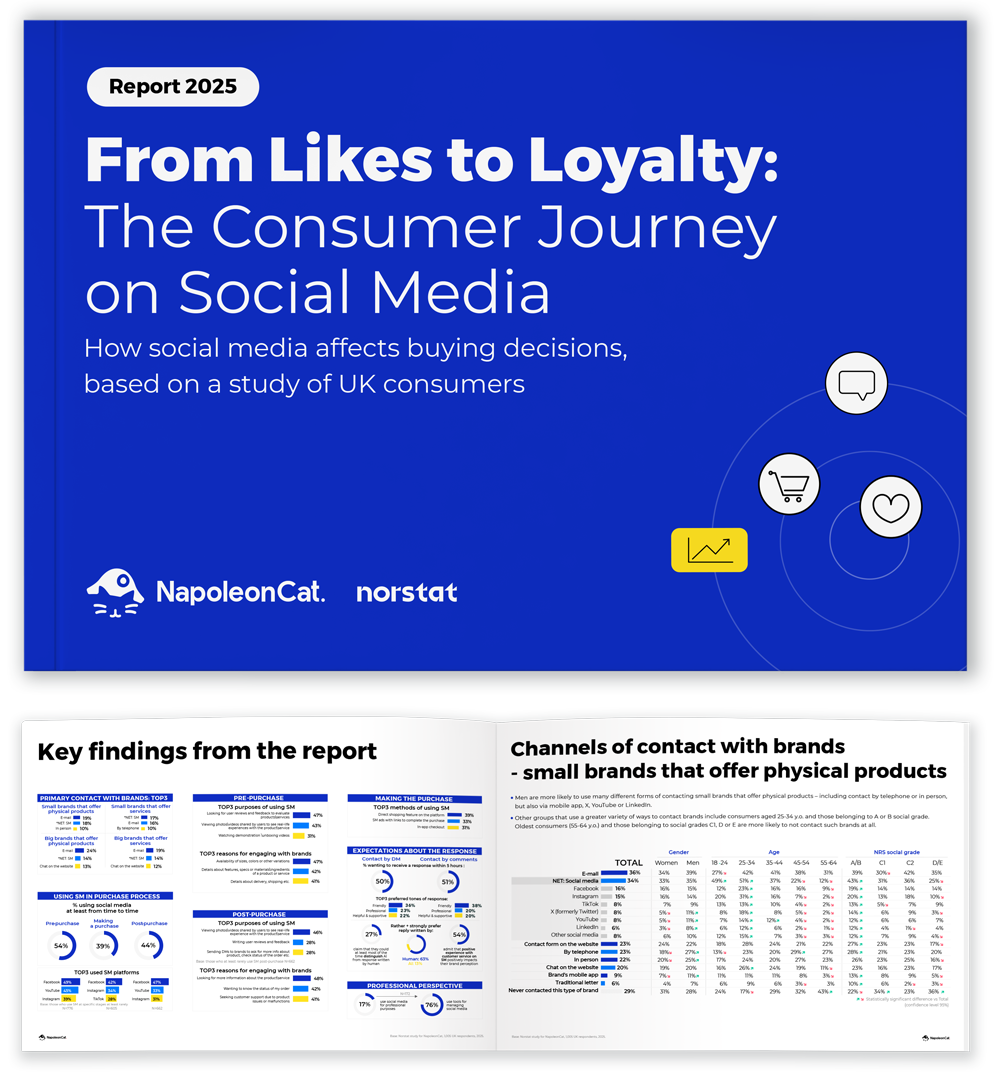
- Key findings from the report
- Close-up on how and why Brits use social media to connect with brands
- Why brands need to reconsider their social media customer service strategy
- Summary: Social media is an integral part of the entire customer experience
- Research methodology

Greg Berezowski
An entrepreneur, founder, and CEO of NapoleonCat
An entrepreneur, founder, and CEO of NapoleonCat – a leading customer engagement and support platform designed to help businesses manage social media interactions, automate moderation, and improve customer service efficiency. With a passion for innovation and technology, he has built a company that empowers brands to streamline their digital communication and enhance customer relationships.
Greg’s perspective on..
Evolving brand strategies for instant engagement
Social media has become a cornerstone of how people shop and interact with brands today. Consumers frequently turn to platforms like Facebook, Instagram, and YouTube to explore reviews, watch product demonstrations, and ask questions before making a purchase. They expect quick, friendly responses—often within hours—and increasingly value interactions that feel personal and human.
Meeting customer expectations for fast communication
For businesses, this shift highlights the importance of being present and responsive across multiple platforms. The challenge lies in balancing speed with quality, ensuring that customers feel heard and valued. Leveraging tools to manage social media interactions efficiently can help, allowing businesses to automate routine tasks while focusing on meaningful, personalized conversations.
Why real-time engagement matters more than ever
Adapting to these evolving expectations is no longer optional—it’s essential for building trust, improving the customer experience, and ultimately driving growth in a highly competitive market

Mick Griffin
Mick has been working in the tech ecosystem for over 15 years for companies such
as GetResponse, Brand24 and now TRAFFIT.
As Chief Growth Officer at TRAFFIT, Mick found that we have a space in recruitment where both candidates and hirers are feeling ncomfortable. With his amazing team at TRAFFIT he wants to fix this problem, and make recruitment processes enjoyable for everyone involved by providing both tools and education.
Mick’s perspective on..
Strategies for inter-team collaboration on social media across pre-sale, sale, and post-sale interactions
This should be a mixture of technology and communication. The first priority is the customer experience, so using tools like CRMs, customer interactions must be stored and accessible. Customers should feel they are ‘building’ relationships with you. If they have to re-explain their situation every time they contact your brand, there is zero difference between you and them talking to your competition. Every Time they start a new conversation, the team member should be able to quickly look at previous communication.
The second element is communication and internal values. Everyone has to feel responsible for the customer and their experience. I saw so many times that sales were empathetic, and then suddenly, post-sales or even accounting were not, and the customer lost. Ensure internally that you meet with all your customer-facing teams together, you workshop topics, and you keep them in the same cultural direction.
Changes small brands should consider competing with large brands in social media
It’s the best time ever to be a small brand on social media. Because you can pivot quickly and you can make being human your USP. As a small business, give more time to your audience. When someone asks a question or comments on your post as a small business, the goal is not to solve it as quickly as possible. When you answer the question they had, ask them nother one. Try to prolong the experience and learn more about your customers. Doing this will beat the big brand, whose only goal will be to solve the issue as quickly as possible and move to the next customer.
How recognizing AI responses affects automated customer service
Massively. We have to separate value and trust. You can generate value and break trust at the same time. However, without trust, you cannot make the sale. My recommendation is to be pen about AI so customers feel they are making their own choices on how to communicate and with whom.
The future impact of AI on social media interactions
I think it will be huge. This isn’t something new in many ways. For years, you have had the option to buy likes, comments etc. In the past, it was bots, in the future, it will be AI. The question will be if the social networks will try to clamp down on AI interaction, or possibly even encourage it or sell this as a feature.

Natalia Kossut-Kaczmarek
Marketing, PR & E-commerce expert with over 20 years of experience. Graduated from Warsaw School of Economics (SGH) and Linköping Universit in Sweden. Cooperated with United PR, Wittchen and OCHNIK. As CMO & e-commerce director, specializes in brand image creation and awareness, overseeing marketing campaigns, social media activities, customer service, and development of e-commerce strategy.
Natalia’s perspective on..
The role of social media in the customer buying process
Social media has evolved into a multifunctional tool across the entire customer journey, serving distinct purposes at each stage. Business experience and data show that a growing number of consumers use social platforms in the pre-purchase phase, with usage continuing through the purchase and post-purchase stages
Key channels in customer-brand communication
While email remains the dominant communication channel across different brand types, social media is gaining significance as consumers seek faster responses and more direct interaction. Facebook leads among social platforms, followed by Instagram, YouTube, and TikTok, which are showing growing importance.
Intersection of e-commerce and social media
A notable trend is the emergence of social platforms as search engines, particularly among younger generations. 25% of consumers prefer searching for brands on social media over raditional search engines, while 21% use platforms to find answers to their questions. Social commerce is becoming increasingly prominent, with platforms serving as both influence hannels and direct sales points. The transformation of social media into customer service hubs is evident, with consumers using these channels for various post-purchase interactions, including delivery tracking, returns, or product complaints.
Factors influencing channel preferences among consumers
Demographic factors significantly influence channel preferences, with the 25-34 age group showing the highest engagement. Importantly, the growing online presence of the 50+ eneration is emerging as a significant market force, requiring specific attention in social media strategies

Magdalena Bochyńska
Magdalena Bochyńska leads the Vasco social Media and Influencer Marketing team, driving innovative campaigns that showcase the company’s goal of breaking down language barriers with advanced translation devices.
As an enthusiastic marketing leader, Magdalena uses smart planning and creativity to guide an international team that produces effective content in 17 countries and four continents. Her team’s efforts have helped increase the visibility of Vasco’s top products, like the Vasco Translator V4 and Vasco Translator E1.
Magdalena’s perspective on…
The role social media plays in sales at her company
At Vasco, we understand how important social media is in our customers’ buying process. In 2024 alone, almost 20% of our direct sales came from social media campaigns. This lighlights the need for a careful approach to managing our online community and understanding customer behavior in this area.
Factors making a difference in social customer care
Responding quickly to comments and messages is key for us. Today’s customers expect fast support at every stage of the buying process – from discovering products to making decisions and even after buying.
It’s also important to use smart automation tools, such as Auto-moderation, which help us handle many interactions efficiently while keeping our communications genuine and empathetic. This also gives our team valuable time to focus on other parts of the campaign.
Overall, our experience shows that quick responses and the right support through social media not only lead to more sales but also let us hear directly from our clients about their needs. Therefore, social media is not just a tool for sales; it’s a way to connect with our customers and build lasting relationships.
What you’ll learn from this report
The report you’re holding in your hands – or, more likely, reading on your screen, whether big or small – looks into consumers in the UK and how they interact with brand
on social media during the purchase process.
Perhaps more importantly, it’s also full of pointers for your brand regarding the customer service on social media that today’s consumers expect and appreciate.
As you’ll see from the results, social media plays a growing role in the buying process, and not just as part of marketing, but an essential part of a brand’s customer service and the overall customer experience.
The report looks in detail at:
- What stages of the buying process social media have the most significant impact on
- What that looks like for different consumer demographics across the UK, different social media platforms, and different types of brands
- And what exactly consumers expect from customer service on social media that brands need to be prepared for.
On the following pages, you’ll find an in-depth look at how British consumers use social media before, during, and after buying products and services and what that means for your business.
Hoping you find it a valuable read,
The NapoleonCat team
Key findings from the report
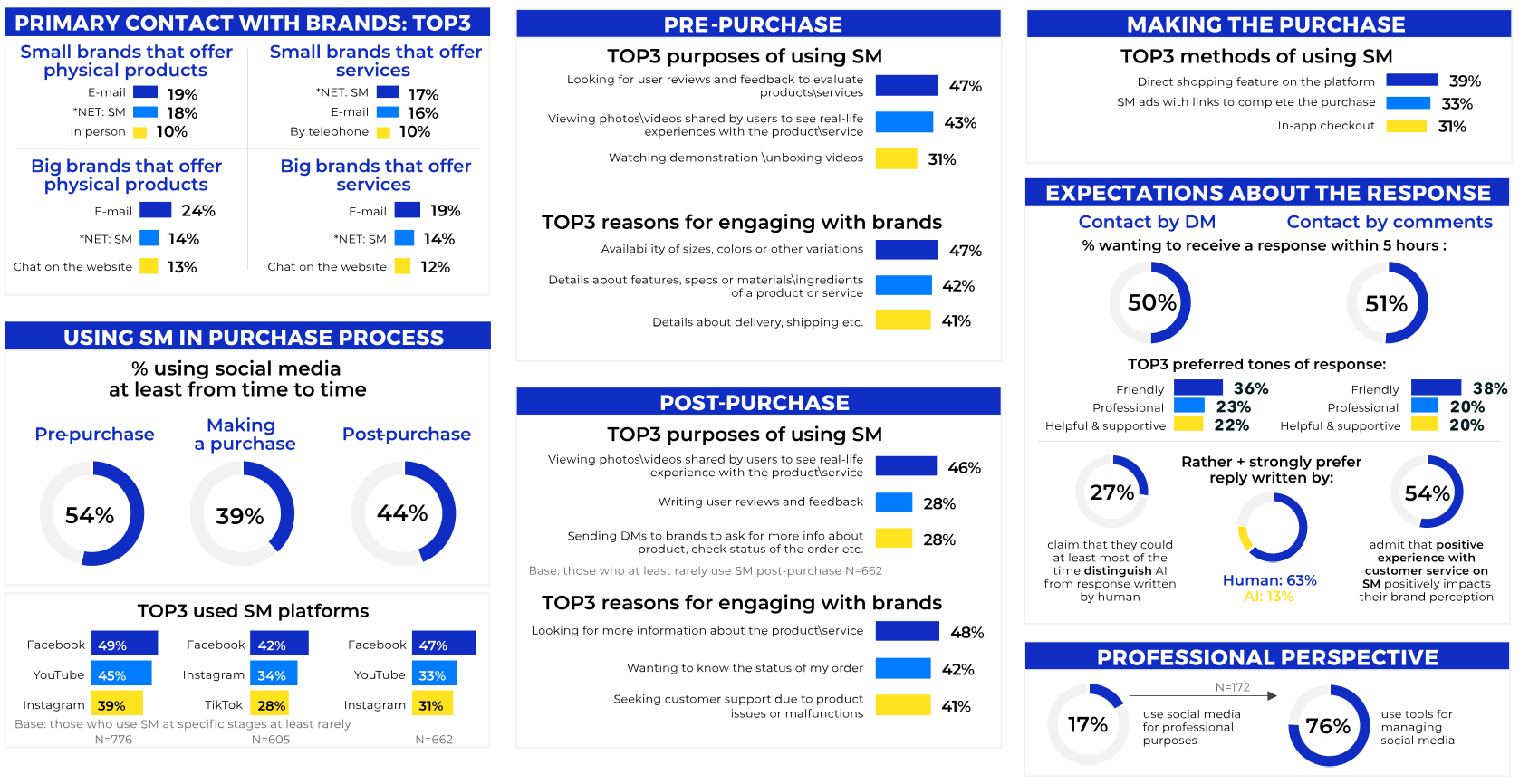
Social media is one of the top ways consumers contact brands in the UK
According to the study, consumers in the UK use a variety of channels to contact brands. While email is still an important channel of communication for many, social media platforms are next on the podium, with Facebook and Instagram being used the most often.
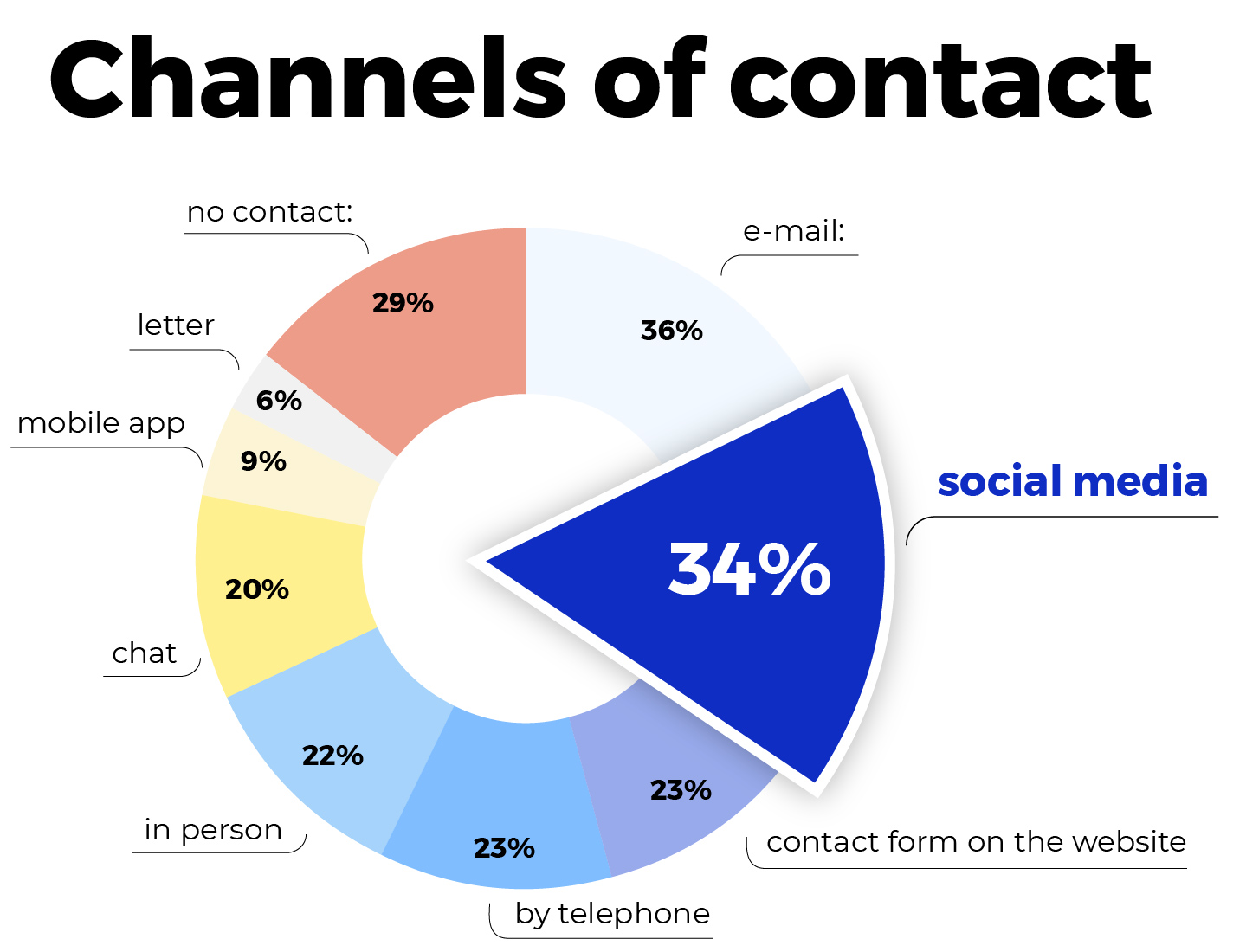
The diagram below shows the channels consumers use at least from time to time to contact brands, and overall, social media is used more than website contact forms or chats.
This is a clear indication that social media needs to be an integral part of your customer service strategy.
This tendency prevails regardless of the size and type of brand, though it’s definitely the most pronounced among consumers of small brands offering physical products, with slightly smaller percentages for brands offering services, whether big or small.
As you can see from the diagrams (p. 13, p. 14, p. 15, p. 16) below, there’s also a clear tendency to use social media among younger consumers, gradually declining across the age groups that follow
Channels of contact with brands
- British consumers are most likely to contact brands by e-mail – regardless of whether it is a small or a big brand and whether it offers physical products or services. Second post popular are social media – although in case of big brands they are almost on par with chats on the website.
- Other commonly chosen channels include online contact forms, telephone or in person

Channels of contact with brands – small brands that offer physical products
- Men are more likely to use many different forms of contacting small brands that offer physical products – including contact by telephone or in person, but also via mobile app, X, YouTube or LinkedIn.
- Other groups that use a greater variety of ways to contact brands include consumers aged 25-34 y.o. and those belonging to A or B social grade. Oldest consumers (55-64 y.o.) and those belonging to social grades C1, D or E are more likely to not contact such brands at all

Channels of contact with brands – big brands that offer physical products
- Also when it comes to bigger brands that offer physical products, consumers aged 25-34 y.o. and those belonging to social grades A or B are more likely to contact brands and in variety of ways, while oldest consumers (55-64 y.o.) are least likely to contact such brands.
- Men more often than all British consumers contact big brands that offer physical products via telephone and traditional letters, but also via social media, especially YouTube or LinkedIn

Channels of contact with brands – small brands that offer services
- Similarly with small brands that offer services: consumers between 25 and 34 y.o. most often contact brands and in many different ways, just like those belonging to social grades A and B. The opposite is true or oldest consumers (55-64 y.o.) and those belonging to social grades D or E – they are more likely to not contact such brands at all.
- Interestingly, 18-24 y.o. more often than all British consumers use Instagram to get in touch with small brands that offer services.

Channels of contact with brands – big brands that offer services
- The situation is similar with big brands that offer services: 25-34 y.o. and consumers belonging to social grades A or B are most likely to contact such brands in variety of ways, while the oldest group (55-65 y.o.) and those from social grades D or E are enerally less likely to contact brands of this type.
- Men more often than all British consumers contact such brands in person, via mobile app or traditional letters, but also via social media, especially X, YouTube, TikTok or LinkedIn

Consumers who use the most popular social media platforms – Facebook, Instagram, TikTok, or YouTube – as their primary point of contact are generally more likely to use social media at all stages of the buying process.
Social media is the preferred contact channel for more people than chats or contact forms. Ergo, it’s not something you can ignore
Channels of contact with brands – most often chosen channel
- When asked about most often chosen channel, e-mail is still on top of the list when it comes to contacting brands – no matter the brand type. But especially in case of smaller brands, it is followed by social media platforms.
- In case of small brands getting in touch in person or by telephone is more popular, while for bigger brands using tools available on websites (like contact forms and online chats) is more likely chosen

When it comes to customer service, expectations are high on social media
Approximately half of British consumers (54%) admit that a positive experience with customer service on social media improves their opinion of the brand or company.
The results clearly confirm that the impact of social media goes way beyond marketing and advertising. A large portion of its impact lies in the overall experience customers have with your brand at any stage of the buying process.
Interestingly, a positive customer service experience on social media seems to have a slightly smaller impact on men’s perception of a brand than in the case of women.
Whether consumers contact brands via direct messages or by commenting on their official content, approximately half expect a response within 5 hours of reaching out. This is not just connected to post-purchase complaints but also questions happening before buying that might affect their decision.
It’s also clear that consumers care not only about the time it takes for a brand to respond to their DM or comment but also about the channels. If they leave a comment on a social media post or ad, they expect to receive a response then and there.
In other words, brands need to be there for their consumers no matter the stage of the buying process.
Most consumers go to social media before they buy
Though the research results show consumers use social media across the entire purchase process, before and after it, they’re most likely to use it before buying.
This makes perfect sense as people research and compare products and services, check reviews, and ask questions to gather the information they need before making the buying decision.
Over half of the British consumers surveyed in the study said they use social media before purchasing at least occasionally. At least one in 10 declared that they almost always use social media at the initial stages of the buying process.
Using social media at different stages of the purchase process
- Social media are most likely to be used in the pre-purchase stage of the purchase process.
- Over half of British consumers admit to using social media at least occasionally before making a purchase, and approximately one in ten declare that they almost always use social media at this stage of the purchase process.

Consumers who use social media in the pre-purchase stage typically do so to look for user-generated content, such as:
- Reviews and feedback
- Photos and videos of real-life experiences with the product or service
- Unboxing and demo videos.
This means one thing:
Your customers are looking at your brand and your products before they buy from you, using social media to form their opinions and make their final buying decisions.
Consumers who interact with brands on social media at this stage of the buying process (e.g., by commenting on official content, sending direct messages, or visiting official profiles) most often seek information about:
- The product (e.g., size, colours, variations, features, specifications)
- Or the purchase process (e.g., delivery, availability, pricing, fees).
If you’re there for them to answer their questions – preferably as quick as they expect you to – chances are higher that they will buy from you, while you’re effectively building customer relationships that will eventually turn into loyalty and advocacy.
Facebook and YouTube are the most frequently used social media platforms before making a purchase, followed by Instagram in third place.
People who actively contact brands on Instagram, TikTok, and YouTube are more likely to follow influencers and participate in competitions during the pre-purchase stage of the buying process. Those who use Facebook or Instagram the most also more often explore their official profiles before making a purchase.
Consumers also use social media during the purchase and after
Social media is also an important channel for consumers to contact brands during the purchase and after, but in different ways and for different reasons.
- During the purchase process, they mostly:
- Use direct shopping features available on the platforms
- Click on social media ads that take them straight to the purchase
- Use in-app checkout options.
Among those consumers who use social media during the purchase stage of the buying process, the youngest consumers (18-24 y.o.) use TikTok and LinkedIn the most.
Slightly less than half (44%) of British consumers use social media after purchasing at least occasionally.
After buying, consumers mostly turn to social media for customer support, asking about order status or shipping. They also share their experiences with others who are in their pre-purchase stages, starting another purchasing process.
Consumers who actively reach out to brands on TikTok are more likely to:
- Answer other people’s requests for recommendations,
- Follow influencers post-purchase,
- Record demonstration or unboxing videos.
Who are the people who use social media in the purchase process in the UK?
Facebook leads the way As you’ll see from the details of this report, groups that stand out in terms of engagement in the buying process include:
- Younger consumers (up to 34)
- Men
- Consumers in social grades A or B (higher and intermediate managerial roles, administrative or professional positions)
- Living in bigger towns or cities
- Employed full-time
- Having children
- Living in households with higher annual incomes.
Consumers in social grades A and B (higher and intermediate managerial roles, administrative or professional positions) stand out the most in their engagement with social media. They also use social media for a broader range of purposes during the pre and post-purchase stages. And they are slightly more likely to prefer AI-generated responses on social media compared to all British consumers.
Facebook users, in particular, send DMs to brands more often and – along with TikTok users – more often comment on brands’ official content.
Facebook leads the way
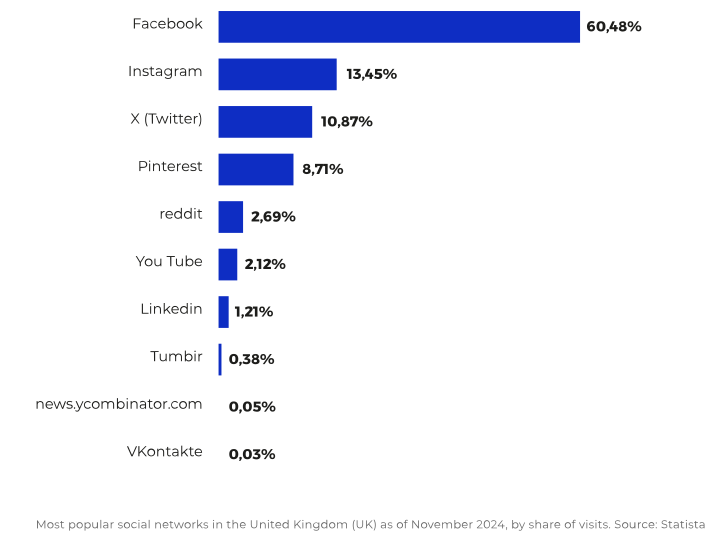
The research has shown that Facebook is the most popular social media platform to contact brands at all stages of the buying process, with almost half of people using social media in the purchase process doing so on Facebook.
This aligns with the general social media usage statistics in the UK. Statista numbers show that Facebook has a market share of around 60%.
Younger consumers use social media for purchases the most
The age group that stands out the most in terms of using social media during the purchasing process consists of consumers aged 25-34. They also use social media for a broader range of purposes during the pre and post-purchase stages and are more likely to use multiple platforms at all stages of the buying process.
They are more likely to admit that a positive experience with customer service on social media positively impacts their opinion of the brand.
Younger consumers (18-34) are generally more inclined to use social media at all stages of the buying process. Compared to all British consumers, they are slightly more likely to prefer responses generated by AI. They also tend to use social media more frequently for rofessional purposes.
Interestingly (but perhaps not surprisingly), Facebook is the only social media platform that is slightly more often used at all stages of the buying process (among those who use social media at these stages) by older consumers (55-64, 45-54. or 35-44, depending on the stage).
This doesn’t apply to using Facebook to contact brands, which is still most common among consumers in the 25-34 age range.
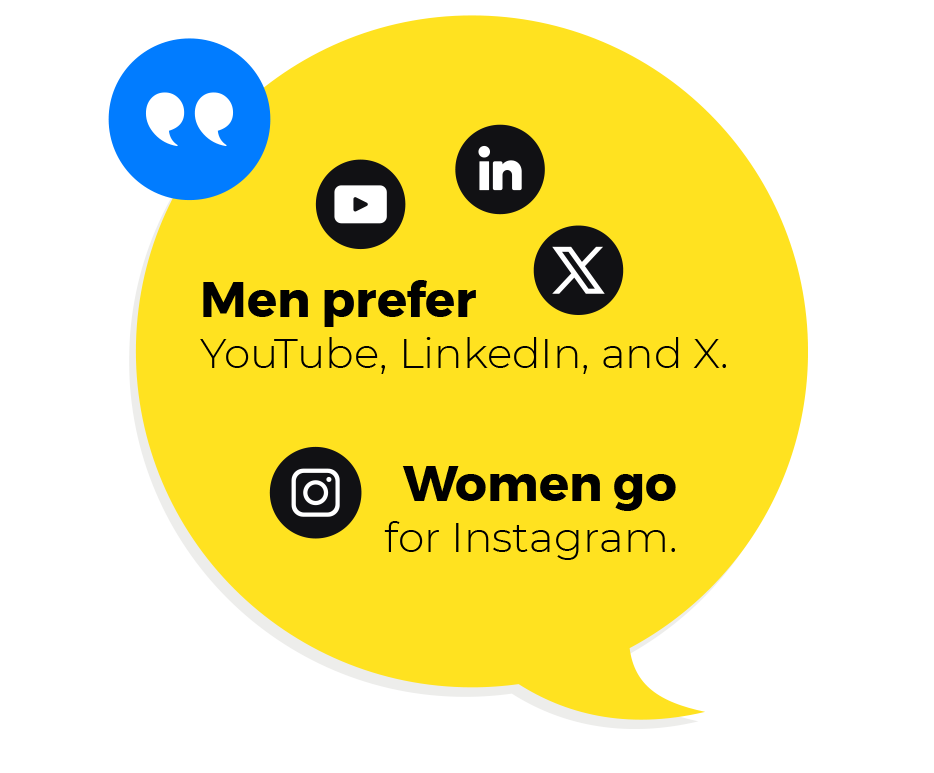
Men prefer X, YouTube, and LinkedIn. Women go for Instagram first.
Men tend to use a greater variety of methods to contact brands, regardless of the type of brand. They also claim they almost always use social media after purchasing more often.
Men are more keen on purchasing directly from DMs sent to a brand or, which might be surprising, through livestream sales.
At most stages of the buying process, men are more likely to use YouTube, X, Reddit, Tumblr, and LinkedIn. On the other hand, women are more likely to use Instagram before making a purchase
Men also more often:
- Use social media at work
- Use tools for managing social media for professional purposes
- Have a job that, at least occasionally, requires them to contact another brand via social media (B2B).

Why Brits use social media at work
17% of British consumers use social media for professional purposes.
The majority (76%) use social media management tools, and nearly half of those who do not would consider using them.
What might be surprising is that content creation is not among the top 3 reasons people use social media management tools at work. In general, these are:
- Analytics and performance tracking
- Social listening
- Managing multiple social media accounts and platforms in one place
In a professional context (B2B contact), the preference for responses written by a person (as opposed to those generated by AI) is less pronounced.
Close-up on how and why Brits use social media to connect with brands
1. Pre-purchase
For UK consumers, social media is typically used the most in the pre-purchase stage of the purchase process. Over half of British consumers admit to doing it, and around one in ten declare that they almost always use social media at this stage of their buying journey.
Consumers first look for reviews and videos
Consumers who declare they generally contact brands on specific social media platforms like Facebook, Instagram, or TikTok are more likely to use social media in the initial stages of the buying process. They mostly do it to look for user-generated content:
- Read user reviews and feedback to evaluate a product or service
- Look at photos or videos showing real-life experiences with a product or service
- Watch demonstration and unboxing videos.
These are the top three reasons, with others including looking at ads and contacting brands directly by messaging them on social media.
Using social media at different stages of the purchase process
- Social media are most likely to be used in the pre-purchase stage of the purchase process.
- Over half of British consumers admit to using social media at least occasionally before making a purchase, and approximately one in ten declare that they almost always use social media at this stage of the purchase process.

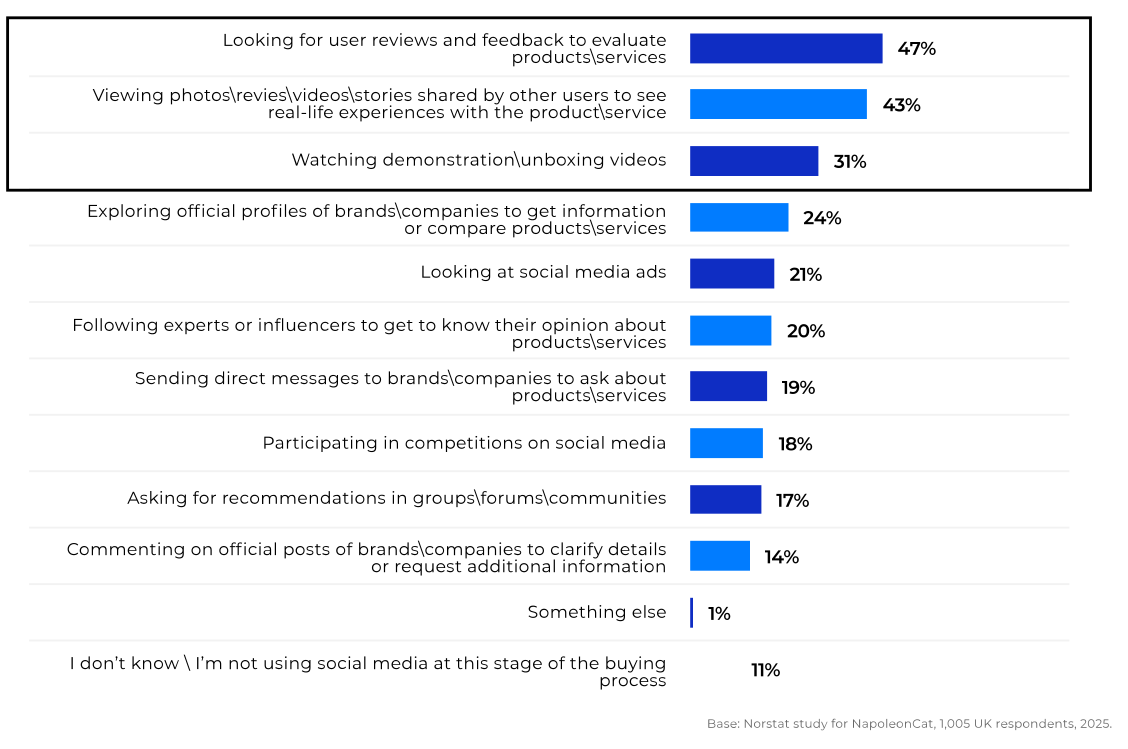
Purpose of using social media during pre-purchase stage
- Those, who use social media before making the purchase, most often do this to look for
user-generated content: reviews and feedback, photos or videos with real-life experience, demonstrations, or unboxing videos. - Commenting on official posts to clarify information or ask about something is least
likely.
And what do they look for exactly?
Most often, they look for:
- Information about the product, like size, variations, prices, specs, etc.
- Delivery and shipping
- Availability
- Clarification on discounts and promos
- Return policy
- And more.
Essentially, things that will help them decide to buy (and the absence of which can also prevent them from going through with the purchase – a solid reason not to ignore their questions.)
Greg Berezowski, NapoleonCat
 Source: Norstat online survey for NapoleonCat, n=1,005 UK respondents, 2025.
Information sought when engaging with brands during pre-purchase stage
British consumers, who engage with brands on social media during the pre-purchase stage of the buying process (either by visiting official profiles, commenting on official content, or sending DMs), most often look for information about the product (sizes, colours, variations, features, specs, etc.) or about a delivery, shipping, availability, fees, etc.
They mostly look on Facebook, YouTube, and Instagram
Yet again, Facebook wins when it comes to doing the above, though YouTube comes a close second and Instagram a pretty close third.
Social media platforms used during pre-purchase stage
- If social media platforms are being used at the pre-purchase stage of the buying process, the most popular are Facebook, YouTube and Instagram.
- Tumblr and Snapchat are the least often used at this stage.

Men prefer YouTube, while women go to Instagram
When you look at the most popular social media platforms and gender distribution, there are pretty significant differences. While Facebook is popular with both men and women, men go to YouTube much more frequently than women, while women tend to search Instagram instead.
Men also use Reddit and X more, while both genders reach for TikTok on their phones at around the same amount.
Men are more likely to watch demos or unboxing videos and to follow experts or influencers to get to know their opinions.
They also tend to use a greater variety of methods to contact brands, regardless of the type of brand. They’re more likely to contact a brand before purchasing to discuss the possibility of collaborating.
Social media platforms used during pre-purchase stage
- While men are more likely to use YouTube, X, Reddit, and Tumblr before making a purchase, women more often turn to Instagram.
- Consumers aged 25-34 y.o. And those from social grades A or B generally more often use many different platforms at this stage of the process. Youngest consumers (18-24 y.o.) more often than the total of British consumers use Instagram and TikTok, while those aged 35-44 y.o. and 55-64 y.o. are more likely to use Facebook.
Purpose of using social media during pre-purchase stage
- Men are more likely to watch demonstration or unboxing videos and to follow experts or influencers to get to know their opinions.
- Consumers aged 25-34 y.o. and those belonging to social grades A or B generally more often engage in various activities on social media before making a purchase, for example watching unboxing videos, exploring brands’ official profiles, following influencers, asking for recommendations and commenting on official posts.
Younger generations choose Instagram and TikTok over Facebook
While Facebook is the most popular with the majority of consumer demographics, it visibly loses to Instagram, YouTube, and TikTok among consumers aged 18-24, which is no surprise.
In general, consumers aged 25-34 engage in various social media activities before purchasing more. It could be, for example:
- Watching unboxing videos
- Exploring brands’ official profiles
- Following influencers
- Asking for recommendations
- Commenting on official posts.
They also look for details about returns, exchanges, and complaints more often than other age groups.
The youngest group in the study is also the one most likely to use social media before buying, making it especially important for brands that serve this demographic
Natalia Kossut-Kaczmarek, Ochnik
Methods of using social media when making the purchaseSocial media platforms used during pre – purchase stage
Consumers aged 25-34 y.o. and those from social grades A or B generally more often use many different platforms at this stage of the process. Youngest
consumers (18-24 y.o.) more often than the total of British consumers use Instagram and TikTok, while those aged 35-44 y.o. and 55-64 y.o. are more likely to use Facebook.
Purpose of using social media during pre – purchase stage
- Consumers aged 25-34 y.o. and those belonging to social grades A or B generally more often engage in various activities on social media before making a purchase, for example watching unboxing videos, exploring brands’ official profiles, following influencers, asking for recommendations and commenting on official posts.

Using social media during pre-purchase stage
- Younger consumers (up to 34 y.o.) are more likely to use social media platforms during the pre-purchase stage of the buying process.
- The same is true for consumers belonging to social grades A or B.

Social grades A or B are more likely to seek info on sustainability
When it comes to different social grades and social media popularity,Facebook is still the most popular across all grades, with slight variations.
In general, grades A/B more often engage in social media activities pre-purchase, and that includes watching unboxing videos, exploring the brand’s official profiles, and asking for recommendations.
They also look for information on sustainability, collaboration options, and user-generated content, while grade C1 more often participate in competitions or giveaways on social media before purchasing.
Social media platforms used during pre-purchase stage
- Consumers from social grades A or B generally are more likely to use Facebook, YouTube and Instagram at this stage of the process

Purpose of using social media during pre-purchase stage
- Consumers from social grades A or B generally are more likely to use Facebook, YouTube and Instagram at this stage of the process

Information sought when engaging with brands during pre-purchase stage
- Men are more likely than all British consumers to engage with brands on social media before purchasing to inquire about the possibility of collaborating.
- Consumers aged 25-34 y.o. are more often looking for details about returns, exchanges, or complaints, as well as for details about upcoming events or competitions. That last one is also true for consumers from social grades A or B, who are also more likely to seek info on sustainability, the possibility to collaborate, and user-generated content. Consumers from social grade C1 more often participate in official competitions or giveaways on social media before purchase.

2. Making the purchase
When you look at the statistics, it’s clear that using social media to make a purchase is slightly less common than during other stages of the buying process. Still, approximately 2 in 5 British consumers use social media for this purpose, at least occasionally.
And it’s definitely the younger generations rather than the older ones – as seen in the diagram below (p. 41).
Using social media at different stages of the purchase process
- Using social media to make the purchase is slightly less likely than during other stages of the purchase process.
- Nevertheless, nearly 2 in 5 consumers admit to using social media to make purchases at least occasionally.

Using social media when making the purchase
- Consumers up to 34 y.o. more often use social media to make the purchase.
- The same is true for those in the A or B social grade, while the least likely to purchase products using social media are consumers in the social grade C1.

Direct shopping is the most popular
It’s most often done through direct shopping features available on the platforms. Other popular methods include:
- Clicking on social media ads to complete the purchase
- Using in-app checkout options
- The least popular method is livestream sales.
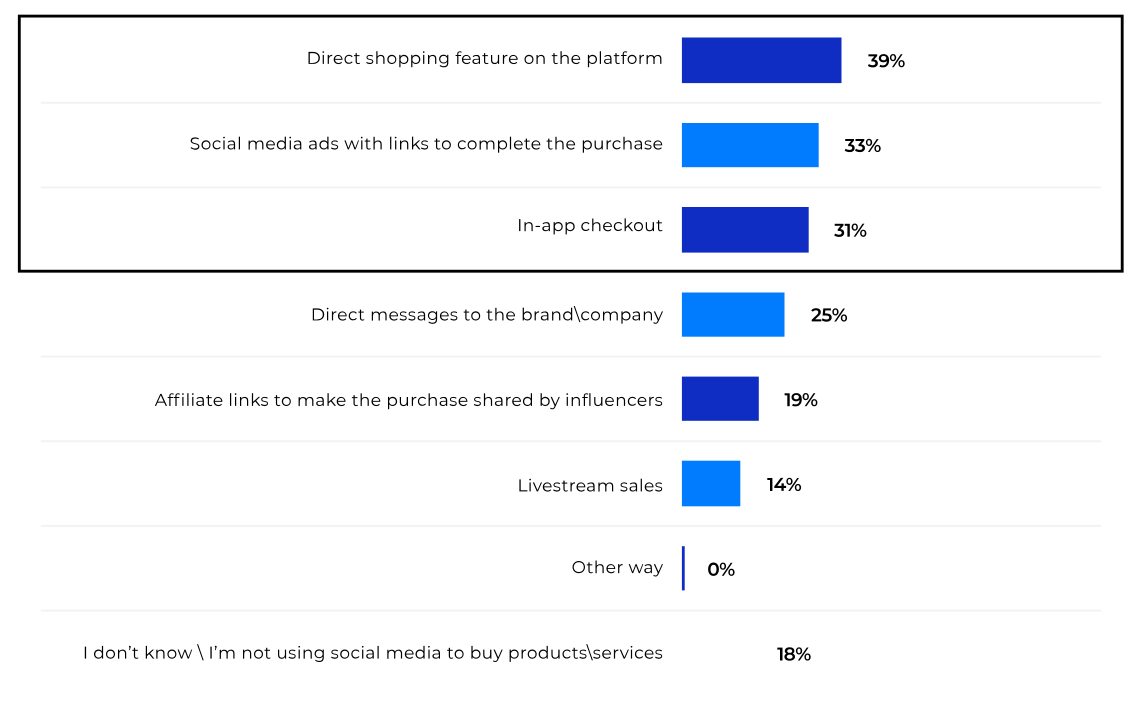 Source: Norstat online survey for NapoleonCat, n=1,005 UK respondents, 2025.
Methods of using social media when making the purchase
- If social media is used to make the purchase, most often it is via direct shopping features
on social media platforms, social media ads or in-app checkout. - The least popular way to use social media during purchase is livestream sales.
Facebook precedes Instagram, TikTok, and YouTube
At this stage of the buying process, Facebook is the most frequently used platform, followed by Instagram, TikTok, and YouTube.
Unsurprisingly, consumers who use social media to contact brands in general are also more likely to buy using social media. That’s especially true for TikTok and YouTube users – a whopping three-thirds do it at least occasionally.
Mick Griffin
Direct shopping is most likely to happen on Instagram, followed by Facebook. Ads with links to complete the purchase are most frequently used on Facebook and YouTube.
What’s interesting is that TikTok leads the way in direct messaging to brands, affiliate links shared by influencers, and livestream sales – the latter of which TikTok has become famous worldwide.
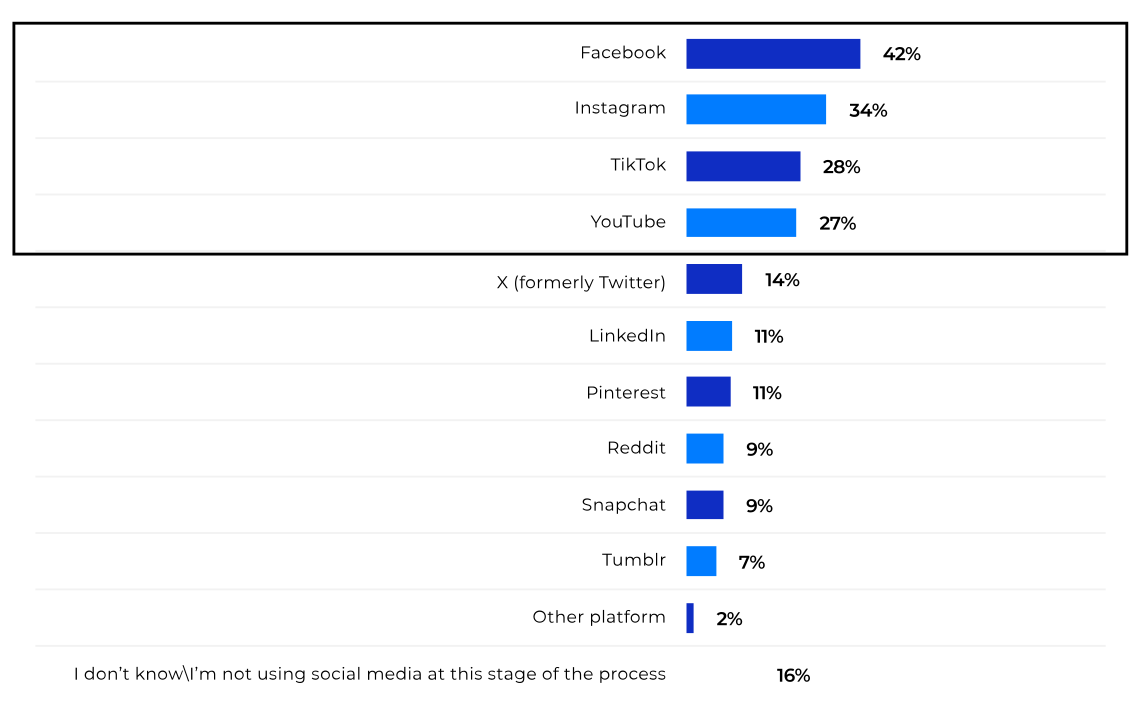 Source: Norstat online survey for NapoleonCat, n=1,005 UK respondents, 2025.
Social media platforms used to make the purchase
- If social media are used to make the purchase, the most often used platform is Facebook, followed by Instagram, TikTok, and YouTube.
- Making the purchase via Tumblr, Snapchat or Reddit is the least common.
Using social media when making the purchase
- Consumers who most often use specific social media platforms (Facebook, Instagram, TikTok, YouTube) to contact brands are generally more likely to use social media to purchase products in comparison to all British consumers – especially users of TikTok and YouTube.

Methods of using social media when making the purchase
- Those who most often use Facebook or Instagram to contact brands are more likely to buy products via direct shopping features on social media platforms – in comparison to all British consumers who at least rarely use social media when making the purchase.
- Clicking on social media ads to complete the purchase is more likely among those who most often use Facebook, Instagram or YouTube to contact brands. On the other hand, those who most often use TikTok to contact brands more often purchase DMs from the brand.

Men and women just as likely to shop directly on social media
There seems to be no difference between genders when it comes to buying directly
on social media platforms. Still, men are slightly more likely to buy from social media ads and – perhaps surprisingly? – during live streams. According to the study, they also contact brands to buy from them more frequently than women.
Men also buy products and services more often using the following social media platforms:
- YouTube
- X
- Snapchat
- Tumblr
When it comes to shopping, women are slightly more active on Facebook
and Instagram, but the difference is minimal.
Methods of using social media when making the purchase
- Men are more likely to buy products using social media via DMs to brands or companies or livestream sales.
- Consumers aged 25-34 y.o. are generally more likely to use a greater variety of ways to buy products via social media. The same is true for consumers belonging to social grade A or B.

Social media platforms used to make the purchase
- Men are more likely to make the purchase using YouTube, X, LinkedIn, Snapchat, or Tumblr.
- In comparison to all consumers who use social media during the purchase stage of the buying process, the youngest consumers (18-24 y.o.) more often use TikTok and LinkedIn to purchase products, but less often Facebook, which is most popular among those aged 45-54 y.o.
- Consumers aged 25-34 y.o. and those in social grades A or B are more likely to use most of the platforms to purchase products.

Younger consumers buy more on TikTok and… LinkedIn (among others)
Looking at all consumers using social media to buy products and services, Instagram and TikTok are clear winners for people aged 18-24. Perhaps surprisingly, this demographic also buys more frequently on LinkedIn, while they’re not so keen on buying on Facebook.
As age ranges progress, this trend is reversed, with the older generations buying on Facebook most frequently and TikTok the least (which is also in line with overall social media usage trends.)
The demographic using most of the platforms to purchase products most frequently are people between the ages of 25 and 34.
25% of [younger] consumers prefer searching for brands on social media over traditional search engines, while 21% use platforms to find answers to their questions
Natalia Kossut-Kaczmarek, Ochnik
Facebook popular across social grades
When it comes to social grades, Facebook wins in all groups, while other social platforms are clearly the most popular in grades A and B for buying products.
Social media platforms used to make the purchase
- Men are more likely to make the purchase using YouTube, X, LinkedIn, Snapchat, or Tumblr.
- In comparison to all consumers who use social media during the purchase stage of the buying process, the youngest consumers (18-24 y.o.) more often use TikTok and LinkedIn to purchase products, but less often Facebook, which is most popular among those aged 45-54 y.o.
- Consumers aged 25-34 y.o. and those in social grades A or B are more likely to use most of the platforms to purchase products.

Using social media at different stages of the purchase process
- Nearly half of British consumers use social media platforms during the post-purchase stage of the buying process at least occasionally.
- Yet only 6% of consumers use social media at this stage always or almost always.

3. Post-purchase
It’s perhaps not surprising that half of British consumers use social media platforms after buying products from brands, at least occasionally. This makes social media an important customer service and loyalty channel that brands shouldn’t ignore.
Leveraging tools to manage social media interactions efficiently can help, allowing businesses to automate routine tasks while focusing on meaningful, personalized conversations.
Greg Berezowski, NapoleonCat
Facebook wins yet again
In general, Facebook is yet again the most often used social media platform post-purchase overall, followed by YouTube and Instagram.
It’s interesting to see that those consumers who actively reach out to brands on social media are most likely to do it on TikTok these days at 84%, though Facebook, Instagram, and YouTube are also well above 60%.
Consumers who most often use YouTube to contact brands more often comment on official brand content after purchase. Those who most often use TikTok to contact brands are more likely to answer other people’s requests for recommendations. Both groups are more likely to follow influencers post-purchase and record demonstration or unboxing videos.
This makes social media an important customer service and loyalty channel that brands shouldn’t ignore.
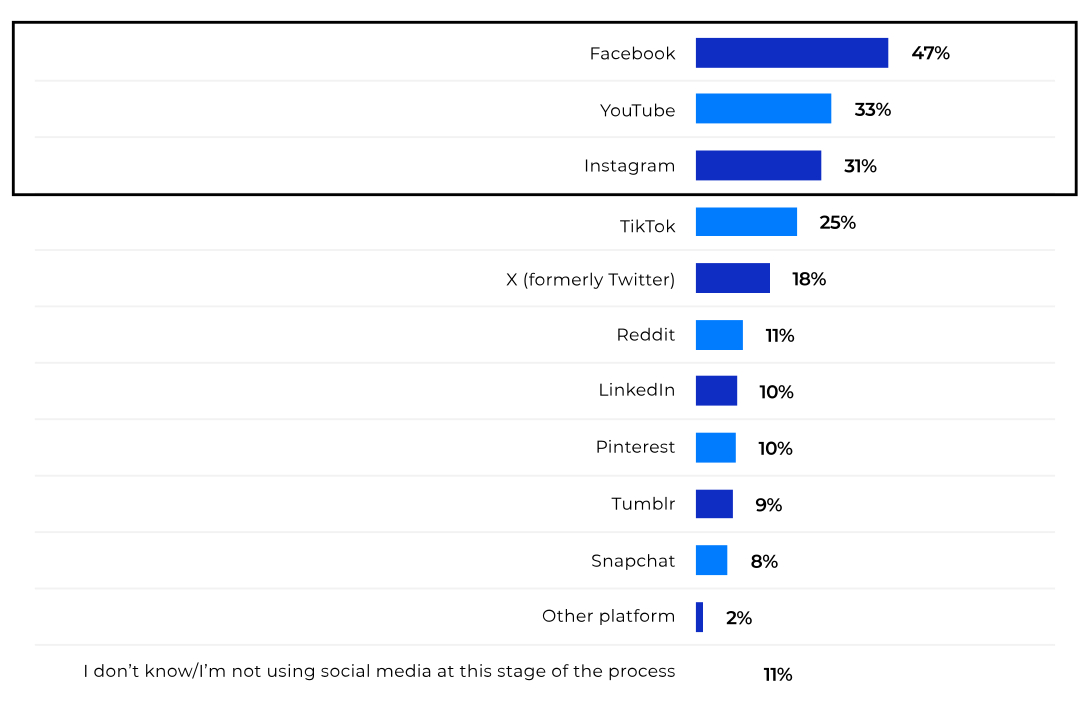 Source: Norstat online survey for NapoleonCat, n=1,005 UK respondents, 2025.
Social media platforms used during post-purchase stage
- Facebook is the most often used social media platform post-purchase.
- It is followed by YouTube and Instagram.
- Snapchat and Tumblr are the least often used at this stage.
Using social media during post-purchase stage
- British consumers, who most often use Facebook, Instagram, TikTok or YouTube to contact brands (either small or big, selling physical products or services), are more likely to at least occasionally use social media during the post-purchase stage of the buying process – especially TikTok users.

Purpose of using social media during post-purchase stage
- Those who most often use Facebook or Instagram to contact brands are more likely to send DMs to brands for more information after making the purchase.
- Consumers who most often use YouTube to contact brands more often comment on official brand content after purchase, while those who most often use TikTok to contact brands are more likely to answer other people’s asks for recommendations. Both groups are more likely to follow influencers post-purchase and record demonstration or unboxing videos.

Consumers seek user-generated content on social media
The most popular way to use social media after making the purchase is to view content (photos, videos) shared by other users to see other people’s real-life experiences with the product or service.
Other ways include:
- Writing feedback
- Sending DMs to brands to get more info about the product, check the order status, etc.
- Answering other people’s requests for recommendations
- Recording demos or unboxing videos – though that’s the least common of all the activities.
This makes social media an essential channel for word of mouth and loyalty. After the purchase, consumers often continue to promote the product to their friends and contact networks. They also have the power to influence others by sharing their negative experiences, which brands shouldn’t forget about.
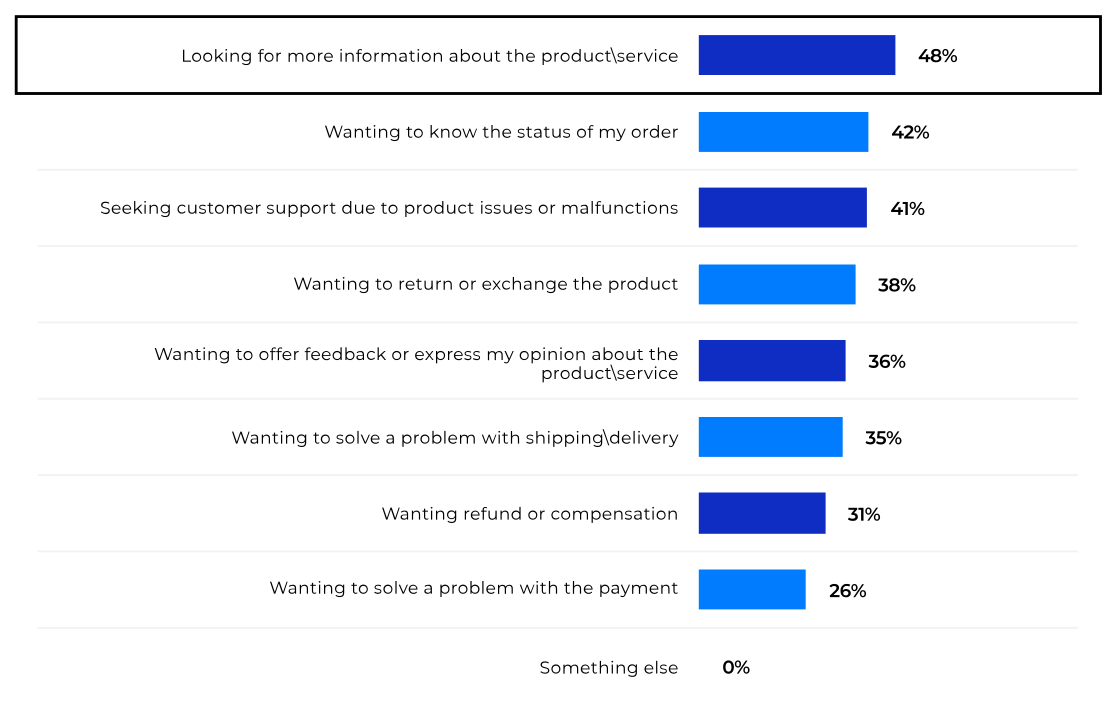
Nearly half of those who engage with brands post-purchase (either by visiting official profiles, sending DMs, or commenting on official content) do so because they are looking for more information about the product or service.
Other common reasons include:
- To know the order status or want to return or exchange the product.
- Seeking customer support
- Wanting to return or exchange the product
- Wanting to offer feedback
- Wanting to solve a problem with shipping or payment
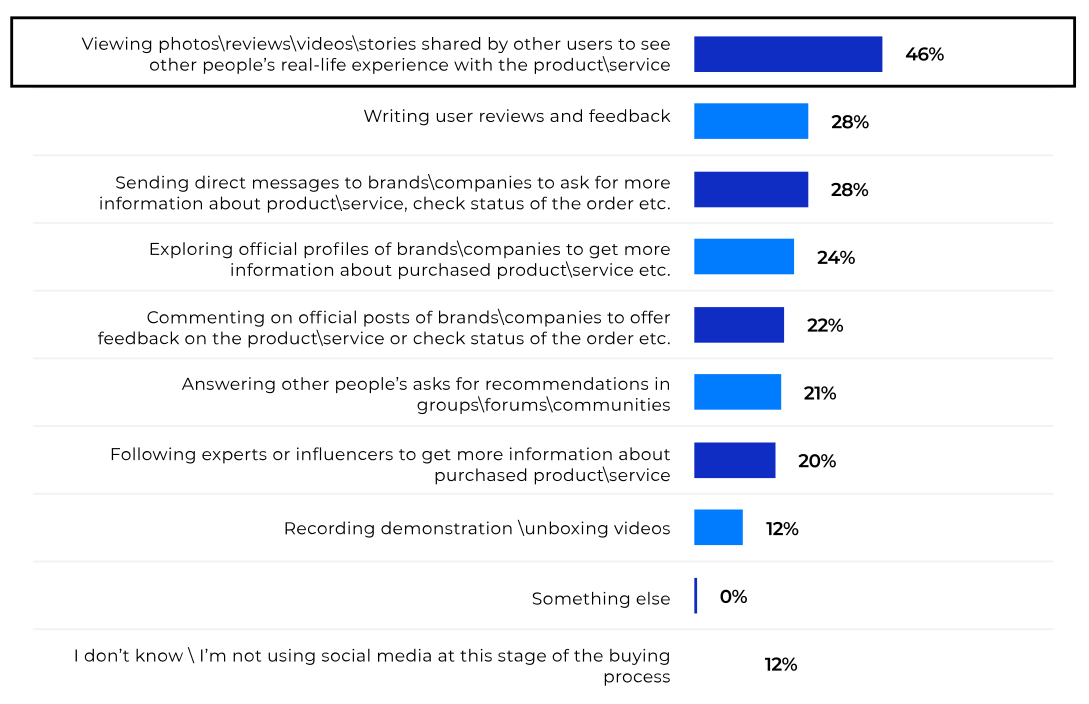 Source: Norstat online survey for NapoleonCat, n=1,005 UK respondents, 2025.
Purpose of using social media during post-purchase stage
- The most common way to use social media after making the purchase is to view content
(photos, videos) shared by other users to see other people’s real-life experiences with the product or service. - Other ways include writing feedback or sending DMs to brands or companies to get more info about the product, check the status of the order, etc.
- Recording demonstration or unboxing videos is the least common.
 Source: Norstat online survey for NapoleonCat, n=1,005 UK respondents, 2025.
Purpose of engaging with brands during post-purchase stage
- Nearly half of those who post-purchase engage with brands (either by visiting official profiles, sending DMs, or commenting on official content) do it because they are looking for more information about the product or service.
- It is followed by wanting to know the status of the order, seeking customer support, or wanting to return or exchange the product.
Customers should feel they are ‘building’ relationships with you. If they have to re-explain their situation every time they contact your brand, there is zero difference between you and them talking to your competition. Every Time they start a new conversation, the team member should be able to quickly look at previous communication.
Mick Griffin, Traffit
Women use social media post-purchase less than men
Men declared more frequently that they use social media post-purchase always or almost always.
They also more frequently answer other people’s requests for recommendations and record demos or unboxing videos than women.
On the other hand, women were more likely to write reviews and feedback and send direct messages to obtain more information.
Using social media during post-purchase stage
- Men are more likely to declare that they are using social media during post-purchase stage of the buying process always or almost always.
- The highest frequency of using social media post purchase can be observed among younger consumers. Those over 45 y.o. are more likely to not use social media at this stage at all.
- Also consumers in social grades A or B more often use social media after making the purchase. The opposite is true for those in social grade C1.

Purpose of using social media during post-purchase stage
- Men are more likely to use social media post-purchase to answer other people’s asks for recommendations and record demonstration or unboxing videos.
- Consumers aged 25-34 y.o. use social media at this stage of the buying process in a greater variety of ways. The same is generally true for those in the social grade A or B. Consumers in social grade C2 more often write user reviews and feedback.

Younger consumers most active post-purchase (no surprises there)
When we look at the age distribution, it’s again the younger generations who go to social
media after purchasing, with peak activity in the 25-34 age range. They also use social
media in a greater variety of ways – they’re more likely to ask for order status or more info, which is an important pointer for post-purchase customer support.
Overall, consumers over 45 are much less likely to use social media to share their
experiences or contact brands for support at this stage. If they do, they’ll probably look for more information on the product or order status.
Purpose of engaging with brands during post-purchase stage
- Consumers aged 25-34 y.o., who engage with brands post-purchase, are more likely to do it to check the status of the order, because they want to return or exchange a product or because they want a refund. Engaging with brands to check order status is also more common in the oldest group (55-64 y.o.).
- Those who most often use Facebook to contact brands more often engage with brands post-purchase because they want to offer feedback, while those who most often use TikTok to contact brands are more likely to engage with brands post-purchase because they seek customer support, want to return the product or solve a problem with payment.

Using social media during post-purchase stage
- The highest frequency of using social media post purchase can be observed among younger consumers. Those over 45 y.o. are more likely to not use social media at this stage at all.

Social grades A/B use a greater variety of platforms post-purchase
Consumers in social grades A or B more often use social media after making the purchase, with Facebook topping the list for all social grades. Instagram is the least popular place to go for grade D/E, but consumers in this group are the most active group on Facebook post-purchase.
Social media platforms used during post-purchase stage
- Men are more likely to use YouTube, X, Reddit, LinkedIn and Tumblr post-purchase.
- The youngest consumers (18-24 y.o.) more often use TikTok after making the purchase, while 25-34 y.o. generally use a greater variety of platforms at this stage of the buying process. Facebook is more often used among those over 45 y.o.
- Also consumers in the social grade A or B use a greater variety of platforms post-purchase.

4. Social media at work
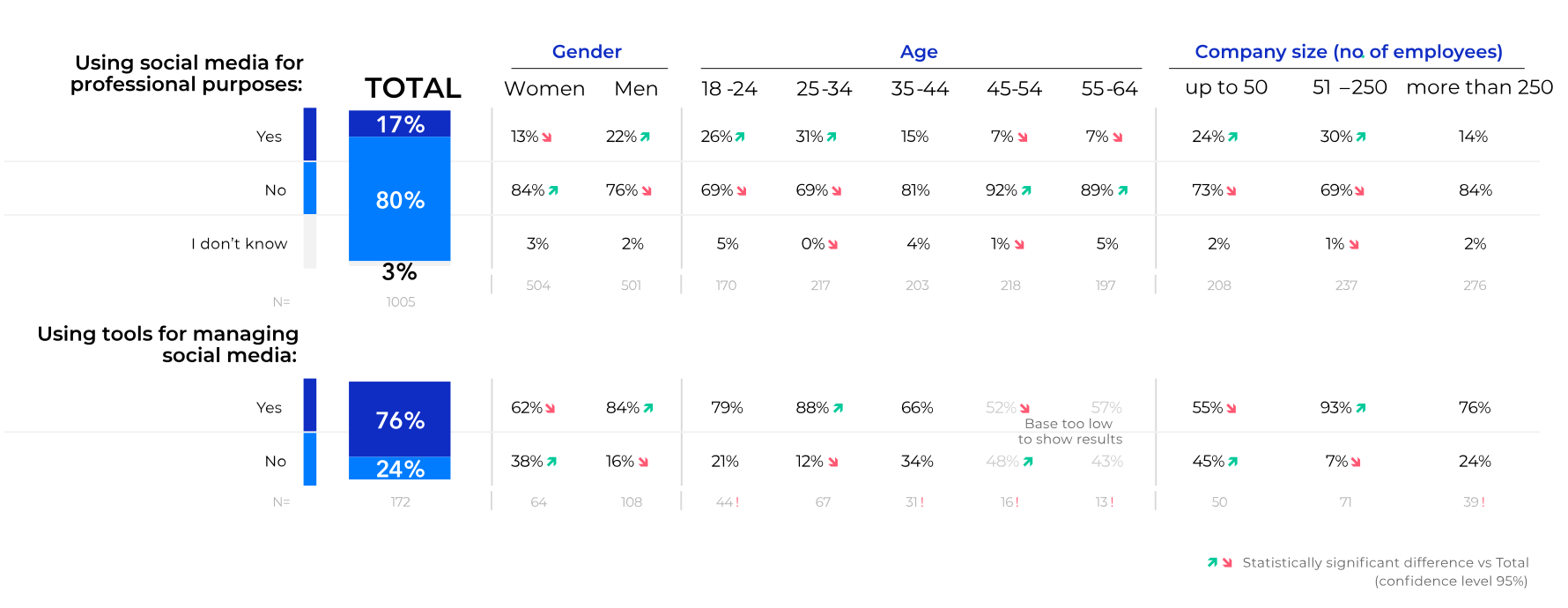
Less than one in five (17%) British consumers use social media for professional purposes. Of those who do, the majority (approximately three in four) use tools for managing social media.
If you look closer, you’ll notice that, yet again, men use social media management tools at work more frequently, at least according to our study.
The age demographic both using social media for professional purposes most often and using social media management tools is people aged 25-44.
 Source: Norstat online survey for NapoleonCat, n=1,005 UK respondents, 2025.
Using social media & tools for managing social media professionally
- Less than 1 in 5 (17%) British consumers use social media for professional purposes.
- However, among those who use social media at work, the majority (approximately 3 in 4) take advantage of tools for managing social media.
Using social media & tools for managing social media professionally
- Men and younger consumers (up to 34 y.o.) are more likely to use social media at work. It is also more common in smaller and medium companies (up to 250 employees).
- Among those who use social media professionally, men are more likely to take advantage of tools for managing social media – similarly to consumers aged 25-34 y.o. and those working in medium-sized companies (between 51 and 250 employees).
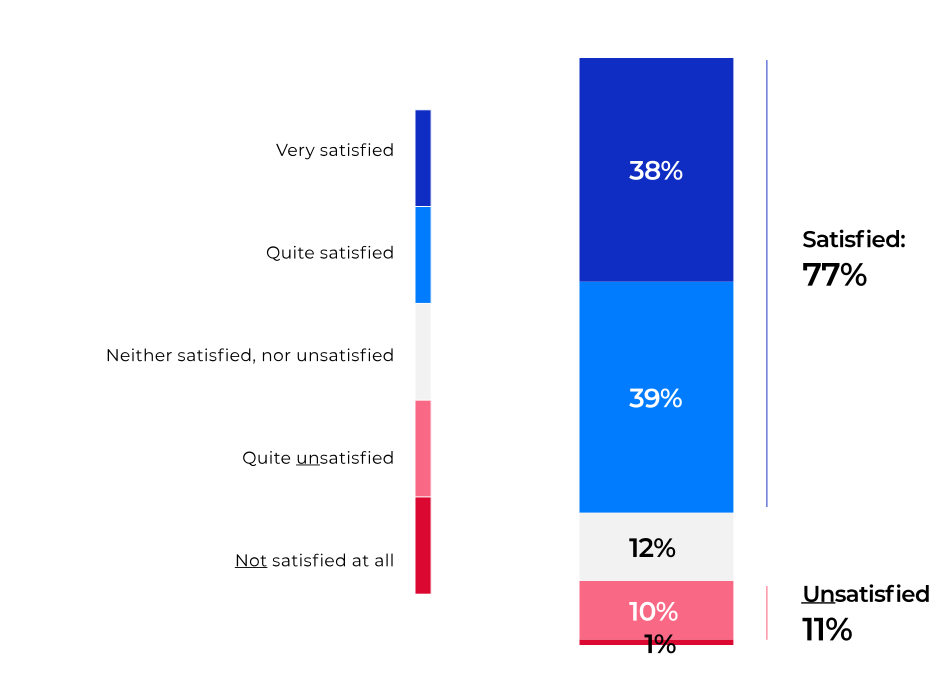
Most people surveyed in the study were either satisfied or very satisfied with their social media management solutions
 Source: Norstat online survey for NapoleonCat, n=1,005 UK respondents, 2025.
Satisfaction with current solution for managing social media
- Among those who use tools for managing social media at work, the majority are satisfied with their current solution, with almost 2 in 5 very satisfied.
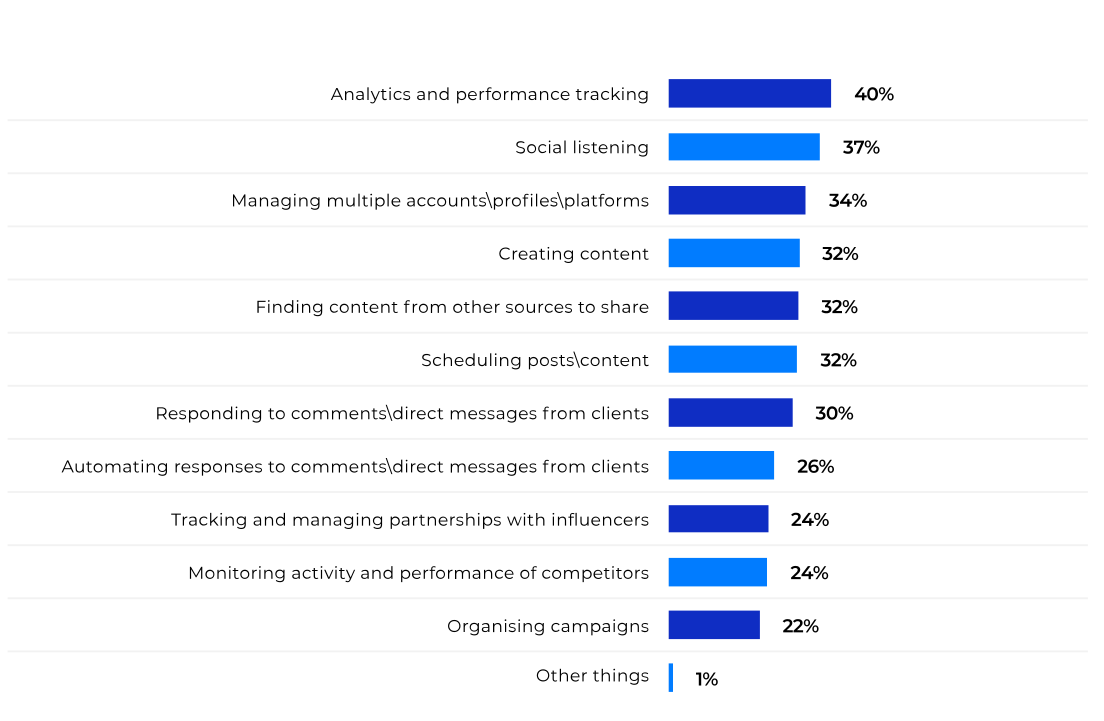
Most commonly, they use social media for:
- Analytics
- Social listening
- Managing multiple social media accounts and platforms.
It’s also important to use smart automation tools, such as Auto-moderation, which help us handle many interactions efficiently while keeping our communications genuine and empathetic. This also gives our team valuable time to focus on other parts of the campaign.
Magdalena Bochyńska, Vasco
 Source: Norstat online survey for NapoleonCat, n=1,005 UK respondents, 2025.
Purpose of tools for managing social media
- Most common reasons for using tools to manage social media include tracking analytics and performance, social listening, and managing multiple accounts or profiles.
- It is followed by creating, finding and scheduling content and responding to comments/DMs from clients.
Almost 20% of British consumers contact brands via social media at work – women are less likely to do it, as are people aged 45 and over.
 Source: Norstat online survey for NapoleonCat, n=1,005 UK respondents, 2025.
Contacting brands/ companies via social media professionally (B2B)
- Almost 1 in 5 British consumers contact another brand or company via social media at work (B2B).
- These are more likely men, younger consumers (18-34 y.o.), and those working in medium-sized companies (between 51 and 250 employees).
Why brands need to reconsider their social media customer service strategy
Customer experience on social media affects brand perception
In general, over half of the consumers we surveyed said that having a positive experience with a brand on social media positively impacts the way they perceive that brand.
That’s especially true for women and younger generations, as seen on the diagram below (p. 75).
And that’s hardly news, but it’s important to highlight that brands still ignore the impact customer experiences on social media have on the business. The results of this study clearly show that brands need to focus more on the image they build on social media, as that’s what matters to their customers.
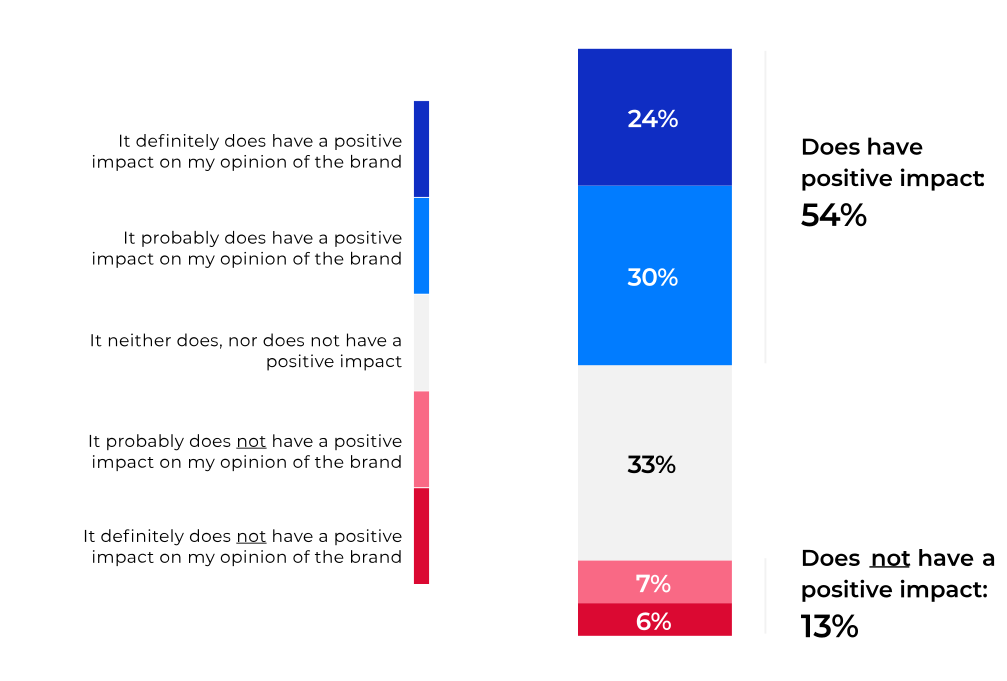 Source: Norstat online survey for NapoleonCat, n=1,005 UK respondents, 2025.
Impact of customer service on social media on brand perception
- Approximately half of British consumers admit that having a positive experience with
customer service on social media positively impacts their opinion of the brand or company, and almost every fourth person claims that it definitely has such an effect. - Only 13% do not see the impact
Impact of customer service on social media on brand perception
- Women and consumers aged 25-34 y.o. are more likely to admit that having positive experience with customer service on social media positively impacts their opinion of the brand or company.

Consumers expect brands to reply within hours
When people reach out to brands – whether via a DM or a comment under your posts – they expect to get a response where they left their question.
Around 40% expect brands to respond to DMs and comments within a maximum of 3 hours, with around a quarter expecting a response within an hour.
It might be interesting to note that younger consumers seem more forgiving, willing to wait between 3 and 24 hours for brands to respond, which is not true for older age groups.
It’s essential for building trust, improving the customer experience, and ultimately driving growth in a highly competitive market.
Greg Berezowski, NapoleonCat
Maximum time brand should take to respond
- Approximately 2 in 5 British consumers think that the brand should take no longer than 3 hours to respond to their query – no matter if the contact was by direct message or by commenting on official content.
- 12%-14% think that it shouldn’t take longer than 30 minutes.
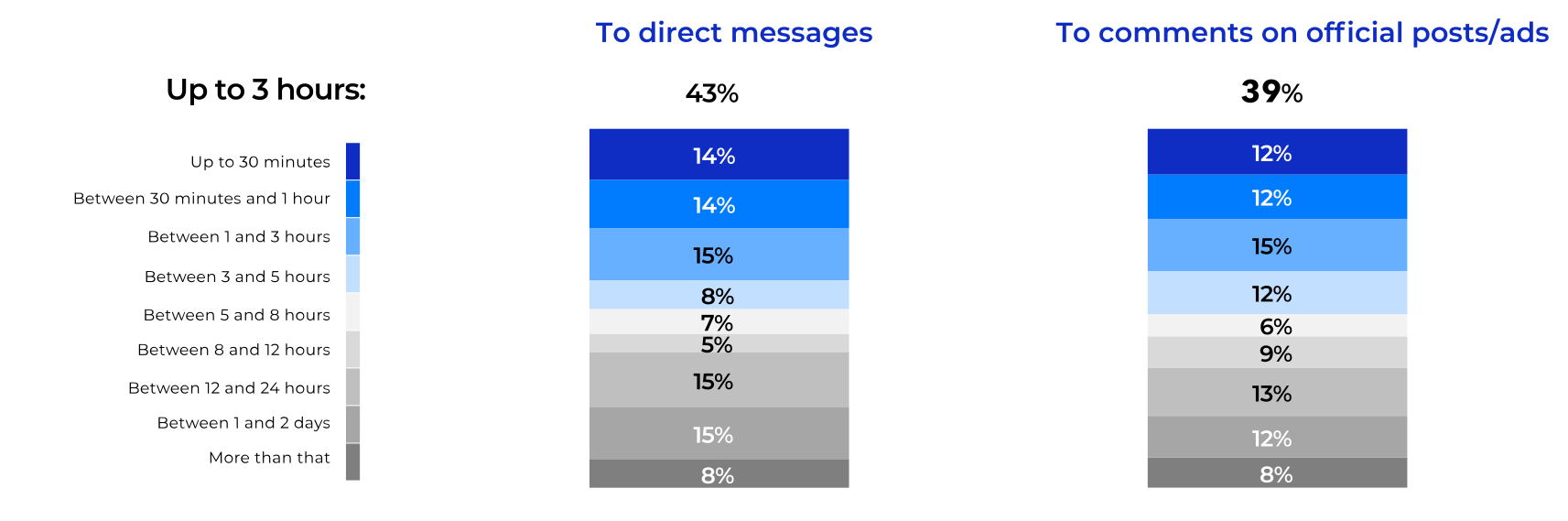
Maximum time brand should take to respond
- Men more often think that brands should reply up to 24 hours after contact – but this difference is only applicable to contact via direct messages. The same is true for consumers belonging to social grade A or B.
- Youngest consumers (18-24 y.o.) are most likely to expect an answer between 3 and 24 hours after contact.
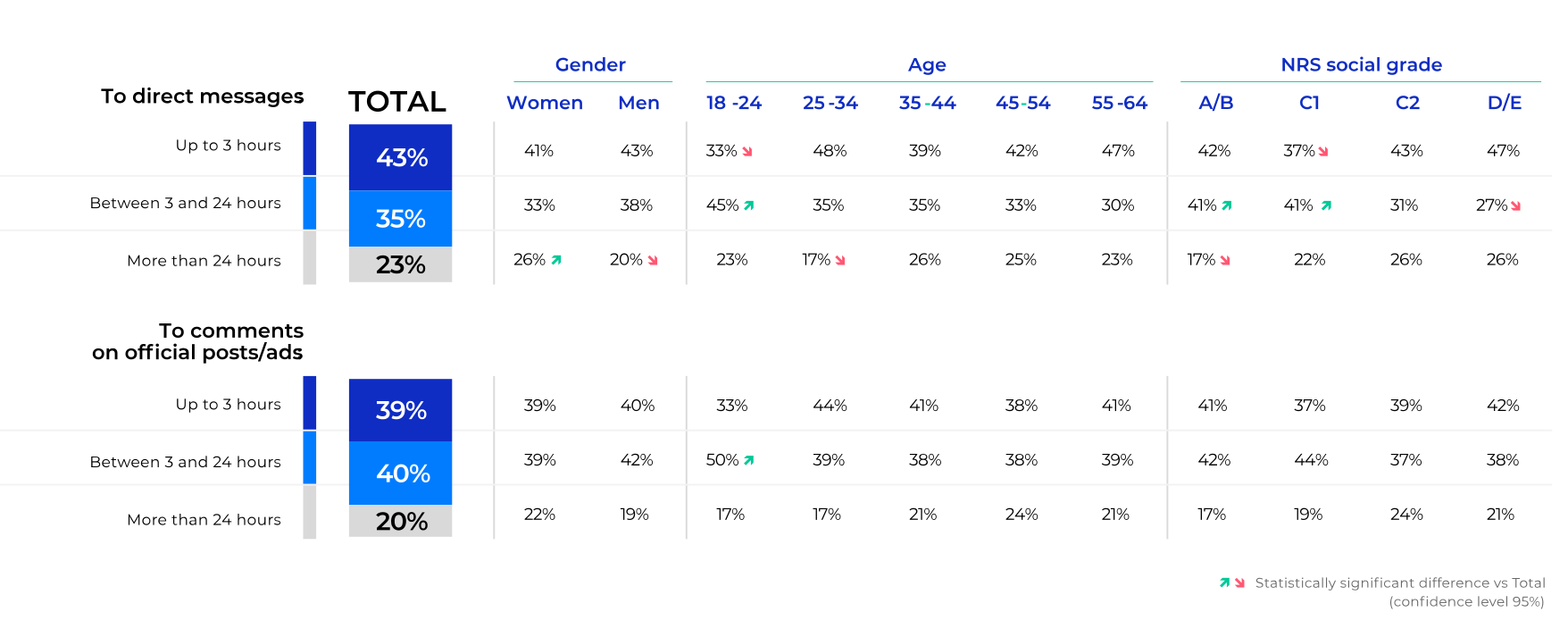
Friendly over professional
When it comes to the preferred tone of response, the study found that most often, British consumers prefer a friendly tone of the message, whether that’s a DM or a comment.
Humour or excitement are very rarely appreciated, though (which is entirely understandable as you’re looking for support from a brand.) As you can see on the diagrams below, humour or excitement are very rarely appreciated, though (which is entirely understandable as you’re looking for support from a brand.) Yet, of course, there are some varieties in the study responses, with fewer women appreciating a professional tone than men and more preferring helpful and supportive responses.
Preferred tone of response
- British consumers most often prefer a friendly tone of response from a brand – both when the contact is via direct messages and when it is via comments on brand’s official content.
- Other liked responses are professional, helpful and supportive.
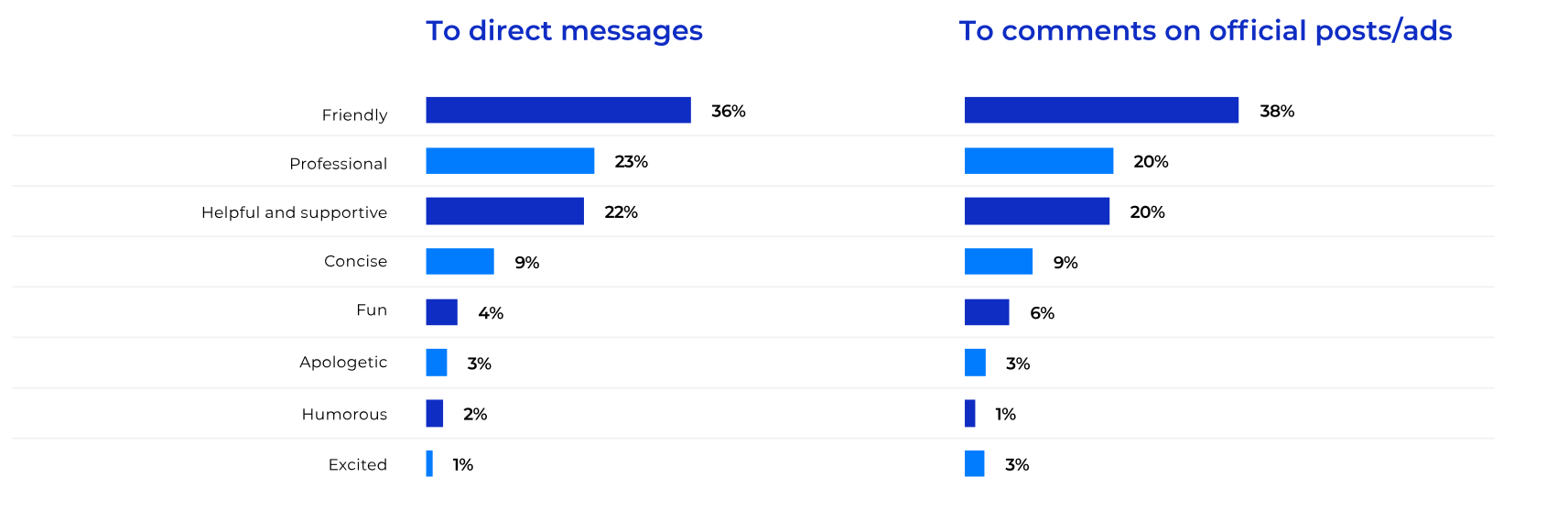
Preferred tone of response
- Men more often respond well to professional and fun replies (the latter only in case of comments). At the same time, women are more likely to prefer apologetic responses (in the case of DMs) or excited (in the case of comments).
- Youngest consumers more often prefer fun responses, while the oldest prefer a professional tone of contact (but only in the case of DMs).

Human over AI-generated
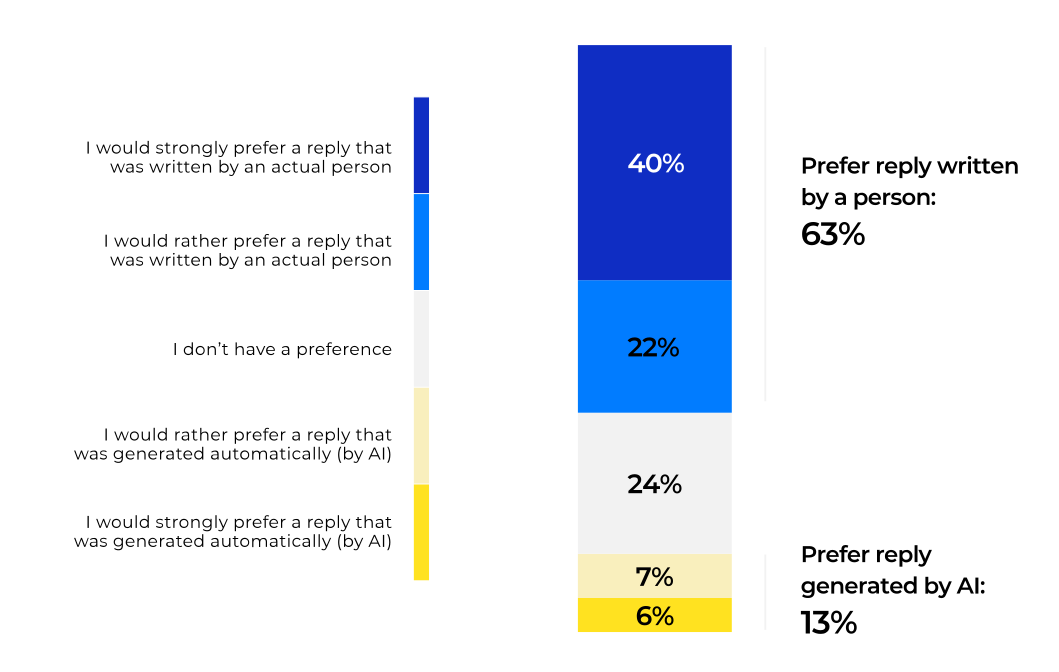
The majority (63%) of consumers in the study prefer responses written by a human, with only 13% favouring AI-generated replies. For 24%, it doesn’t seem to make a difference.
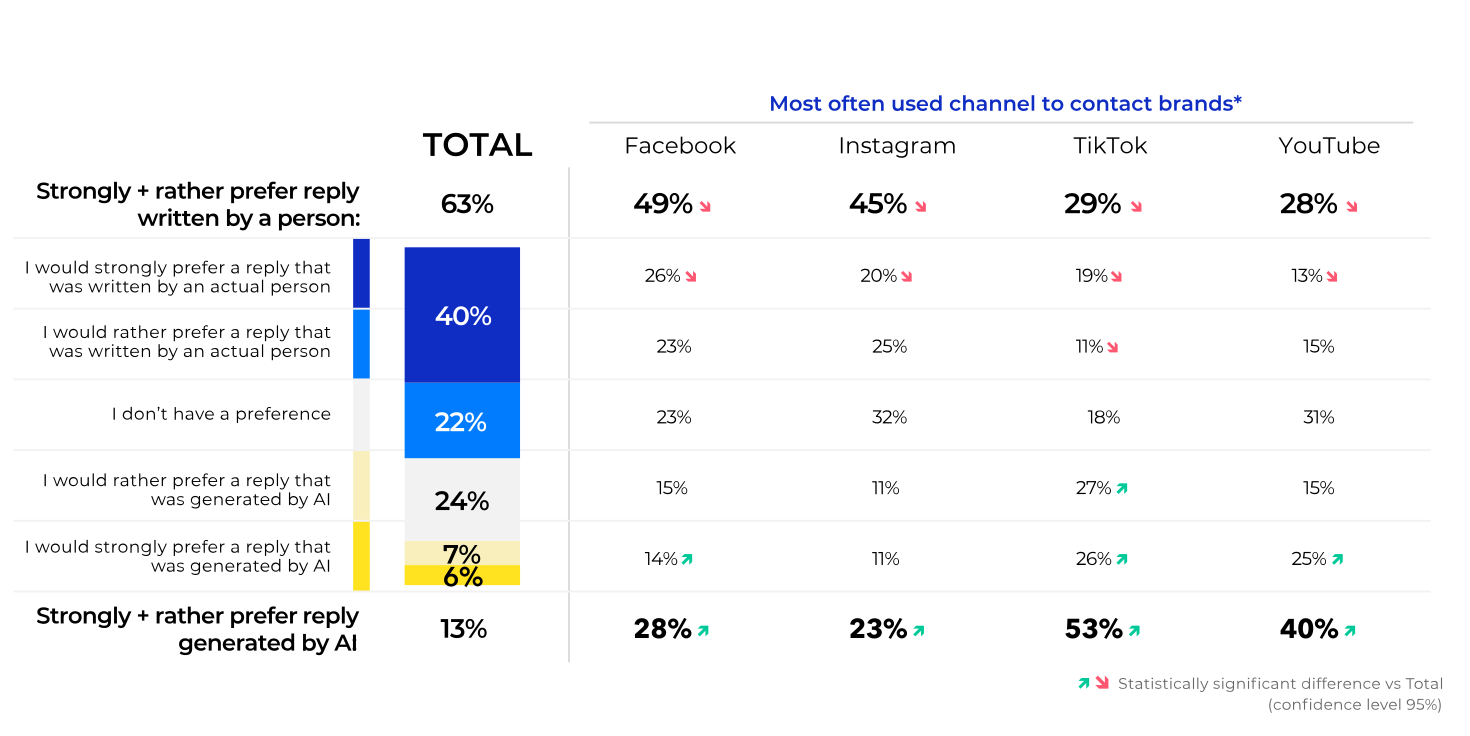
Consumers who use Facebook, Instagram, TikTok, or YouTube as their primary point of contact with any brand are more likely to prefer automatic responses. This is especially true for TikTok and YouTube users.
Those who prefer AI-generated responses most often cite speed and convenience as the main reasons. On the other hand, those who favour responses written by humans emphasize that they feel more personal and authentic.
What also stands out in the results of the study is that the more consumers value a positive customer experience on social media overall, the more they tend to prefer human-written responses.
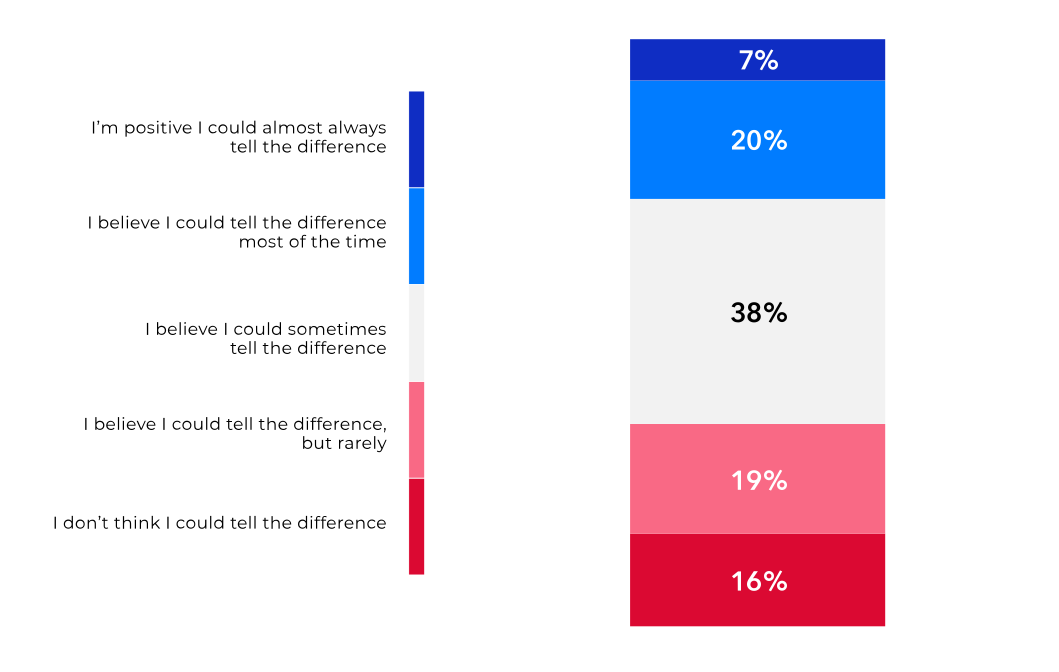
Interestingly, only 7% of the people surveyed were positive that they could always detect an AI-generated reply, with almost two-thirds preferring a reply written by a person.
My recommendation is to be open about AI so customers feel they are making their own choices on how to communicate and with whom.
Mick Griffin, Traffit
 Source: Norstat online survey for NapoleonCat, n=1,005 UK respondents, 2025.
Ability to distinguish automated replies vs written by a person
- Only 7% of British consumers claim that they can almost always tell the difference
between replies generated by AI and written by a human. Every fifth person thinks that
they can tell the difference most of the time. - Majority is of the opinion that they can make the distinction at least sometimes.
 Source: Norstat online survey for NapoleonCat, n=1,005 UK respondents, 2025.
Preference of automated replies vs written by a person
- Majority of British consumers prefer to receive replies written by an actual person –
only 13% prefer responses generated by AI. - Approximately 2 in 5 consumers strongly prefer replies written by a human.
- For almost every fourth person it does not make a difference (they don’t have a preference).
Consumers most open to AI-generated communication are TikTok users,
while Instagram and Facebook users prefer a more traditional, human approach.
Preference of automated replies vs written by a person
- Those, who use social media platforms (Facebook, Instagram, TikTok, YouTube) as their first choice of contact with a brand (for any type of brand: small or big, offering physical products or services) are more likely to be open to responses generated by AI – especially in case of TikTok users, approximately half of whom would prefer to receive a reply generated by AI. Also in the case of YouTube users the share of those who prefer replies generated automatically is higher than the share of those who prefer responses written by a person.
As the lines between the two blur, it’s important to remember to use a human tone when replying to a customer – and automated replies don’t exclude that.
Summary: Social media is an integral part of the entire customer experience
Consumers find it natural to connect with brands on social media. And with the growth of social media platforms, they’re only bound to do it more and more. Depending on their age, gender, or social grade, they might do it in slightly different ways, on different social media platforms, and at different stages of the buying journey.
The report findings on the specific groups and social media platforms can inform your social media strategy depending on your target audience and marketing mix.
But whatever these are, you need to be there for your customers where they look for you, when they look for you – at all stages of their buying journey:
- Pre-purchase to reply to comments and questions (including those they leave under ads), handle objections, and help customers make confident buying decisions.
- During the purchase to make buying on social media as easy as possible for those who are ready to buy.
- Post-purchase to provide excellent customer service and foster loyalty, so they recommend your brand to others, starting new buying journeys for your potential customers.
Adapting to these evolving expectations is no longer optional—it’s essential for building trust, improving the customer experience, and ultimately driving growth in a highly competitive market.
Greg Berezowski, NapoleonCat
This critical shift in how consumers interact with brands requires cross-departmental collaboration
This includes making social media an integral part of customer service and sales workflows, which is an absolute must for brands that want to build a positive customer experience not just on social media but overall.
Social media can’t exist in a silo. It’s not just about posting content on your feed. Nor is it solely an advertising network where you can place your ads and focus on the conversion metrics – and forget about connecting with customers.
It’s an ecosystem with consumers at the core. As they interact with your ads and organic content, reach out to you in the DMs with specific questions, and seek user-generated posts and reviews, you need to stay on top of the entire conversation. Because those are all building blocks for lasting customer loyalty.
Everyone has to feel responsible for the customer and their experience.
Mick Griffin, Traffit
Bonus: Making collaboration and customer conversations easier at scale
As your business grows and your audience expands, it becomes more difficult to meet consumer expectations because of pure scale. That’s where social media management tools come in to help you:
- Get all comments and DMs in one dashboard instead of checking each platform separately multiple times a day.
- Prioritize comments and messages and delegate them to different members of your team.
- Reply quickly – just as your audience expects it.
- Automate some replies depending on the context. (Don’t forget: automated replies can also sound human!)
- Notice comments on your ads quicker and respond to them to maximize the use of your advertising budget.
- Leverage user-generated content to enhance your social media strategy.
- Delegate conversation threads to different team members and consult with experts outside of your team.
- Keep building the customer loyalty loop on social media.
And if you’re currently looking for a tool to do all that and more, give NapoleonCat a try, and see what it can change for your business and your customer satisfaction.
Research methodology
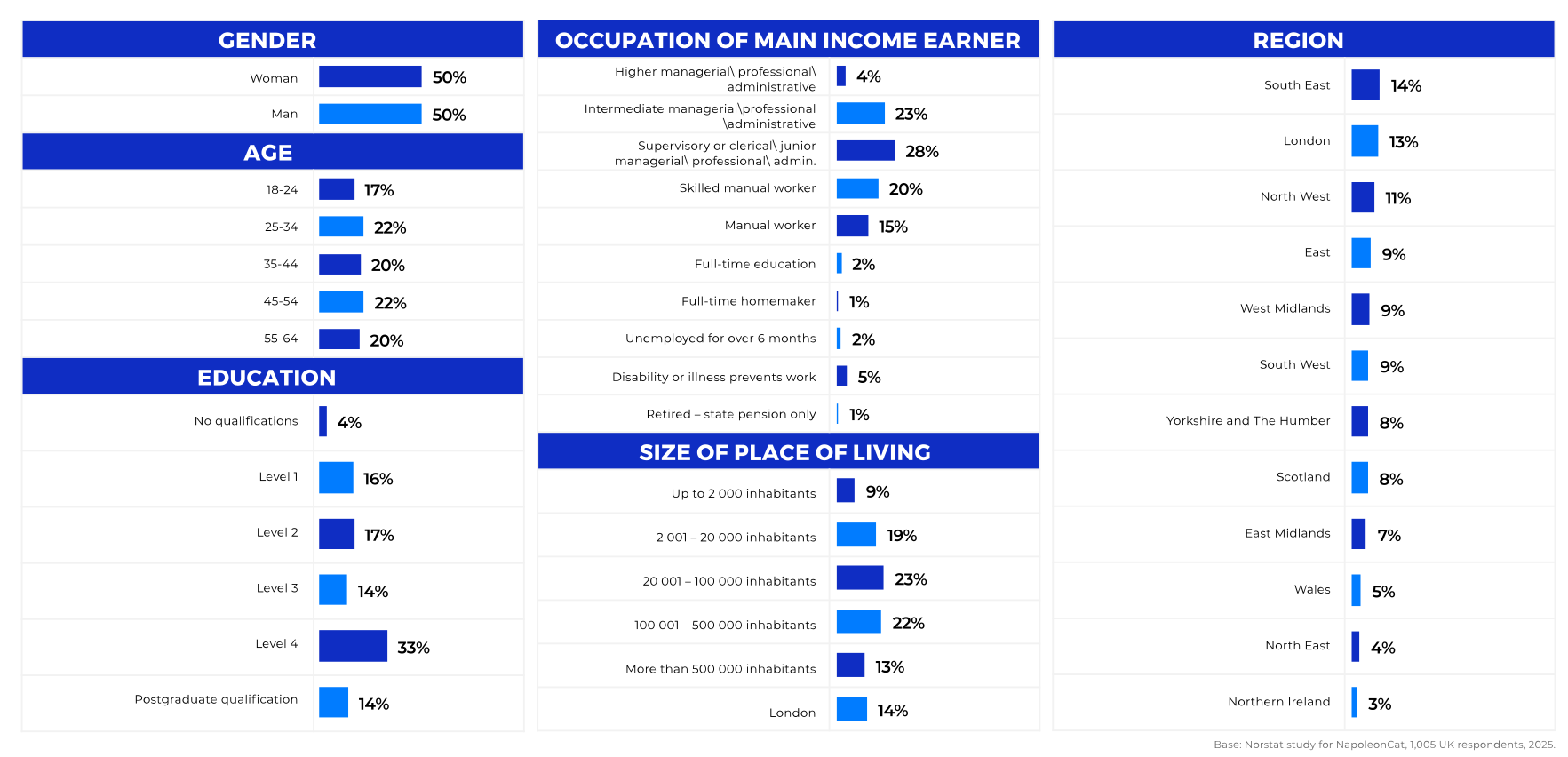
The study was conducted by NapoleonCat and Norstat, interviewing 1005 consumers in the UK – women and men aged 18-64. The sample was representative for the United Kingdom based on:
- Gender
- Age
- Region
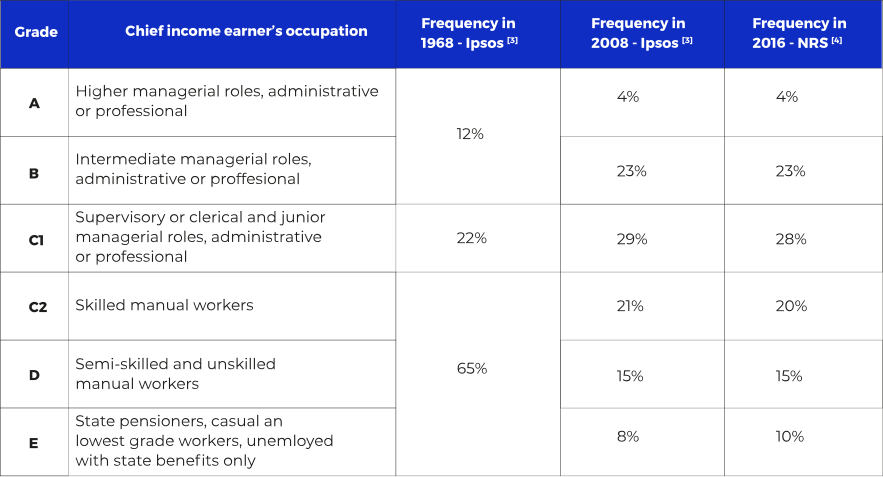
- NRS social grades*
To obtain relevant data, 15-minute interviews were conducted via a CAWI survey (computer-assisted web interviewing).
 Source: Norstat online survey for NapoleonCat, n=1,005 UK respondents, 2025.
What are NRS social grades?
It’s a system of demographic classification used in the United Kingdom based on the occupation of the head of the household rather than income, wealth, or property ownership (making an NRS social grade something other than a social class.)
Statistical significance
The report highlights statistically significant differences between the results for the groups included in the report and the results for the overall population of British consumers. A statistically significant result indicates that it is unlikely to have occurred by chance (due to random variations in the data).
If a specific group selected a given response more or less frequently (and the result for this group is significantly higher or lower than for
the overall UK population), it’s indicated next to the result with an upward or downward arrow.

Profile of all respondents (1/2)
Profile of all respondents (2/2)

About authors
NapoleonCat is a comprehensive social media management platform designed to streamline customer relationship management across all social channels, supporting businesses at every stage of the purchasing process. Our unified Social Inbox enables efficient handling of messages, comments, and reviews from platforms like Facebook, Instagram, TikTok, LinkedIn, YouTube, and Google My Business. Features such as auto-moderation and social CRM facilitate seamless engagement, ensuring timely responses and personalised interactions. By integrating publishing, analytics, and reporting tools, NapoleonCat empowers businesses to manage their social media presence effectively, enhancing customer satisfaction throughout the entire purchasing journey.
Established in 1997, Norstat has become one of Europe’s leading data collectors for market research. We specialise in delivering trustworthy, high-quality data to support well-informed analysis and decision-making. Employing fair and transparent data gathering methods, we maintain an extensive international panel network and trusted relationships with respondents. Our services support over 1,800 market research firms, brands, media and advertising agencies, publishers, and consultancies across various industries. With access to more than 4 million respondents across 19 countries, we provide reliable data tailored to your specific needs.
Social Media’s Big Impact
Customer service expectations on social media are higher than ever – and the impact goes far beyond marketing. This year’s research explores how social platforms shape buying decisions and why brands must stay tuned in.
What’s Inside the Report?
This isn’t just another generic market study. It’s your ultimate guide to:
- The Social Media Sweet Spots: Discover which stages of the buying process social media has the most influence on.
- Demographic Deep Dives: See how different consumer groups across the UK interact with social platforms – and how that impacts your strategy.
- Customer Service Must-Haves: Learn exactly what consumers expect when they reach out to brands on platforms like Facebook, Instagram, TikTok, and beyond.
Discover how UK consumers engage with brands on social media throughout their buying journey – and why keeping up with these changes is key to staying competitive.
Why Does This Matter?
- Social Media > Contact Forms & Chatboxes
Our research shows social platforms are now one of the top three communication channels for UK consumers, surpassing even the website forms and chat tools. - Young Consumers Lead the Change
From Gen Z to Millennials, younger demographics are driving this shift. If you’re not engaging with them where they are, rest assured your competitors will. - Customer Service is the New Marketing
Today’s consumers expect fast, personalised interactions on their preferred platforms. The clear division between marketing, sales, and retention is now a thing of the past.
Don’t Get Left Behind.
Click below to join the waiting list and get over 100 actionable insights for free.
Navigating the Social Chaos in 2025: Why Consumer Insights Matter
Social media never stands still – algorithms change, trends shift, and new platforms emerge. In this fast-moving landscape, knowing how consumers use social media to shop is more crucial than ever.
Our report reveals which platforms different audiences prefer, how they communicate, and what drives their purchases – offering insights to keep your brand ahead of the curve.
- Universal Trends: From Gen Z to Baby Boomers, consumers expect fast, personalised interactions on the platforms of their choice – not yours.
- Resilience Through Adaptation: Brands that integrate social media into their customer service and engagement strategies are thriving despite market uncertainties. However, it’s not always smooth sailing!
- The Bigger Picture: Social media offers a glimpse into how people think, feel, and act in today’s interconnected world.
This report gives actionable data that will, hopefully, inspire you to view social media as a vital growth lever. Who knows? It may even lead you to try selling through social streaming – something that’s proving attractive to some rather surprising demographics.
Whether you’re a marketer, customer service manager, or business leader, this report offers the insights you need to make smarter decisions in a world that’s anything but predictable.
METHODOLOGY
METHODOLOGY
Consumer Research by Norstat for NapoleonCat
This research, conducted by NapoleonCat and Norstat, explores how UK consumers engage with brands on social media. Interviews were carried out with 1,005 UK consumers – both men and women, aged 18-64. The study, conducted in 2025, draws exclusively from actual, up-to-date data.
The sample was representative of the UK population based on:
- Gender
- Age
- Region
- NRS social grades
Why is this study important?
The aim of this study was to gain a deeper understanding of how UK consumers use social media to interact with brands at different stages of engagement – from initial communication, through the purchasing process, to post-purchase support. By identifying preferred channels and consumer expectations for social media interaction, this research helps better meet customer needs and build stronger relationships.
Use this data to:
- Know Your Customers Better: Discover how UK consumers use social media to connect with brands, from the first message to post-purchase interactions.
- Find the Key Moments: Learn which stages of the buying journey are the most impacted by social media, and use this knowledge to your advantage.
- Meet Customer Expectations: Understand what consumers expect when contacting brands on social media – quick responses, personalisation, and exceptional service.
- Understand Your Audience: Explore how different demographics, particularly younger consumers like Gen Z, engage with brands online and tailor your strategy to stay ahead.
Insights from Experts
In this report, you’ll discover valuable insights from leading experts in marketing, customer service, and social media strategy. With years of experience, these professionals provide a thorough exploration of the constantly evolving world of social media and its influence on consumer behaviour. From identifying emerging trends to offering practical strategies, they share their expertise on how to engage with today’s audiences and stay competitive in a fast-changing market.
Download the 2025 Social Media Insights Report
This comprehensive guide is filled with actionable insights to help you make smarter decisions when refining your strategy, building essential capabilities, or attracting the right talent for your business.
Get ready for what’s next – invest in your growth and the future of your brand.

An entrepreneur, founder, and CEO of NapoleonCat – a leading customer engagement and support platform designed to help businesses manage social media interactions, automate moderation, and improve customer service efficiency. With a passion for innovation and technology, he has built a company that empowers brands to streamline their digital communication and enhance customer relationships.

Magdalena Bochyńska leads the Vasco Social Media and Influencer Marketing team, driving innovative campaigns that showcase the company’s goal of breaking down language barriers with advanced translation devices.
As an enthusiastic marketing leader, Magdalena uses smart planning and creativity to guide an international team that produces effective content in 17 countries and four continents. Her team’s efforts have helped increase the visibility of Vasco’s top products, like the Vasco Translator V4 and Vasco Translator E1.

Marketing, PR & E-commerce expert with over 20 years of experience. Graduated from Warsaw School of Economics (SGH) and Linköping University in Sweden. Cooperated with United PR, Wittchen and OCHNIK. As CMO & e-commerce director, specializes in brand image creation and awareness, overseeing marketing campaigns, social media activities, customer service, and development of e-commerce strategy.

Mick has been working in the tech ecosystem for over 15 years for companies such as GetResponse, Brand24 and now TRAFFIT. As Chief Growth Officer at TRAFFIT, Mick found that we have a space in recruitment where both candidates and hirers are feeling uncomfortable. With his amazing team at TRAFFIT he wants to fix this problem, and make recruitment processes enjoyable for everyone involved by providing both tools and education.