
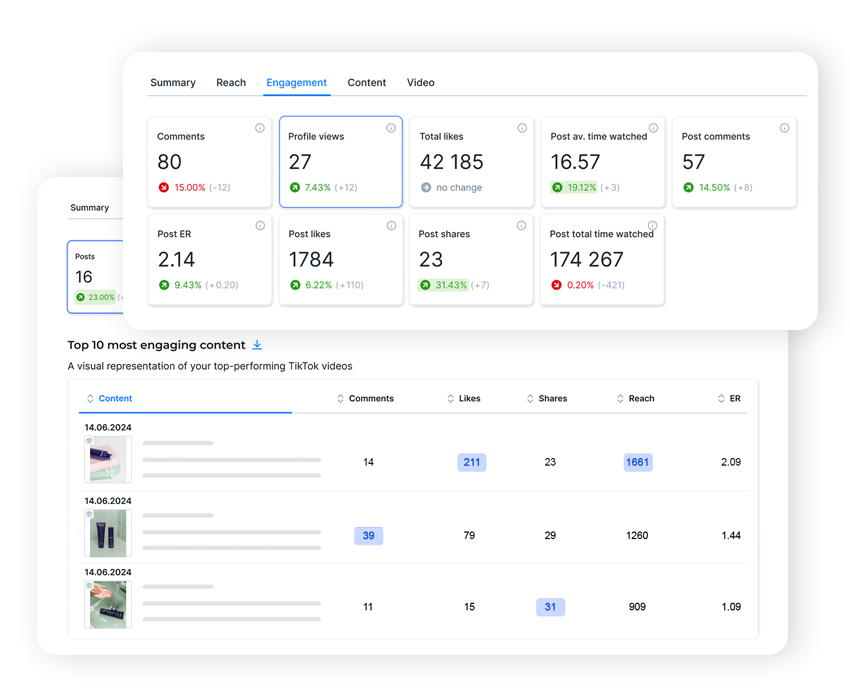
Agencies charge a fortune for competitive analytics, and doing it by hand takes weeks. NapoleonCat’s social media competitor analysis tool puts your competitors’ numbers next to yours – and emails the whole thing to whoever needs to see it.
Social Media Competitor Analysis Tool – Insights & Reports
Trusted by:


Supported platforms








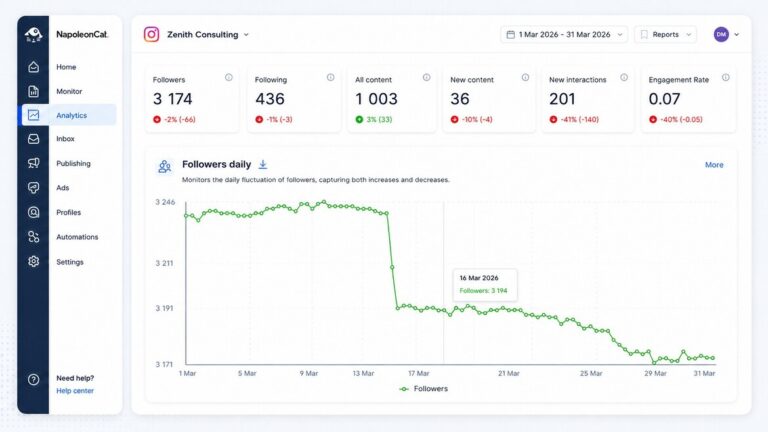
Analyze any competitor on Facebook, Instagram and YouTube
You don’t need admin access to anyone’s account. Add a competitor’s Facebook Page, Instagram profile or YouTube channel. NapoleonCat starts collecting their numbers from that day on.
A profile you follow gives up fewer numbers than one you manage – but enough to see what lands and what doesn’t.
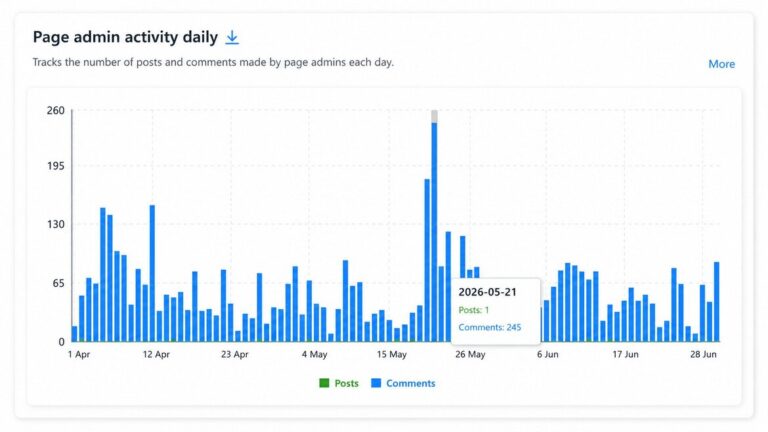
Check how often your competitors post
How often does your competitor actually publish? NapoleonCat counts it for you, day by day, so you can stop scrolling their feed trying to work it out. On Facebook you also see their admin activity – not just the posts, but how often they bother to answer the comments on their Page.
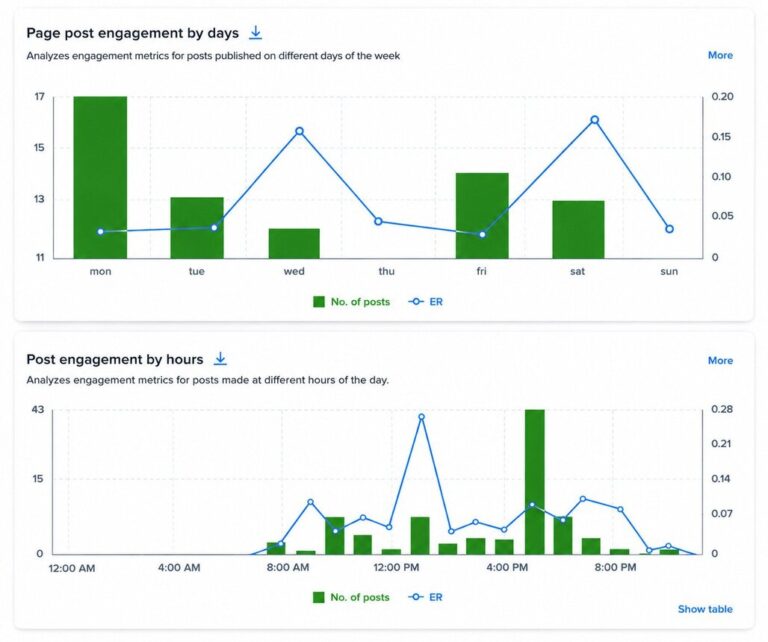
Post at the hours that already work for them
Guessing your posting schedule is expensive. Look at their engagement by day of the week instead, and on Instagram hour by hour, then take the slots their audience actually turns up for.
No running the experiment on your own feed first. Just the hours that already work for somebody selling to the same people you are.
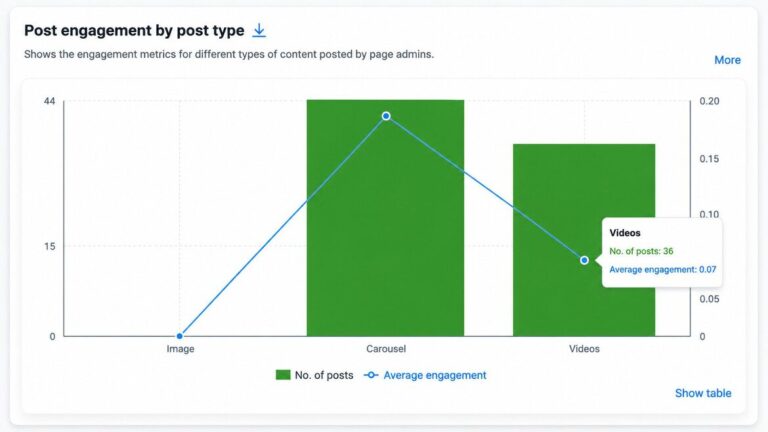
Spot the post types that work on their profiles
Reels, carousels, photos, video – one of them is usually doing most of the work on their profile, and you get to see which. On Instagram their engagement comes broken down by post type, and by number of hashtags, too. So you know what to make more of before you brief anyone.
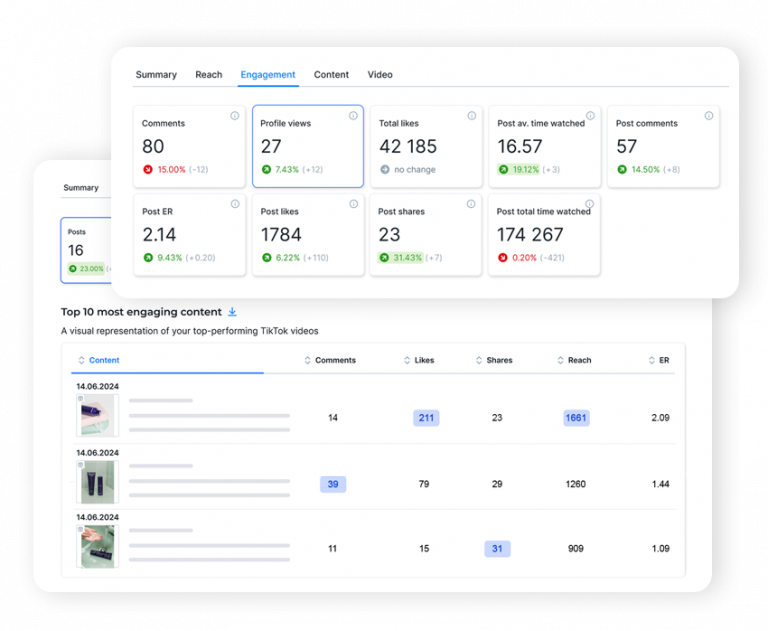
Find their best-performing content
Plenty of profiles have a handful of posts carrying the whole quarter. NapoleonCat ranks the ten most engaging pieces of their content on Facebook and YouTube, with comment counts, interactions and engagement rate behind each one. On YouTube you even get sentiment. (Yes, really.)
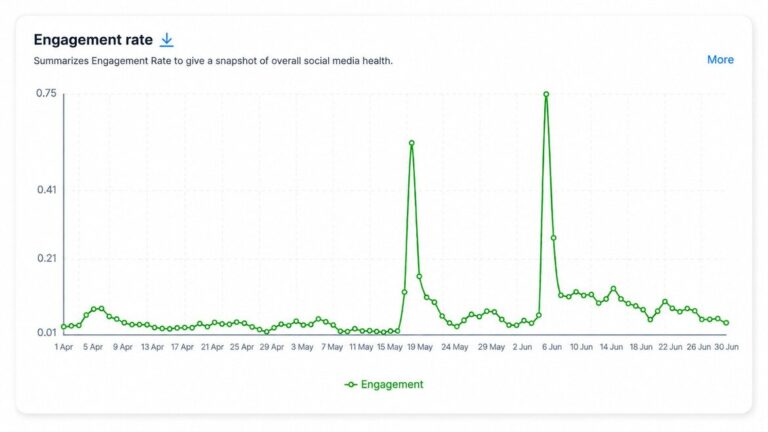
Compare engagement rates, not just follower counts
A big following doesn’t mean much on its own. Engagement rate is where you find out whether anyone’s listening, so it’s charted daily for the Facebook and Instagram profiles you follow, next to their interactions and Facebook’s Social Interaction Index.
Follower counts flatter people. Engagement rate doesn’t.
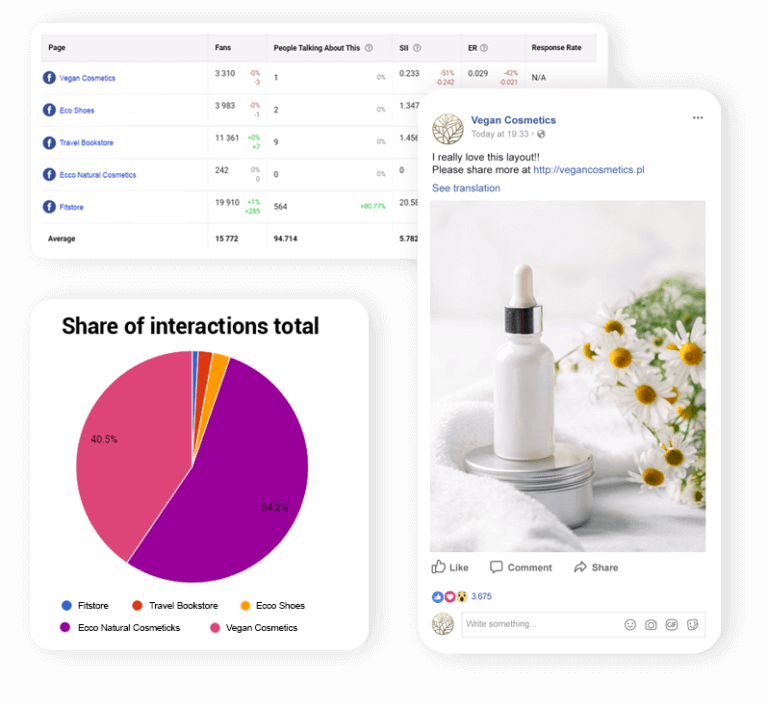
Benchmark yourself against a set of competitors
Drop your own profiles and a whole set of competitors into one comparison, then read the table top to bottom. Followers, engagement rate, interactions, posting volume – you’ll see where you’re ahead, where you’re behind and by how much, which is the part that changes what you do next week.
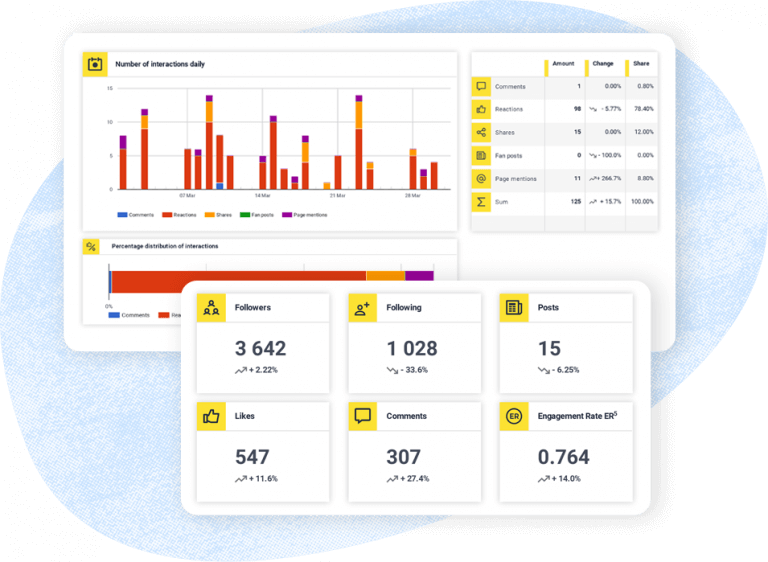
Get the competitor report by email every month
Nobody enjoys building a competitor deck by hand. NapoleonCat packages the numbers into a PDF with your own logo on it and emails it weekly, monthly or quarterly – to you, or straight to your client. So you don’t have to.
Try the social media competitor analysis tool free for 14 days




Here’s why our clients love NapoleonCat
Join the agencies and brands that benchmark their competitors every month without building a single slide.

NapoleonCat saves up to one-third of a full-time position. That’s time we would otherwise spend manually moderating thousands of comments each month using the Meta Business Suite, profile by profile and comment by comment. Time we can now use for growth. NapoleonCat is the best tool of its kind on the market, and it’s still constantly evolving and improving by introducing new AI features.

It’s hard to imagine our work without a tool that includes so many valuable features. It won’t be an overstatement when I say that NapoleonCat saves us multiple full-time positions that would be dedicated to just moderating comments or manually generating reports.

NapoleonCat gives us the full picture of social media interactions. It’s easier to pick up urgent threads that need taking immediate action. And with conversation history, it’s much easier to continue the work of another team member while they’re out of office.

We work with multiple clients, and with NapoleonCat, we don’t waste time switching between multiple software tools. We can also deliver reliable data from a single source. We tested other social media moderation and analytics tools before, but none of them lived up to what NapoleonCat delivers. They’re the best, and I personally love using the tool. 🙂

NapoleonCat is now an indispensable tool that we use for moderation and analytical purposes, as well as content publishing. We’re curious to see new capabilities of the tool and test its new uses, for example, to moderate TikTok ad comments, as we predict this social media channel to become more and more important for our clients.

It’s the first social media engagement tool we have ever tried that is truly intuitive and that makes it easy for us to include the clients in the process. The service and support is great and personal. And the value for money is great!

We were looking for a tool that would allow us to consolidate and manage comments and private messages from Messenger in one place. Analytics and reports were also very important to us, as they would show us the level of our social media customer service. That’s why, in 2017, we decided to choose NapoleonCat.
See how NapoleonCat compares to its alternatives:
| Feature | NapoleonCat | Hootsuite | Sprout Social | Agorapulse |
|---|---|---|---|---|
| Networks you can track competitors on | ✅ Facebook, Instagram and YouTube | ⚠️ Facebook, Instagram, X (no YouTube) | ⚠️ Facebook, Instagram, X (no YouTube) | ⚠️ Facebook and Instagram only |
| Competitor engagement by day of the week and by hour | ✅ Yes (hourly on Instagram) | ❌ No day or hour breakdown | ❌ No day or hour breakdown | ❌ No |
| Competitor engagement per post format | ✅ Yes (Instagram) | ⚠️ Listening add-on | ⚠️ Post counts by format, not engagement | ✅ Yes |
| Competitor engagement by number of hashtags | ✅ Yes (Instagram) | ⚠️ Listening add-on | ❌ No | ❌ No |
| Their top posts ranked by engagement | ✅ Yes (top 10, Facebook and YouTube) | ⚠️ Listening add-on | ✅ Yes | ✅ Yes (six posts) |
| How often their admins reply to comments on their Page | ✅ Yes (posts and admin replies, daily) | ❌ No | ❌ No | ❌ No |
| YouTube competitor channels, with sentiment | ✅ Yes | ❌ No | ❌ No | ❌ No |
| Daily engagement rate history per tracked profile | ✅ Yes | ⚠️ Limited history | ✅ Yes | ⚠️ Limited |
| Side-by-side benchmarking of multiple profiles | ✅ Yes | ✅ Yes | ✅ Yes | ✅ Yes |
| Competitor data in scheduled white-label PDF reports | ✅ Yes (weekly, monthly, quarterly) | ⚠️ Limited | ⚠️ Scheduled PDFs on the Advanced plan | ⚠️ PDF export, scheduling on higher tiers |
| EU-based, GDPR-first hosting | ✅ Yes | ❌ Canada-based | ❌ US-based | ✅ EU-based |
Frequently asked questions
Which social networks can I run competitor analysis on?
Facebook, Instagram and YouTube. Competitor tracking isn’t available for TikTok or LinkedIn. And a profile you follow returns a smaller set of metrics than one you manage – you don’t get audience demographics for a competitor’s Instagram profile, for instance.
Do I need access to a competitor’s account to analyze it?
No, the public profile is enough. There’s nothing to install and nothing to ask them for. NapoleonCat starts collecting their public numbers the day you add them, though what it can collect varies by network – Facebook and Instagram give the most, YouTube the least.
How do you do a competitor analysis on social media?
Pick three to five competitors selling to the same people you do, then track the same things on their profiles as you do on your own: how often they publish, which formats they use, when they post, their engagement rate over time and which posts pulled the most. Then line the two up and look at the gaps. NapoleonCat does the collecting and the comparing for you.
How far back does competitor data go?
The record starts the day you add the profile, so there’s no back catalog waiting for you on a competitor you add this afternoon. From then on NapoleonCat keeps up to 24 months of it and you can pick any timeframe inside that. Worth adding the profiles you care about now rather than the week before you need the report.
Can ChatGPT analyze social media accounts?
Only what you paste into it. It has no access to Facebook’s, Instagram’s or YouTube’s data, so it can’t tell you a competitor’s engagement rate over the last six months, count how often they posted or email anyone a report next month. It’s useful for reading a set of numbers once you have them – getting the numbers is the part a tool like NapoleonCat does.
How much does a social media competitor analysis tool cost?
Competitor tracking, analytics and automated reports sit on NapoleonCat’s Standard plan, which is $89 a month, or $79 a month billed annually, for 2 users and 5 profiles. More users and profiles move you up in published steps. There’s a 14-day free trial and it doesn’t ask for a card.
Competitive analytics without the agency invoice
Free 14-day trial: full access, zero commitment.
No credit card required