

Save hours on social, every day.
Automate moderation and replies, schedule posts, and pull reports - all in one tool.
Table of Contents
- How we did this, and what nearly derailed it
- Finding 1: the complaint is not quality, it is justification
- Finding 2: the price hikes are real, and we can show you the receipts
- Finding 3: the ratings do split, and the split is about the contract
- Finding 4: people stay for reporting and listening, not publishing
- Finding 5: check who is recommending the alternative
- Finding 6: it is the right tool built for the wrong job
- Finding 7: what people actually move to
- What Sprout Social costs in 2026
- What that means for a team
- Sprout Social vs NapoleonCat
- So should you buy Sprout Social in 2026?
- Sprout Social reviews on Reddit: the questions people keep asking
Sprout Social scores 4.4 on G2 and 4.4 on Capterra. Almost nobody on Reddit says it is a bad tool. What they say, over and over, is that they cannot justify what it costs.
We read two years of Reddit threads about Sprout Social, counted what people actually complain about and actually praise, and stripped out the accounts with something to sell. So we checked them against archived copies of Sprout’s own pricing page, going back to 2019.
- How we did this, and what nearly derailed it
- Finding 1: the complaint is not quality, it is justification
- Finding 2: the price hikes are real, and we can show you the receipts
- Finding 3: the ratings do split, and the split is about the contract
- Finding 4: people stay for reporting and listening, not publishing
- Finding 5: check who is recommending the alternative
- Finding 6: it is the right tool built for the wrong job
- Finding 7: what people actually move to
- What Sprout Social costs in 2026
- What that means for a team
- Sprout Social vs NapoleonCat
- So should you buy Sprout Social in 2026?
- Sprout Social reviews on Reddit: the questions people keep asking
Key Takeaways
- Price is the single biggest theme, at 40% of comments. 90 of 226 independent comments raise cost.
- The price complaints are documented, not just felt. Sprout’s Standard plan went from $99 a seat in 2021 to $249 in 2023, a 152% rise, read off archived copies of their own pricing page.
- But the increase stopped three years ago. Every snapshot from 2023 onward reads the same $249. People are angry about a jump that has already finished.
- 35% of the same comments are positive about the product. This is not a tool people call bad. It is a tool people call hard to justify, which is a different problem and a different decision.
- The rating gap is real, and it is not about the product. G2 says 4.4 from 6,873 reviews and Capterra 4.4 from 608, against 1.7 on Trustpilot from 85. Of the 58 one-star Trustpilot reviews, 34 are about cancellation and auto-renewal. Three are about a bug.
- The alternatives being recommended to you are not evenly sourced. Hootsuite’s 170 mentions come from 110 different people. Statusbrew’s 76 come from 15, and two accounts produce 54 of them.
- What people credit it for is reporting and listening, named in 38% and 28% of comments. The publishing is rarely the reason anyone stays.
- Sprout is a listed company, ticker SPT. Much of what a search for “Sprout Social on Reddit” returns is stock discussion in investing subreddits, which is why casual research on this tool goes wrong.
How we did this, and what nearly derailed it
We searched 22 subreddits directly, plus Reddit-wide for six phrasings of the name, then kept only the results that came from an allowlist of 25 marketing and social-media subreddits. That left 235 threads from the last 24 months that discuss the product. We pulled every comment from 229 of them, which came to 2,766 comments. 329 of those name Sprout and give an opinion.
Then we removed two groups. 47 comments were written by someone selling a rival, caught either by a disclosure in the body or by a brand name in the username. A further 56 came from eleven accounts that only ever appear recommending one competing tool, which we will come back to.
That leaves 226 comments from 177 people across 14 subreddits. The year split is 26 from 2024, 145 from 2025 and 55 from 2026, so this describes the product as it is sold today rather than the one people argued about in 2019.
One caveat. Upvote counts in these threads are low, topping out at eight. These are working threads in niche subreddits, not front-page arguments, so the value here is in the consistency of 226 opinions, not in any single endorsed comment. Six of the 235 threads could not be retrieved.
The thing that nearly derailed the sweep is what makes a quick Reddit search on this tool misleading. Sprout Social is publicly traded under the ticker SPT. Search Reddit for the name and a large share of what comes back is German-language stock analysis in r/wallstreetbetsGER, r/SPT_Stock and r/Aktien. None of it is about the software. We excluded it with a subreddit allowlist.

Manage and automate conversations across all your socials
Manage and automate social media interactions on Facebook, Instagram, TikTok, LinkedIn, YouTube, and Google My Business – with an all-in-one social media tool.
Finding 1: the complaint is not quality, it is justification
90 of 226 comments raise price. That is 40%, and it is the largest single theme.
What makes it interesting is the company it keeps. 80 comments, 35%, use positive language about the product: solid, great, reliable, the best at what it does. The two groups overlap heavily. The characteristic Sprout comment is not “this is bad”, it is some version of “this is very good and I am not sure I can keep paying for it”.
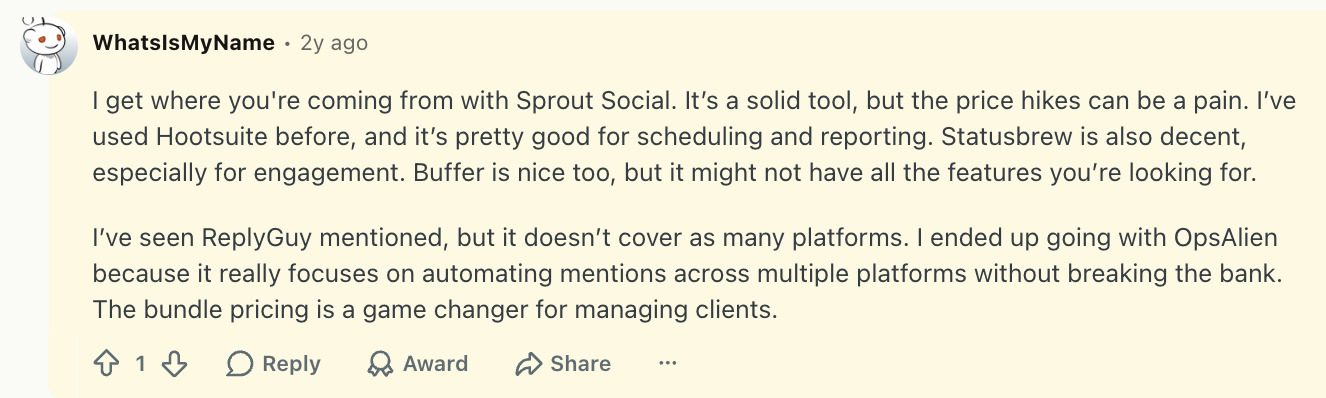
One user in r/SocialMediaMarketing put it in a single line: it is a solid tool, but the price hikes can be a pain.
The counts back that up from the other direction too. Only 11 comments in 226 use language that attacks the product itself: buggy, clunky, broken, frustrating. Complaints about what Sprout costs outnumber complaints about how it works by roughly eight to one.
That framing matters when you are evaluating it. With most tools, a wall of Reddit complaints tells you the product has problems. Here it tells you the product works and the invoice is the argument. If your budget clears the number, most of the criticism you will read does not apply to you.
Finding 2: the price hikes are real, and we can show you the receipts
Here is the gap in what Reddit can tell you. 40% of comments raise price, but almost always as a feeling about the number on the invoice today. Exactly one comment names price hikes as such, and it offers no figures. So we went and got them, from archived copies of Sprout’s own pricing page. Monthly per-seat rates:
| Pricing page snapshot | Standard | Professional | Advanced |
|---|---|---|---|
| 29 May 2019 | $99 | $149 | $249 |
| 1 June 2021 | $99 | $149 | $249 |
| 1 June 2023 | $249 | $399 | $499 |
| 2 June 2024 | $249 | $399 | $499 |
| 9 June 2025 | $249 | $399 | $499 |
| September 2026 | $249 | $399 | $499 |
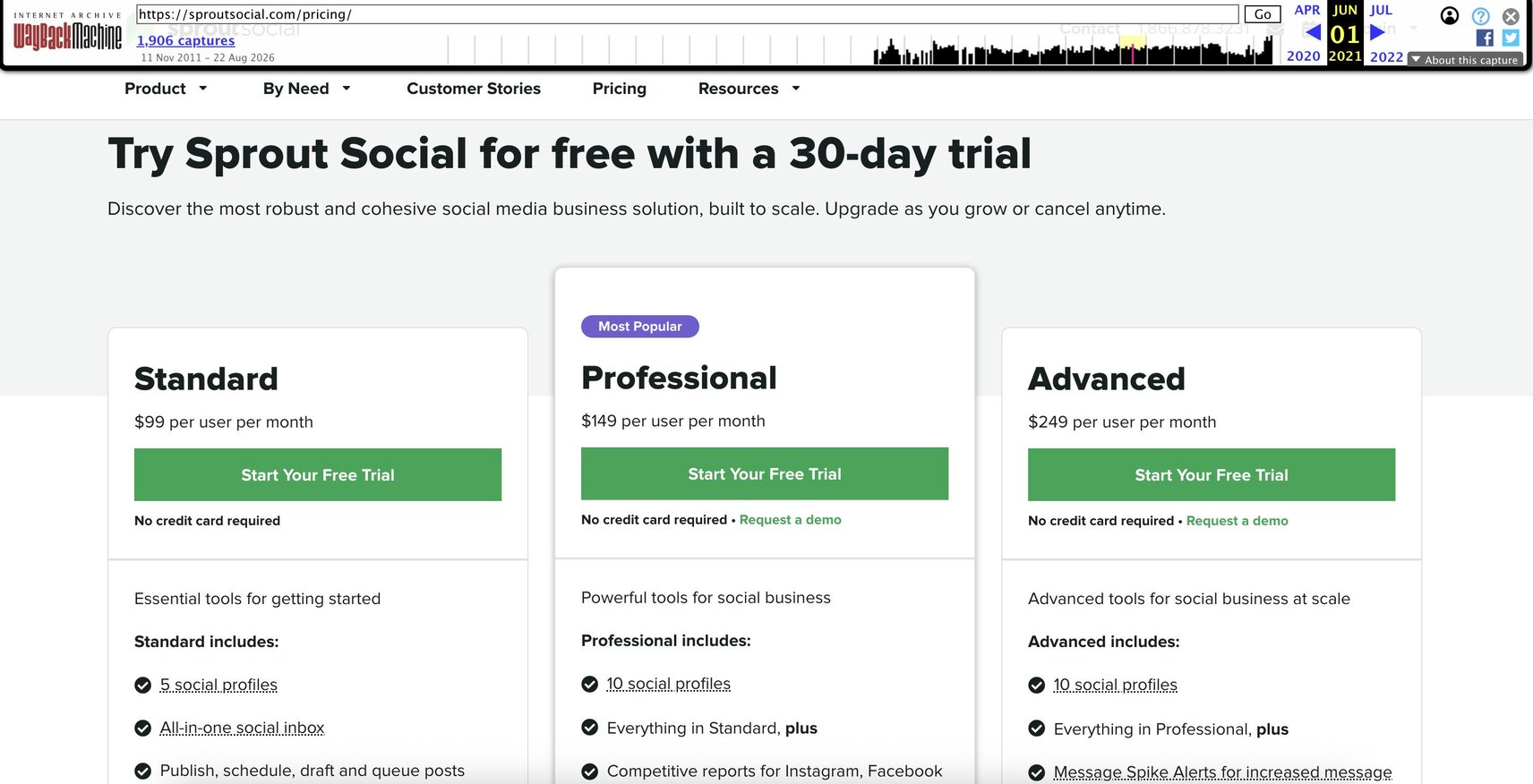
Between June 2021 and June 2023 the same plan names went up by 152% on Standard ($99 to $249), 168% on Professional ($149 to $399) and 100% on Advanced ($249 to $499). The complaint is not nostalgia. It is arithmetic.
And here is the part that makes the complaint less useful than it looks: none of those three plans has moved since 2023. Three consecutive June snapshots and today’s page all read the same $249, $399 and $499. The anger you are reading on Reddit is about a jump that finished three years ago. A buyer evaluating Sprout in 2026 faces a high price, not a rising one.
There is one more detail worth noticing. Essentials, the entry plan added after mid-2025, is $99 per seat. That is exactly what Standard cost in 2019 and 2021. Sprout has quietly restored its old entry price under a new name, with five profiles and a publishing focus instead of the full Standard feature set.
Finding 3: the ratings do split, and the split is about the contract
Sprout scores 4.4 on G2 from 6,873 reviews and 4.4 on Capterra from 608. On Trustpilot it scores 1.7 from 85 reviews, 71% of them one star.
A gap that wide usually means the sites are catching people at different moments. G2 and Capterra reach users mid-contract, often through a vendor review campaign. Trustpilot reaches them when something has gone wrong. So we read all 83 Trustpilot reviews we could retrieve, to find out what the something is.
It is not the software. Of the 58 one-star reviews we read, 34 are about cancellation, auto-renewal or contract terms. Three mention a bug. Trustpilot’s own topic labels for the page are Cancellation, Customer service, Customer communications and Ethics. The most recent ones describe emailing to cancel three times and being auto-renewed into another year anyway, and a customer who cancelled verbally in January and was renewed regardless.
That is the same verdict Reddit gives, arrived at by a completely different population. There, 5% of comments attack the product and 40% raise price. Here, 5% of the one-star reviewers mention a bug, while the largest single group, 34 of 58, is arguing about the invoice and the exit.
What this is not is a category problem. Trustpilot lists the tools people also looked at, on the same page:
| Tool | Trustpilot score | Reviews |
|---|---|---|
| Hootsuite | 1.3 | 554 |
| Later | 1.5 | 346 |
| Sprout Social | 1.7 | 85 |
| Buffer | 3.4 | 116 |
| Metricool | 3.9 | 639 |
| Agorapulse | 4.0 | 57 |
| Sendible | 4.3 | 25 |
| Publer | 4.8 | 1,000+ |
Same category, scores from 1.3 to 4.8. The three lowest sell annual contracts through a salesperson, and most of the higher ones sell month-to-month subscriptions you can switch off yourself in the app. Later is the exception, self-serve and still at 1.5, so treat this as a pattern rather than a rule. It is still enough to say the spread tracks the billing relationship more closely than it tracks the software.
Two caveats, because 85 is a small number against 6,873 on G2. Trustpilot is self-selecting and pulls in people with a grievance, so read 1.7 as a signal about one specific failure mode rather than a verdict on the product. Trustpilot also flags that Sprout has no recent history of inviting reviews, and only twelve have been left in the last twelve months. Trustpilot records that Sprout has replied to 41% of its negative reviews.
The useful thing to do with this is narrow and worth doing: before you sign, get the notice period, the auto-renewal terms and the cancellation process in writing. Sprout’s own pricing page publishes none of the three. Most of the one-star reviews on Trustpilot are somebody finding that out afterwards.
Finding 4: people stay for reporting and listening, not publishing
Sorting the 226 comments by what they actually discuss:
| What the comment is about | Comments | Share |
|---|---|---|
| Price, cost, value | 90 | 40% |
| Reporting and analytics | 85 | 38% |
| Publishing and scheduling | 68 | 30% |
| Social listening | 64 | 28% |
| Agency or enterprise context | 37 | 16% |
| Inbox and engagement | 34 | 15% |
| Support | 23 | 10% |
Reporting and listening are what people name when they explain why they are still paying. Publishing is actually named slightly more often than listening, at 30%, but it is rarely what people give as the reason they stay, because every tool in the category schedules posts.
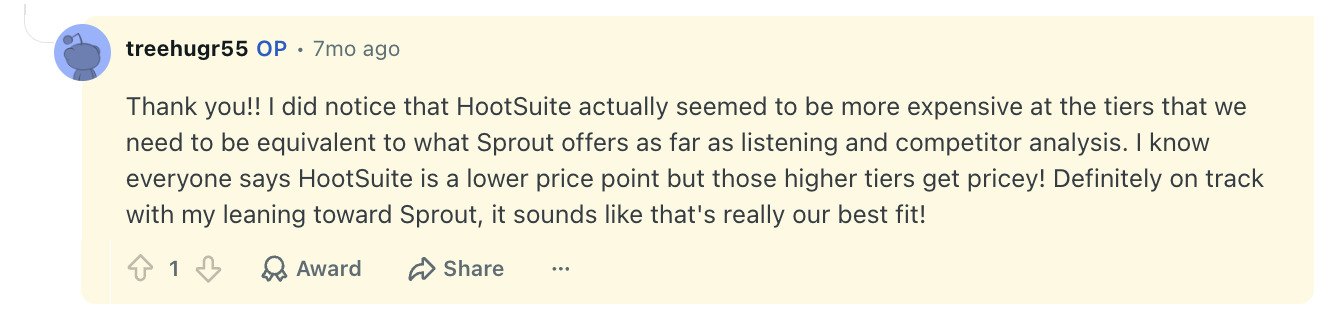
The clearest version came from a buyer in r/SocialMediaManagers comparing tiers rather than headline prices, who found that Hootsuite worked out more expensive at the tiers matching what Sprout gave them on listening. The decision comes down to this: if listening is the job, Sprout is competitively priced. If it is not, you are paying for a module you do not open.
Worth knowing before you budget: on Sprout’s own pricing page, Listening and Premium Analytics are add-ons to the Standard plan and up, sold separately with no published price. What each tier actually includes, and where the add-ons land, is set out in Sprout Social pricing.
Finding 5: check who is recommending the alternative
This is the finding we did not expect, and it changes how you should read every “try X instead” reply. The counts below are taken across all 329 opinionated comments, before the eleven single-tool accounts were removed, because what they show is what you would see reading the threads yourself.
| Tool recommended | Mentions | Distinct people | Mentions per person |
|---|---|---|---|
| Hootsuite | 170 | 110 | 1.5 |
| Buffer | 106 | 83 | 1.3 |
| Statusbrew | 76 | 15 | 5.1 |
| Sprinklr | 64 | 35 | 1.8 |
| Later | 60 | 53 | 1.1 |
| Metricool | 49 | 27 | 1.8 |
| RecurPost | 27 | 6 | 4.5 |
The useful number is mentions per person. Hootsuite runs at 1.5, Buffer at 1.3, Later at 1.1: a lot of people each saying it once, which is what an organic recommendation looks like. Statusbrew runs at 5.1 and RecurPost at 4.5. Two accounts alone produce 54 of Statusbrew’s 76 mentions, one of them 36 on its own.
Eleven accounts met our test of four or more mentions with at least 70% pointing at a single tool. We removed all 56 of their comments from the counts above. Hootsuite works as the benchmark here because we ran the same sweep for Hootsuite reviews on Reddit, and its recommendations were spread across a comparable range of accounts.
Every number here is countable from public comment history. One of those accounts, created in October 2024 with 234 comment karma, mentions Statusbrew in 11% of everything it has ever posted across 21 subreddits. That is unusual, not proof. But if you searched Reddit for Sprout alternatives and came away thinking one small tool had a groundswell behind it, this is where that impression came from.
Finding 6: it is the right tool built for the wrong job
One of the sharpest comments we read is not about price at all. A community manager in r/CommunityManager explained that Sprout is built first as a social media management tool rather than a true community management platform, and that this is exactly why it felt so limited for their work.
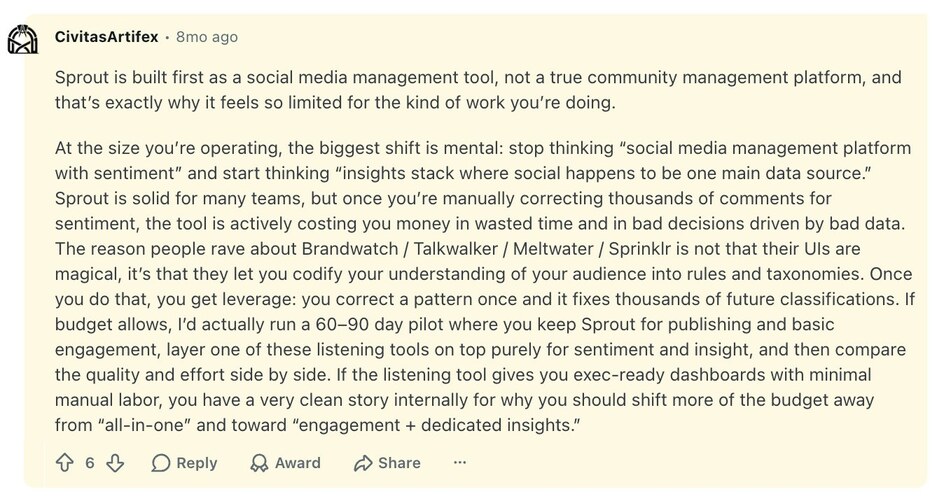
This is the second-order complaint underneath the price one. The same threads that call it too much for a small team also describe it as underkill for community management, or for deep listening against a dedicated tool like Brandwatch. The tool is excellent in the middle of its range and awkward at both ends, and its price only makes sense in the middle.
Finding 7: what people actually move to
Switching, cancelling or downgrading comes up in just 11 comments, 5% of the total. The destinations they name fall into two groups.
Metricool and Later come up for teams who wanted scheduling and basic analytics at a fraction of the cost. One user in r/SocialMediaMarketing wrote that they left Sprout for Metricool and volunteered that nobody was paying them to say it. Another in the same thread pointed out that Later works well for scheduling and is a lot cheaper than both Hootsuite and Sprout.


Sprinklr comes up in the other direction, from teams who outgrew Sprout’s analytics rather than its price.
The pattern in those few is consistent: people leave Sprout downward for cost or upward for depth, and almost nobody names a like-for-like replacement. That fits the rest of what we read, but 11 comments is too thin to call it a trend on its own.
Manage and automate conversations across all your socials
Manage and automate social media interactions on Facebook, Instagram, TikTok, LinkedIn, YouTube, and Google My Business – with an all-in-one social media tool.
What Sprout Social costs in 2026
These are read off Sprout’s own pricing page in September 2026. Every plan is priced per seat, from the first seat. The page defaults to annual billing, so the number you see first is not the month-to-month rate.
| Plan | Monthly | Billed annually | Social profiles |
|---|---|---|---|
| Essentials | $99 per seat | $79 per seat | 5 |
| Standard | $249 per seat | $199 per seat | 5 |
| Professional | $399 per seat | $299 per seat | Unlimited |
| Advanced | $499 per seat | $399 per seat | Unlimited |
| Enterprise | Custom | Custom | Custom |
Every plan includes 100 AI agent credits per seat per month. The free trial is 30 days with no credit card, more than twice the length of Hootsuite’s 14 days and of NapoleonCat’s.
What that means for a team
Per-seat pricing is the whole story once more than one person touches social.
A five-person team on Standard is $1,245 a month paying monthly, or $995 billed annually. Ten people is $2,490 a month. Nothing about the product changes between one seat and ten; the invoice simply multiplies.
This is why the price theme dominates a set of comments that otherwise likes the tool. A single social media manager at $249 is a normal software line item. The same tool for a team of eight is a headcount-sized decision.
Sprout Social vs NapoleonCat
| Feature | Sprout Social | NapoleonCat |
|---|---|---|
| Pricing model | Per seat, from seat one | Per plan, users included, capacity in published steps |
| Entry price | $99 per seat/month (Essentials, 5 profiles) | $89/month (Standard, 2 users and 5 profiles), publishing and analytics only |
| Cost for 10 people | $2,490/month on Standard | $299/month on Pro, the plan that matches Standard on having an inbox |
| Publishing and analytics | Standard, $249 per seat | Standard, $89 |
| Inbox for comments and DMs | Included from Standard | Pro, $109 |
| Automatic moderation | Not listed on Sprout’s pricing page | Expert, $139 |
| Social listening | Keyword and location monitoring; deeper Listening is a paid add-on | Not a listening tool |
| Platforms | Broad, including X | Facebook, Instagram, TikTok, YouTube, LinkedIn Company Pages, Google Business Profile, plus Google Play and App Store reviews. X is publishing only |
| Historical analytics | Premium Analytics is a paid add-on from Standard up, price not published | 24 months of data retention on every paid plan |
| Free trial | 30 days, no card | 14 days, no card |
| Company and hosting | US-based company | EU-based company, EU-hosted |
The read: these tools are not competing for the same buyer on features. Sprout is a listening and analytics platform with publishing attached, priced for the one or two specialists who live in it. NapoleonCat is a moderation and engagement platform for teams, where going from two people to five costs $60 a month on Standard rather than another $249 a head.
If your problem is the one Reddit keeps raising, that Sprout is very good but the seat maths has stopped working, the question is not which tool is better. It is whether you are paying per seat for capability that only one or two people in your team actually use. If that is the case, it is worth weighing NapoleonCat as a Sprout Social alternative, feature by feature.
So should you buy Sprout Social in 2026?
Sprout still makes sense if:
- social listening or serious reporting is a real part of your job, not a nice-to-have
- one or two people need the tool, rather than a whole team
- you are comparing tier for tier rather than headline for headline, where it prices well
- the software itself is not in question, and the contract terms are something you are willing to negotiate up front
- 30 days is long enough to prove it, and it usually is
Look elsewhere if:
- your headcount is growing and every new login adds another full seat price
- you mainly need scheduling, which every cheaper tool in the category does
- your problem is comment and DM volume rather than measurement
- you need true community management, which several commenters say it is not built for
- your listening needs are deep enough that a dedicated tool would beat the add-on
Sprout Social reviews on Reddit: the questions people keep asking
What is Sprout Social, in one paragraph?
A social media management platform built around publishing, analytics, social listening and a shared inbox, sold per seat and aimed at mid-sized teams and agencies. The tiers differ mainly in how much listening and reporting you get, which is where almost all of the price argument on Reddit sits.
Is Sprout Social worth the money?
It depends almost entirely on headcount and on whether you use the listening and reporting. Of the comments we read, 40% raise price while 35% speak positively about the product, and the same people often do both. For one or two specialists who live in the analytics, the answer in these threads is generally yes. For a team of five who mainly schedule posts, it is generally no.
Why is Sprout Social rated 1.7 on Trustpilot?
Because Trustpilot catches people at renewal rather than mid-contract. Of the 58 one-star reviews we read, 34 concern cancellation, auto-renewal or contract terms and three mention a bug. It is a rating of the commercial relationship, not the software, which is why G2 and Capterra both sit at 4.4. Get the notice period and cancellation process in writing before you sign.
Why do Reddit users say Sprout Social is expensive?
Because it charges per seat from the first seat, and the tiers step up sharply. Standard is $249 per seat per month, so five people is $1,245 a month and ten is $2,490. The product does not change between one seat and ten, only the invoice.
What do Reddit users like about Sprout Social?
Reporting and analytics, named in 38% of comments, and social listening, named in 28%. Publishing is discussed nearly as often, but it seldom decides the purchase, because every competing tool schedules posts.
What are the best Sprout Social alternatives according to Reddit?
Hootsuite is named most often and by the widest range of people, 170 mentions from 110 accounts, with Buffer second at 106 from 83. Sprinklr comes up for teams wanting deeper analytics, Metricool and Later for teams wanting the cost to come down. Treat recommendations for smaller tools carefully: Statusbrew’s 76 mentions come from just 15 accounts and RecurPost’s 27 from six.
Is Sprout Social better than Hootsuite?
The one buyer we found who compared them tier for tier rather than by headline price found Hootsuite more expensive once matched on listening, the same pattern we hit comparing Hootsuite vs Sprout Social across every plan. Both sit in the same bracket. The more useful question is whether you need what either charges for, or whether a per-plan tool covers the work at a fraction of the team cost.
Does Sprout Social have a free trial?
Yes, 30 days with no credit card required. That is more than twice as long as the trials at Hootsuite and NapoleonCat, both of which run 14 days, also with no card.
Manage and automate conversations across all your socials
Manage and automate social media interactions on Facebook, Instagram, TikTok, LinkedIn, YouTube, and Google My Business – with an all-in-one social media tool.