

Save hours on social, every day.
Automate moderation and replies, schedule posts, and pull reports - all in one tool.
Table of Contents
- How we did this
- Finding 1: 56 of the 87 mentions of CommentGuard on Reddit come from its founder
- Finding 2: there is genuinely nowhere else to look
- Finding 3: two users reported comments becoming visible again, and what can explain it
- Finding 4: what people who like it actually credit it for
- Finding 5: the Meta permissions request comes up in more than one thread
- Finding 6: the detailed positive record rests on two accounts
- Finding 7: the conversation is happening in ad subreddits, not social media subreddits
- Should you buy CommentGuard in 2026?
- CommentGuard reviews on Reddit: the questions people keep asking
CommentGuard has no G2 listing, no Capterra listing, and a Trustpilot profile it claimed in October 2025 that still has zero reviews. If you want to know what using it is like, Reddit is not one option among several. It is the only one.
So we read all of it. Every thread, every comment, counted and dated.
- How we did this
- Finding 1: 56 of the 87 mentions of CommentGuard on Reddit come from its founder
- Finding 2: there is genuinely nowhere else to look
- Finding 3: two users reported comments becoming visible again, and what can explain it
- Finding 4: what people who like it actually credit it for
- Finding 5: the Meta permissions request comes up in more than one thread
- Finding 6: the detailed positive record rests on two accounts
- Finding 7: the conversation is happening in ad subreddits, not social media subreddits
- Should you buy CommentGuard in 2026?
- CommentGuard reviews on Reddit: the questions people keep asking
Key Takeaways
- We read 1,025 comments across 69 threads. 87 of them mention CommentGuard. That is effectively the whole public conversation about this tool on Reddit.
- 56 of those 87 comments came from one account. It belongs to the founder. That leaves 31 comments from 24 other people as the independent record.
- 32 of the founder’s 56 comments carry no disclosure. He does say who he is in the other 24, which is more disclosure than many founders manage.
- Two users reported comments becoming visible again, two years apart. One had spent months recommending CommentGuard, then said comments were unhiding themselves and moved to NapoleonCat, which he called the more expensive option. The second, an unconnected user, reported in April 2026 that comments which should have been hidden were still publicly visible. Neither report can be checked from outside.
- The people who like it are using it for the same job. Spam control on Facebook, Instagram, TikTok and YouTube, paid and organic, through auto-hiding, AI filters, keyword auto-replies and comment exports.
- The conversation lives in ad subreddits, not social media ones. It is a comment moderation tool, but the people buying it are advertisers, and the problem they bring is spam under paid posts.
How we did this
NapoleonCat sells a competing tool, so here’s the method in full – every count in it can be reproduced. We searched 16 subreddits for every form of the name, added the six threads Google itself ranks for this query, and added every thread the tool’s own team has ever posted in. That produced 69 threads and 1,025 comments, 87 of which mention CommentGuard. That last search followed the founder’s own posting history, so the way we searched raises his share of what we counted.
The count itself produced the biggest finding: 56 of the 87 were written by a single account, and it belongs to the founder.
What’s left is 31 comments from 24 other people, written between 2024 and 2026. That’s the independent record.
We weighted everything towards the last 24 months, because moderation tools change fast. The year split of all 87 mentions: 21 in 2024, 57 in 2025, 9 so far in 2026.
Finding 1: 56 of the 87 mentions of CommentGuard on Reddit come from its founder
The account’s entire visible history is 85 comments. 56 of them mention CommentGuard: 66% of that history, spread across 14 subreddits between April 2024 and July 2026.
In 24 of those 56 comments, the founder says who he is – stating outright that he founded CommentGuard to solve the problem being discussed, or, in a thread about a rival product, describing it as his tool.
In the other 32, he doesn’t. Those read as one-line endorsements from an ordinary user: use this tool, this one is the winner here, the best comment moderation tool for Facebook and Instagram, better and more affordable.
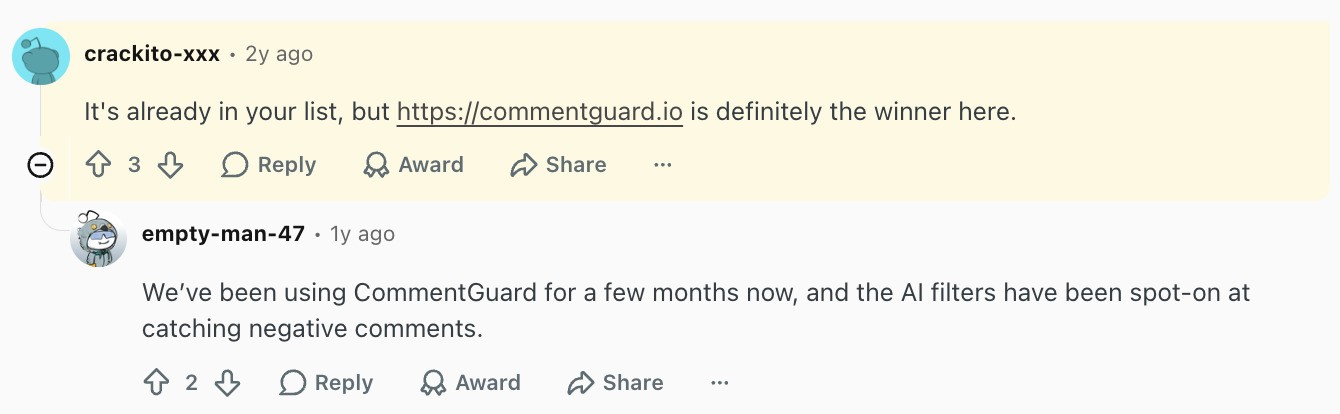
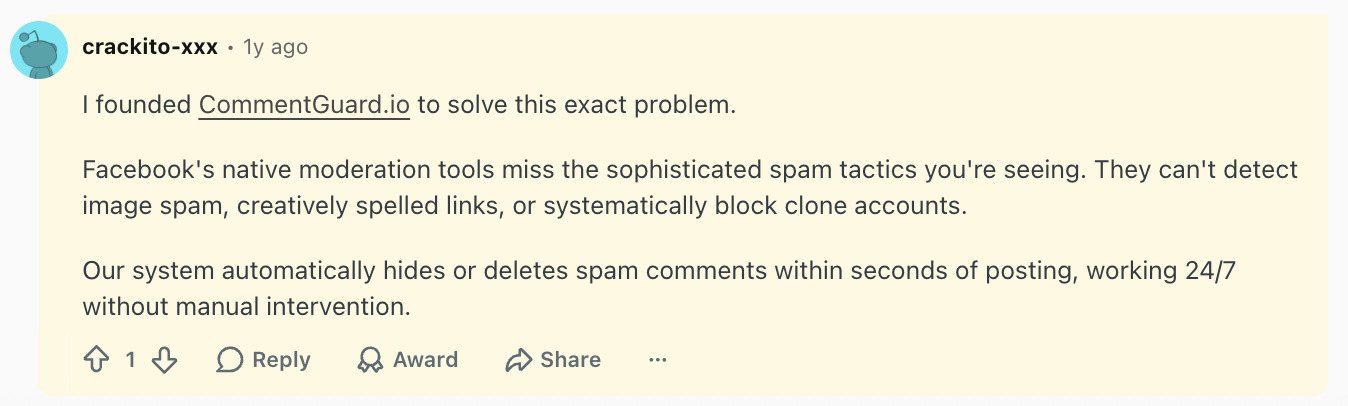
Every number above is countable from public comment history, and disclosing in 24 of 56 comments is more than plenty of founders manage. But if you searched Reddit and came away thinking a lot of people recommend CommentGuard, this is the reason.
Finding 2: there is genuinely nowhere else to look
Before relying on Reddit, we checked what else a buyer could read.
| Review site | CommentGuard listing | Reviews |
|---|---|---|
| G2 | No product page at all | None |
| Capterra | No listing; a site search returns unrelated products | None |
| Trustpilot | Profile exists and was claimed in October 2025 | Zero |
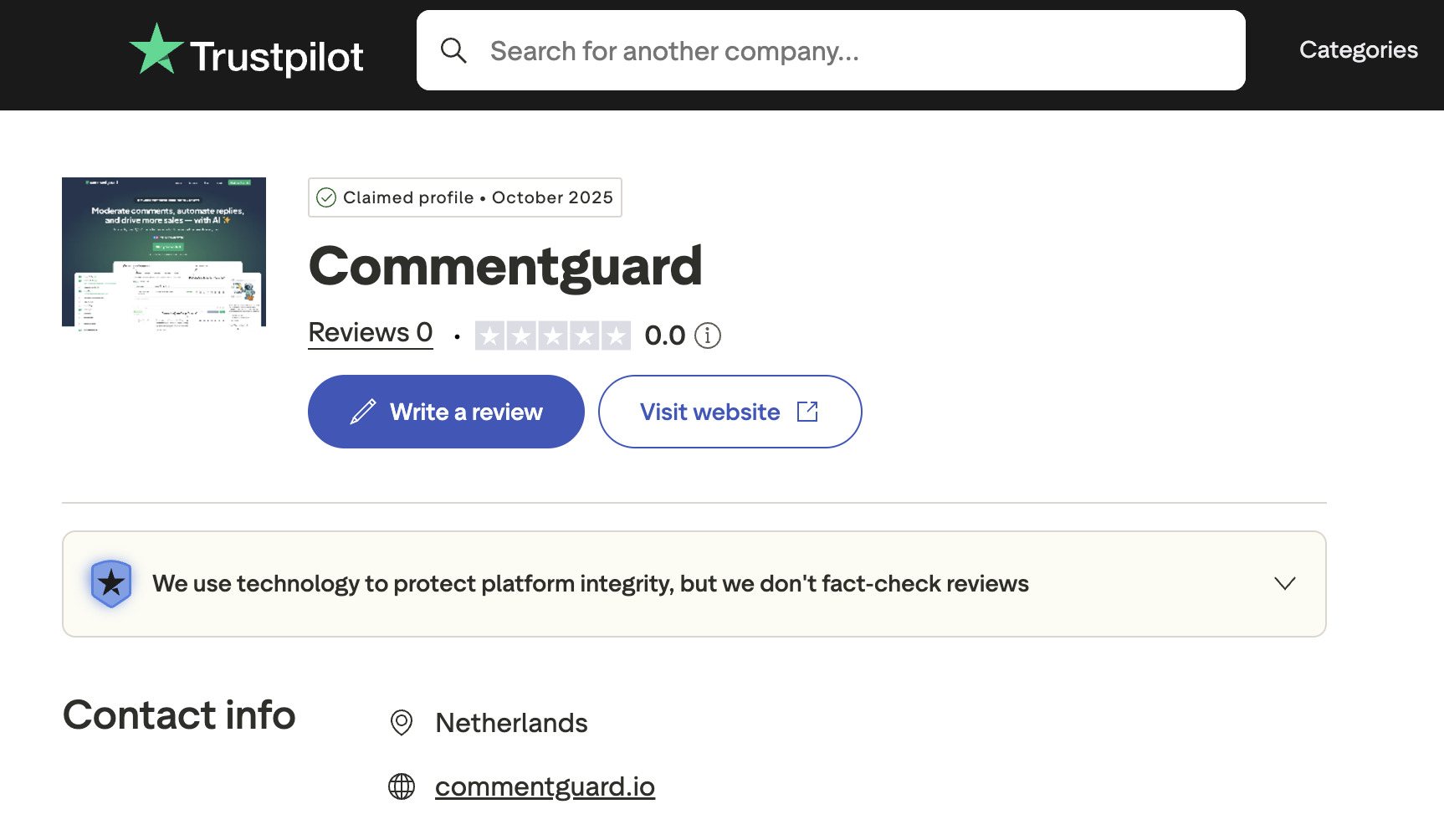
For a product that reports over 2,500 users, that’s an unusual gap – though not necessarily a red flag. Small, bootstrapped, self-serve tools often never build a review presence.
It does mean there’s no overall score to check anything against, no volume of reviews to smooth out one bad experience, and no record of how the company answers complaints. On Reddit you’re reading individual accounts and weighing them yourself.
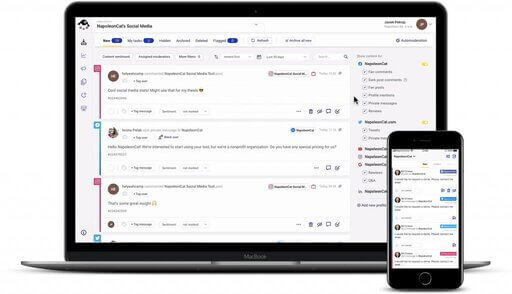
Manage and automate conversations across all your socials
Manage and automate social media interactions on Facebook, Instagram, TikTok, LinkedIn, YouTube, and Google My Business – with an all-in-one social media tool.
Finding 3: two users reported comments becoming visible again, and what can explain it
Two unconnected users, two years apart, described comments staying visible when the tool should have hidden them – the one thing a moderation tool exists to prevent.
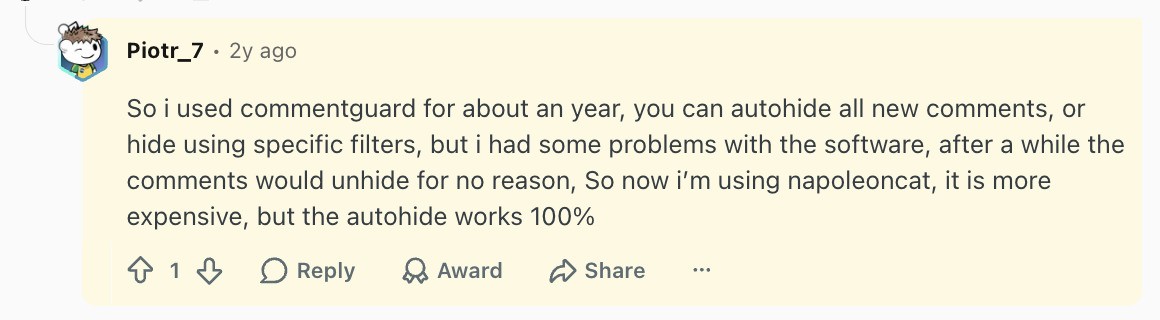
In May 2024, a user in r/FacebookAds who had spent the previous months recommending CommentGuard wrote that after a while comments would unhide themselves for no reason, and that he had moved to NapoleonCat – more expensive, he said, but the auto-hide held. His report is older than the 24-month window we used for everything else; it stays because a second one followed.
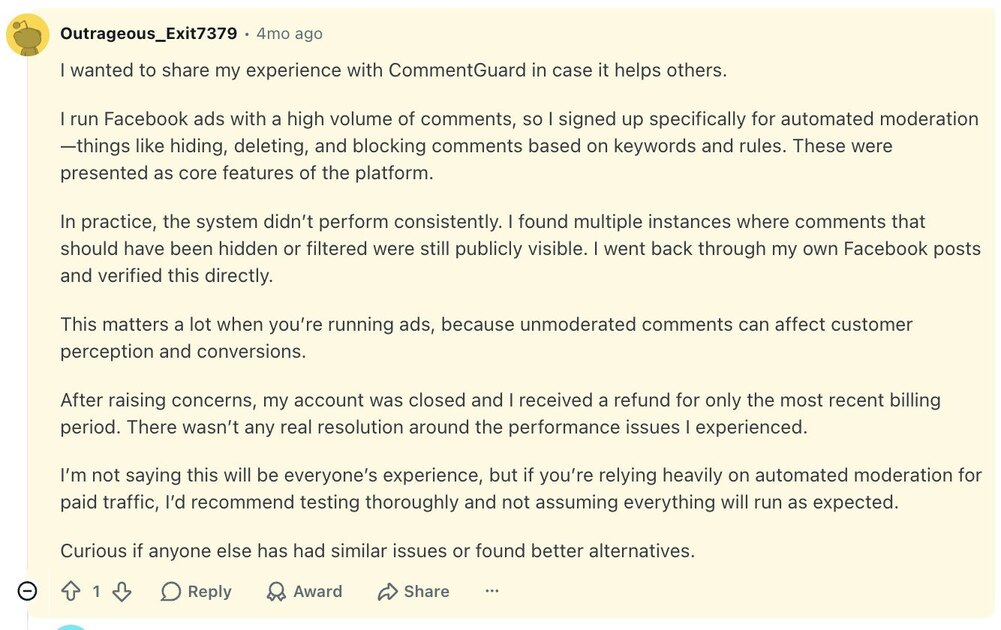
In April 2026, a user in r/PPC running high-volume Facebook ads wrote that comments which should have been hidden were still publicly visible, that he checked by going back through his own posts, and that after he complained his account was closed and his last billing period refunded. That account has since deleted its comments, so the report can no longer be checked at the source.
There is a documented reason a comment can appear to come back on its own: a hidden Facebook comment stays visible to its author, their friends, and anyone holding a role on the Page, so checking your own posts while logged in proves nothing either way. Neither report proves there is a fault hitting everyone, and no one else in the 87 comments describes the same thing.
If you’re buying a moderation tool to protect paid traffic, test exactly this during the trial: hide a comment by rule, then check the post several days later from an account with no role on the Page, and once more after the trial ends, before the first renewal date.
Finding 4: what people who like it actually credit it for
Four independent users gave concrete, checkable reasons for liking it, and they use it for different parts of the same job.
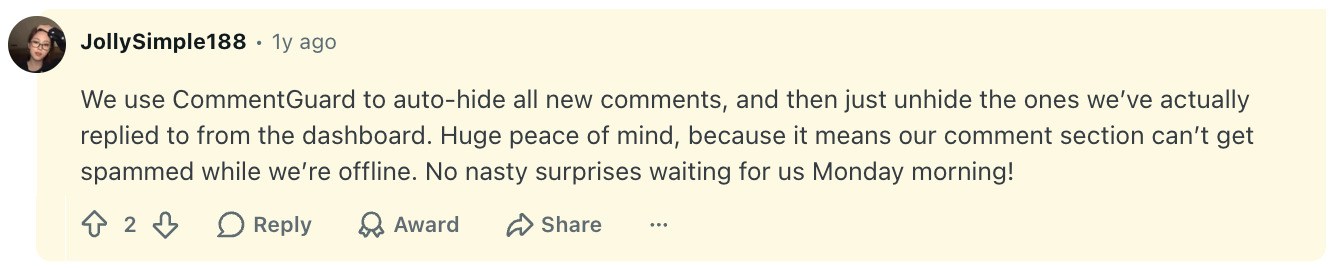
The pattern people describe is hide everything, then unhide selectively. One user in r/facebook explained that they auto-hide all new comments and then manually unhide only the ones they have replied to, so the comment section cannot be spammed while nobody is watching. Another in r/FacebookAds said the AI filters had been accurate at catching negative comments over several months of use.
Two more named specific features rather than impressions. One in r/DigitalMarketing uses the keyword-triggered auto-replies, and rates being able to rotate several reply variants so the responses do not look repetitive, and to send a public reply and a DM at the same time. One in r/PPC uses it mainly to make weekly exports of comments on posts and ads.
All four are describing spam control on paid and organic Facebook, Instagram, TikTok and YouTube – exactly what the product claims to do, and nothing else.
Finding 5: the Meta permissions request comes up in more than one thread
Connecting CommentGuard asks for a broad set of Meta permissions, including business management and ad account access, and more than one thread starts with someone asking why a comment tool needs to touch their ad account.
The answer given publicly, both by the founder and independently by a user who says he checked with support, is that Meta bundles these permissions: moderating comments on ads requires ad account access even though the tool does not create or spend on ads. A rival founder in one of those threads, who built a competing product, publicly agreed that the permissions are necessary.
That explanation is backed up from more than one direction. Know it before you start – the consent screen asks for more than people expect, and the signup flow itself doesn’t explain it.
Finding 6: the detailed positive record rests on two accounts
Both long-form reviews we found were posted in September 2025, in two different subreddits. They’re the most substantial positive accounts we found.
One, in r/ecommerce, is a careful account of setup, brand-voice training and reliability, and it includes a limitations section. That account is no longer active, and Reddit does not publish reasons for account closures, so there is no way to check who wrote it.
The other, in r/FacebookAds, addresses the permissions question and describes real-time catching of spam under ad campaigns. That account is six years old with normal karma and a broad posting history, and reads as a genuine user.
Two accounts, then, carry most of the detailed positive record – and one of them can no longer be checked.
Finding 7: the conversation is happening in ad subreddits, not social media subreddits
Where a tool gets discussed tells you who buys it. CommentGuard mentions cluster in r/FacebookAds, r/PPC and r/ecommerce. It barely registers in the subreddits where social media managers talk about their stack.
The problem people bring to those threads is consistent: spam, scam links, crypto bots and hate under Facebook ads, and the effect all of that has on conversion rates and ad spend. Not content calendars, not reporting, not approvals.
CommentGuard is a comment moderation tool, but the people buying it are advertisers rather than social media managers. If your problem is the comment section under your ads, you’re the customer it was built for. If your comment queue also arrives from TikTok, YouTube, LinkedIn and Google reviews, you’re not – and the threads reflect that.
Should you buy CommentGuard in 2026?
CommentGuard still makes sense if:
- your comment problem is Facebook, Instagram, TikTok and YouTube ads, and nothing else
- you have a large team or outside contractors, and per-seat pricing is what hurts
- you want moderation and nothing more, and already own the rest of your stack
- you are willing to test auto-hide reliability properly during the 7-day trial
Look elsewhere if:
- you also moderate TikTok, YouTube or LinkedIn company pages, or want Google reviews landing in the same inbox as your comments – CommentGuard covers Facebook and Instagram only
- you need proof of reliability from more than a handful of public accounts
- you want publishing, analytics or customer history in the same tool
If Facebook and Instagram are not the whole job, it’s worth weighing NapoleonCat as a CommentGuard alternative, with rule-based auto-moderation on Facebook, Instagram, TikTok, YouTube and LinkedIn company pages. That sits on NapoleonCat’s Expert plan, from $139 a month, because the cheaper plans either have no inbox or moderate by hand. CommentGuard starts at $29, so it is the cheaper tool at entry.
CommentGuard reviews on Reddit: the questions people keep asking
Is CommentGuard legit?
Yes. It is a real product from a Netherlands-based company that has been selling it since 2022, and it has independent users on Reddit describing real workflows. The caveat is how thin the public evidence is: it has no G2 or Capterra listing and no Trustpilot reviews, and most of its Reddit mentions come from its founder’s account rather than from customers.
What do Reddit users say about CommentGuard?
The independent verdicts split. Users who like it credit accurate AI filters, auto-hiding everything and unhiding selectively, rotated auto-replies, and comment exports. Two users, two years apart, report the reverse: comments which should have been hidden stayed publicly visible. One moved to NapoleonCat afterwards, calling it the more expensive option. A hidden comment stays visible to anyone holding a role on the Page, so checking from an admin account can’t confirm the fault either way.
How much does CommentGuard cost?
From $29 a month for up to 5,000 comments, rising to $199 for 50,000, with unlimited users and pages on every plan. Monthly or annual billing is available, with two months free on annual. The tiers above 50,000, which run to $1,999 a month for 500,000 comments, are covered in CommentGuard pricing.
What are the alternatives to CommentGuard?
The names that come up alongside it in the same Reddit threads are NapoleonCat, Statusbrew and a handful of smaller ad-comment tools. Which one fits depends mostly on whether you need moderation beyond Facebook, Instagram, TikTok and YouTube, and they are not priced alike: automatic moderation in NapoleonCat starts on its Expert plan at $139 a month, against $29 for CommentGuard.
Why does CommentGuard ask for so many Facebook permissions?
Because moderating comments on ads requires ad account access under Meta’s own permission model, even though the tool does not create or spend on ads. This has been explained publicly by the founder, and separately confirmed by a user who checked with support and by a competing founder in one of those threads.
Does CommentGuard work on Instagram as well as Facebook?
Yes. It covers comments on organic posts and ads on both platforms, plus Facebook, Instagram, TikTok and YouTube direct messages. It does not cover any other platform.
Manage and automate conversations across all your socials
Manage and automate social media interactions on Facebook, Instagram, TikTok, LinkedIn, YouTube, and Google My Business – with an all-in-one social media tool.